“The people who are guaranteed to win are the lawyers. The people who are guaranteed to lose, you and me.” – Quentin Solt
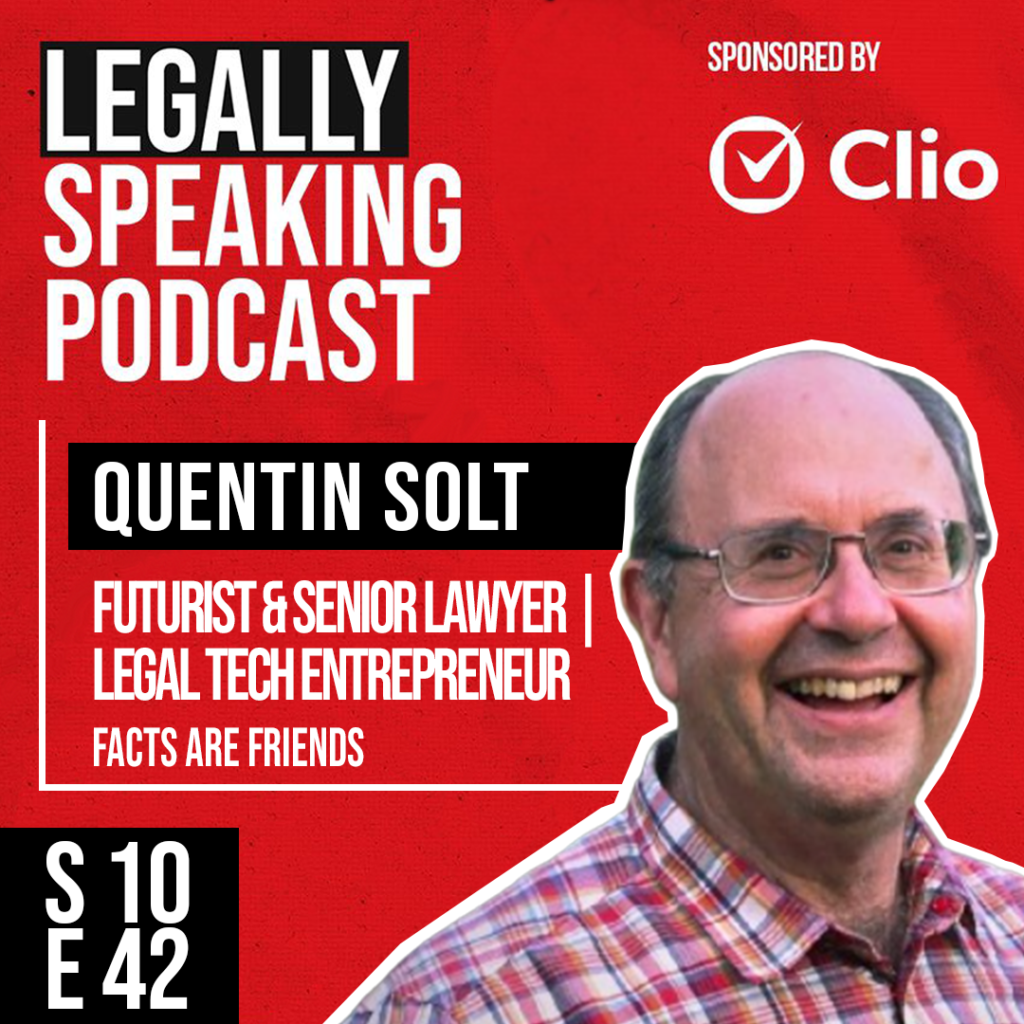
On today’s Legally Speaking Podcast, sponsored by Clio, I’m delighted to be joined by Quentin Solt. Quentin is a veteran UK corporate and technology lawyer. He trained at Pinsent Masons, moved to a London firm where he ran an insolvency group, and became an early internet and legal-tech adopter. He now writes widely on LinkedIn about how AI will reshape law. In our conversation today, he lays out his main ideas.
Quentin believes that AI only has to be “good enough”: reliable, quick, cheap and safe enough for a client to decide. He backs this with a story of an AI tool matching or beating several legal-AI products and his own review of a £6.5m credit facility. Second, his “consumption paradox”: legal work will be consumed far more as it gets cheap, but fewer humans will be needed to supply it, and law may eventually be sold like a utility.
He sees the traditional law-firm pyramid as unsustainable and expects the junior and trainee role to disappear, though the timing is uncertain and the change may arrive suddenly, like a tsunami. He argues that lawyers’ “judgment” is largely sophisticated pattern-matching. What stays valuable is being a trusted adviser who walks the whole transaction with the client. He also predicts the billable hour will unwind quickly, and he describes “living contracts”: ongoing, renegotiated agreements built on trust and accountability.
So why should you be listening in?
You can hear Rob and Quentin discussing:
– What Makes AI Good Enough
– Expanding Legal Consumption
– Disrupting the Law Firm Pyramid
– Replacing the Billable Hour
– Successfully Building Client Relationships.
Connect with Quentin Solt here – https://uk.linkedin.com/in/quentin-solt
Transcript
Quentin Solt (00:00)
You introduce me to a human who knows more than the internet knows, and I’m going to be fascinated. The reality is the client has a demand. They want an answer. Imagine going to a lawyer now. Firstly, you have to decide and frame what the question is. Then you need to go to the lawyer and ask the question. And you go through an entire engagement process if you’re not already engaged, and that’s painful. When I challenge lawyers by saying,
this profession is not going to exist. Their responses always are, but we exercise judgment. And I say, okay, what is judgment?
Rob Hanna (00:38)
On today’s Legally Speaking podcast, sponsored by Clio, I’m joined by Quentin Salt. Quentin is a senior lawyer with more than four decades of experience across corporate finance, MA, and technology-led businesses. He is also the co-founder of a pan European venture capital fund and has been investing in technology for more than twenty-five years. Quentin is currently exploring the biggest questions facing the legal profession through his writing. Facts are friends. He is a strategic advisor on legal tech, AI, ethics, and compliance.
Quentin has developed the idea of the consumption paradox. AI makes law cheaper to deliver while simultaneously destroying the demand that pays for it. Today we’re going to explore the future of legal practice, the value of legal training, the collapse of the traditional law firm pyramid, and whether AI could help us move from working to live to living to work. So a very big warm welcome to the show, Quentin.
Quentin Solt (01:31)
Thank you and thank you for inviting me.
Rob Hanna (01:32)
It’s an absolute pleasure to have you on the show. I know we’ve got mutual friends in and around the world of lore, including the likes of Sean Jardine, who’s featured on the show. Before we get into your journey and story, a couple of quick fire icebreaker questions for you. Firstly, what’s your favorite beverage and what’s your preferred choice of footwear on a typical work day?
Quentin Solt (01:50)
boring I don’t drink and I probably go for a lemonade and lime and my favorite footwear is really easy to answer my Crocs. I’ve even got a pair of City Crocs which are the same sort of things but they’re black.
Rob Hanna (02:05)
I like it. I’m actually you’ll be surprised we’ve had a few folks that have said Crocs in in recent episodes. Okay, one piece of legal technology or everyday technology you now rely on which would’ve seemed unthinkable at the start of your career.
Quentin Solt (02:19)
a keyboard. When I started, we were still writing everything down. But that probably aides me. I’m a dinosaur.
Rob Hanna (02:28)
Not at all. You’ve got a lot of wisdom to share. So let’s get into your journey and story, Quentin. Could you give us a short version of that journey, from your beginning, I guess, career in law at Pinson Masons in Birmingham to investing in technology and and indeed sort of business?
Quentin Solt (02:42)
Absolutely. I started at Pinsons where I trained on qualification. They had this weird policy of not inviting you to join a seat until you’d been in it for three months. And my last seat was corporate and I wanted to go into corporate and I’d been offered seats everywhere else, but they were waiting for that three months to expire. And I got itchy feet and I ended up going into London. I joined Bowen Layton, had an absolute ball there and it was an amazing firm.
At one stage our insolvency teams had to hunt it out and I was pulled in there. So I ended up in charge of this insolvency group, which was hysterical because I was a junior recruiting people who were far more senior and sophisticated and experienced than me. And after I’d done that for three or four years, I went back to my senior partner and said, I’ve done this now. And I was now a junior partner and I want to go back into corporate. He said, what do want to do? said, corporate. And it was, didn’t understand the question. And then it came out.
what do you really want to do? And I had a friend who was working at McKinsey and he told me about this intra-web, intra-knopped thing, which was really exciting. And so I got involved with the internet at that point. And in the mid-90s, I went out to spend a couple of years with the ABA, the Narrokin Bar Association, sponsored by my firm, just going backwards and forwards from the UK. And I set up the first UK-focused technology investment group in a city law firm.
headed out of corporate. At that time, everything was headed out of commercial because it was all seen as techie stuff. Anyway, long story, I set up a small business which we originally called BeLegal, which was hosted on an ASP, an application service provider. You and I would now recognize that as SAS. And we called it an expert system. It was the very earliest bits of the algorithms which acquire.
intelligence and that leads to today’s AI. We developed a suite for the employment lawyers and in conscience the employment lawyers told me they couldn’t use it because if they could do it this quickly and this cheaply they couldn’t justify the fees they were charging. We teamed up with
Rob Hanna (04:50)
We
Quentin Solt (04:51)
the wonderful Richard Punt and his team from Deloitte and changed from being be legal to be professional and we sold quite a lot of rather large businesses.
And then Sarbanes-Oxley hit, which you may remember, Sarbox, the must be brought in in 98, 99. And that in effect said to Deloitte, either you keep these as audit clients or you can service them through your joint venture company. Well, the audit was always going to win. And there was quite a long football match between Deloitte and Paisner as it was then.
during which I was kicked from side to side, one saying we were worth a lot, the other saying we’re worth nothing unless you’re out of the room. And eventually I got bored and left to set up my own thing. I didn’t know what I was going to do. I signed in on Compete and set up a small venture fund and took one of the early stage technologies, which I found, which was Intelligent Agent. And we put that into the fund, which we listed on the stock exchange. And we sold out from that earlier this year. 26 years later, we did quite well on that.
It was a really good journey. Then one of my clients came back and said, Quentin, can you help me? I no, I’ve signed in on Compete. He spoke with the firm who very graciously let me off everything. They paid me a fortune to not compete. then they said I could. And I set up on my own, ran that for a bit, did a couple of techie deals. I set up Shazam. Do remember the music app?
Rob Hanna (06:16)
Still use it today?
Quentin Solt (06:17)
I was involved in setting up the legals on that. couple of other businesses some people have heard of.
One stage I got involved with a US business and we dealt with Pillsbury Winthrop Shore Pitman and the partner on the other side graciously flew over and wanted to meet me and took me out for lunch and asked if I had joined them, which was very flattering, but I thanked them and declined. But I did go and sit in their office for two or three years doing some legal tech for them, which is kind of interesting. And then I came across a US based Silicon Valley based memory.
chip company. And I joined the board of that. We floated on the junior exchange here on AIM and four or five years later took that to NASDAQ. And I jumped off the board at that stage. I didn’t want to the regulation of the US industry. carried on running my own private firm, sold that to West End practice and then set up another business which was involved in investments and helping people to invest. That was quite fun. And then
I carried on giving legal advice or commercial advice and having sold my firm, the reason for selling it was to escape the shackles of the SRA and the insurance policies. So from there on out, I just gave advice in the personal capacity. And there’s a huge amount you can do without having to be regulated. My clients accept that.
Rob Hanna (07:47)
I think for our listeners just just hearing that you can see why we were so excited to have Quentin on the show, just in terms of his entrepreneurial flair, his interest in technology, your legal acumen and everything else. So, you know, you you touched on there back early, early, you know, you’ve been interested in AI and tech for much longer than most lawyers. When did you first realise technology was really going to change the tools lawyers use and the trajectory ultimately of the legal profession?
Quentin Solt (08:12)
When I was doing my training contract with Pinsons, there was one of the secretaries who ran from floor to floor carrying a big floppy disk. And these things were a total misnomer because they weren’t floppy at all. I realized that she was carrying entire documents around with her and it was a lot of fun to, or fun’s the wrong word. I realized then that there was something which was so much faster about being able to replicate at speed and to access. And you know, I mentioned about having the
Been involved in the insolvency group Bowen Layton. Yes I was one of the first who demanded a laptop and it was tremendous because I would take my laptop with a large screen to the client office when we were I acting for the liquidator or the administrator and we would literally sit there and Type the contract as the clients were talking and so the but guy buying would say yeah
I’ll buy this and I accept whatever it was he wanted to accept. And I literally typed his words in and they appeared on the screen. And you could see my counterpart, his lawyer, say, yeah, well, he doesn’t actually mean that. said, I’m sorry, didn’t he say that? And then the liquidator would look at it, guys, time’s clicking, know, how long do want to be here? And we moved on. And so we’re literally able to do the deal then and there. And the hardest bit was getting the dot matrix printer to print out.
Rob Hanna (09:35)
I c I can imagine that.
Quentin Solt (09:37)
And that, I think it was that that led me onto this idea of the Be Legal, the idea that we could do the professional services. Now bear in mind, I was at Bowen Layton and it was a good Jewish firm. I’m not Jewish, but the firm was. And I remember on occasion, I was invited to Birmingham, to the Law Society Conference, whatever it was. And there was a plenary session and I stood there and said, look, if this is how much work we do.
click, this much is of value. There I am on the front page of the Law Society cassette giving a Hitler-style salute with my fingers just visible underneath.
Rob Hanna (10:18)
wow, wow, wow, wow. Well let’s build on your career because you’ve also become a very popular commentator on where sort of legal practice is heading. What inspired you to start writing and thinking publicly about the future of law?
Quentin Solt (10:32)
So this is a really roundabout way. I was sitting in church with my men’s breakfast group and we were talking about the future of society and this is in 2022, I think. And I said, you know, of course we’re going to have societal unrest and we’re going to have mass redundancy and people just don’t see what’s coming. And most of the guys stood there and, or sat there around the bacon butters and nodded sagely.
I thought this is an educated lot and I carried on going. And one of them, who’s a senior director of a listed company, looked over at me and said, Quentin, this was in church, Quentin, what are you talking about? It’s a bit stronger language.
Rob Hanna (11:15)
Yeah, yeah, yeah, yeah.
Quentin Solt (11:16)
And I talked about machine learning and artificial intelligence and how I could see it was going to substitute what we were doing.
And there was just disbelief and non-comprehension against all these men who’d been sitting there nodding. And I thought, gosh, I need to educate. So I wrote a book, which is still to be published. And the book was at that point based around Charlie and the Chocolate Factory. And the idea of how Charlie’s father, who used to screw caps on the lids of toothpaste tubes, was made redundant because a machine took his job.
And then you saw how the Amazon lorries roll in and out of the chocolate factory, but never a worker. And you see the Oompa Loompas. And of course, Rob, you know that the Oompa Loompas are AI. And they do their job cheerfully. They don’t make mistakes because they just keep doing what they’re told to do. If somebody gets in the way, they pick them up singingly, lovingly, sling them out to make sure they’re not hurt.
carry on doing what they do. And so you then have Charlie, who is you and me and the other kids and each of those kids have flaws. That was the genesis of the book. And I took it to a publisher who says, I love it, but you’ve got to be somebody. And I looked at myself and said, I am somebody.
Rob Hanna (12:37)
Yeah we could
Quentin Solt (12:39)
Somebody to go and get a social media presence. To me, social media was LinkedIn. And I to LinkedIn. So if you look back three years ago, I guess, there’s
a month or two when I’m talking very generically, but I start getting sucked into the law. And then I was commentating on it and I got some feedback and it was really engaging with me and I felt I had some authority so I carried on going. And then last year I published the Trojan Horse built on sand series of articles which got quite a lot of people talking. And what I’ve subsequently learned is that a lot of senior partners
in a lot of law firms and actually accountancy firms are reading this stuff. And they talked to me privately, but you would not know from the footprint on LinkedIn that they’re there at all.
Rob Hanna (13:30)
Yes.
Quentin Solt (13:30)
Anecdotally, I went to talk at a conference in Germany earlier in the year, and they invited me for dinner in the evening and there were just tables and long benches on them. I’m sure you’re familiar with this. And I went and sat down and the chap opposite me said, and he called me by name and.
said yes we’ve done what you told us to do said who are you and what have i told you to
Rob Hanna (13:54)
Yeah,
it’s quite
Quentin Solt (13:57)
He turned out to be the head of the EY team in Germany, and he had read one of the articles and interpreted it in a way which frankly was far brighter than anything I’d written and was being really well out of it. So that’s how I got engaged.
Rob Hanna (14:15)
Fantastic. And I talk a lot about the importance of a personal brand, particularly in the age of AI, and Quentin’s given a fantastic professional example of there of how he was able to do it as well. One of your most important ideas that I want to talk about is good enough. You have outlined that AI doesn’t need to match the judgment of a senior partner at the likes of a magic circle firm. It needs to be good enough for what the client requires. Why is this distinction so important?
Quentin Solt (14:40)
It’s absolutely critical bit because the client, I think you have to start by saying, what does the client want? The client wants an outcome. And this is all about some supply demand side. As lawyers, we’re looking at the supply side the whole time. We assume the client will come to us. How do we supply it better? The reality is the client has a demand and they want an answer. Imagine going to a lawyer now.
Firstly, you have to decide and frame what the question is. Then you need to go to the lawyer and ask the question. And you go through an entire engagement process if you’re not already engaged, and that’s painful. And when you ask the question, there are a whole load of unknowns, like how long is it going to take for the lawyer to give you an answer? How much more information is the lawyer going to want? How much is it going to cost? You don’t know if it’s 300, 3000 or 30,000 pounds. I’ve just…
sold a business and we went to lawyers to get quotes and I’m absolutely serious this business we got quotes between 120 000 and 600 000 pounds for exactly the same work and I did not want to instruct lawyers at all but and this is part of what’s going to save the law firms for a while the inertia in me said it’s a really big deal I’ve got to get it covered which is kind of interesting but
The point is that the answer doesn’t have to beat the best specialist in the country. The answer simply needs to be reliable, quick, and safe enough for the decision to be made. And what you’ll discover is that clients actually know their own businesses, and they probably know what they want. And what they want is somebody to say, yeah, actually, this is fine, or it’s just another review. So that’s why being good enough is sufficient.
As lawyers, we look at the tech and attempted to say, look, it hallucinated. It made a mistake. It’s unreliable. How often in the course of drafting a SAS agreement, any agreement, is the opportunity to hallucinate on the law really there? And I can tell you a story if you’re interested about comparing different tools, which will explain why I say it’s good enough.
Rob Hanna (16:58)
Please share that because do you think lawyers are underestimating the power of good enough?
Quentin Solt (17:01)
Firstly, they’re massively underestimating the power of good enough. And secondly, they are underestimating the power of AI. So just to give you an example, I was working for a client on a six and a half million pound revolving credit facility. And I had done the work and it’s taken me eight or nine hours to work through the whole plethora of materials which they had presented to us. And there was the drawdown agreement, the facility, the security, it was quite a big package of papers.
I had a friend in the city, so with my client’s agreement, I redacted everything and chucked them to the friend who had both Legora and Harvey available to him. It was about the time that Niti had put out his Laverne product and my co-assessors out there. And so I was going to parallel run these to see what they came up with as substantive comments on the suite of documents.
I come up with about 14 comments. Harvey came up with about 16 of which 12 were the same as mine. missed two of mine and it had another four which were valuable. They were good. LaGaurat, let’s simply say it wasn’t quite as good, but it did okay. Now, this was the instance running by my friend. I have no idea how he ran it. I simply told him that I wanted the major headline points to get back with. Levin, I’m sorry I couldn’t get it to work.
My co-SS I had running on my open claw device at the time and it came up and it was respectable. It wasn’t, it wasn’t as good as the others, but then it’s an open source just running and it was based on what I had. It happened to be that week when Anthropic put Fable out the first time. And there were, do remember there were two days before the government closed it down when we could access Fable.
Rob Hanna (18:53)
Yes, I do vividly actually.
Quentin Solt (18:55)
I put the redacted version into Fable and ran it and it came back. It got everything I’d got. It got everything Harvey had got. There was nothing that any of the other engines had got that it didn’t capture. I then gave it instructions to annotate the core document base and I put it into Cowork in Word and said, implement. It went through and it made all the red line changes as red lines and it commented.
in my vernacular, which I’ve taught it in the comment section, why we’ve made the changes. I sent that to the lawyers for the bank and it took them 10 days and they came back saying, we accept all your changes.
Rob Hanna (19:37)
Wow. That’s a powerful story.
Quentin Solt (19:39)
That was Fable out of the box on my instruction set. So I don’t know how much it already has from what I’ve talked to it, but it was quite impressive.
Rob Hanna (19:53)
The the only, I guess, point to mention today is obviously you had the wisdom and the know how and the judgment to know what to to sort of be be putting in there, but the end result and the product and the offering as a result of it was phenomenal. One thing you’ve shared is the consumption paradox. You know, in brief, AI makes law cheaper to deliver while simultaneously destroying the demand that pays for it. So would you mind explaining to our watchers, listeners around the world the consumption paradox in more detail?
Quentin Solt (20:20)
job as legal intelligence becomes cheap. And by the way, we have to understand why lawyers have been so expensive in the past. And that’s because they’ve lived in a black box. You have to buy their black box. And the knowledge they had was scarce and their abilities were scarce. So they were expensive. And I can I will happily unpack that next. But the consumption paradox is legal intelligence becomes cheap and immediate. People and businesses
consume far more of it. The consumption goes up. And someone who would never have paid for an answer now ask 10 questions because he can. So the consumption is shooting through the roof. The business currently takes legal input on nothing and it’ll take hundreds of small decisions. The total consumption keeps on going up, but it’s being served by
the technology is not being served by a human. And the paradox is as more people consume it, so the number of people required to serve it reduces. And lots of people rely on the Jevons paradox, but they’re missing the key point. And that is that the consumption is coming or the production is at a different place. So you come back to what I was saying earlier about, this supply or demand side? If we look at it as demand side and it can be supplied,
And one of the other things you’ll see is my longer term projection that law will be sold as a utility. And this is supplied then by the utility to consumption paradox, lots more law being consumed, many fewer lawyers providing.
Rob Hanna (22:04)
That’s interesting ’cause you know, a lot of people, as you say, go the other way in terms of more demand, you know, there’ll be more need for lawyers and so forth than everything else. let’s talk about the law firm pyramid in traditional models now. because there there’s basically been a pyramid, hasn’t it? A small number of partners at the top, with associates, trainees performing all the underlying work. If AI can do much of the trainees’ work and if indeed sort of, you know, one two year level associates, what happens to the pyramid?
Quentin Solt (22:27)
So let’s just, firstly, the pyramid is totally unsustainable because what we are seeing is the guys who were climbing the ladder previously, they’ve got the chainsaw out and saying, my word, what I was doing was just commodity stuff. I can commoditize it. And they’re cutting swathes of the ladder away.
While they’re busy doing that, they’re not noticing that somebody above them is doing exactly the same to the ladder that they’re climbing up. And all the focus goes on the cheap, easy to do stuff. But actually where the value is going, and we saw this with the Harvey acquisition, or the Harvey fundraising and the associated acquisition yesterday, is the technology is taking away all the pieces of the legal structure. The pyramid relies on lots and lots of people being required to do the work.
You’ve already said the juniors aren’t doing the work. So there’s no pyramid. You now take away the juniors. You are now left with a whole load of seniors who do the work on their own. But they’ve got the legacy of the very expensive offices, the infrastructure, and they are all now looking after each other. The guys who are going to be most successful are those who can do it on their own. So the sole practitioner is for various reasons in a much better place than the
partner at the top of the law firm.
Rob Hanna (23:54)
Today’s episode is brought to you by Clio. If you’re spending more time managing your practice than practicing law, it’s time for a change. Clio is the intelligent legal work platform built for modern solicitors, combining context-aware AI with trusted legal research to help you work smarter, not harder. Switching is easier than you might think. Clio’s dedicated migration teams handle your client and case data every step of the way.
So you can focus on what matters most, your clients. Plus award-winning support 24-5 via live chat, phone, and email. Means help is always on hand when you need it. Visit Clio.com forward slash UK to find out why thousands of UK solicitors trust Clio. Now back to the show.
Let’s stick with ’cause we’ve got a range of listeners, you know, right, from people running law firms and legal tech CEOs, people aspiring to get into the profession, junior lawyers, etc. Just on the junior lawyers, because there is a lot of anxiety around this. Junior lawyers, you know, traditionally did learn by doing the work, but as as we’re sort of sharing here, AI can obviously do it at rapid pace, you know, the research, doc review, due diligence analysis, arguably the stuff that people didn’t particularly enjoy doing. How will the use of AI then specifically affect the role of trainees and junior lawyers?
Quentin Solt (25:09)
the Wank B. Row?
Rob Hanna (25:10)
And your confidence level of that from a naught to a hundred, just again to give our listeners some proof from from your your sort of experiences and being in law firms, running law firms, et cetera, et cetera. ‘Cause I think that’s an important statement you’ve just made.
Quentin Solt (25:23)
100%. The question you want to ask is how long? That’s the much harder question. And I’m anticipating that the transition will take longer than we expect and then will happen in a tsunami. I think that we’re going to see a lot of waves rolling in and then it rolls out again and the sand always looks clean until suddenly that tsunami hits.
Rob Hanna (25:49)
So let’s talk about legal training then. You know, we’re we’re saying potentially eradication of roles, you know, but all things evolve, don’t they? You know, in in in every sort of revolution there are you know, there’s the there’s roles that are redundant and roles that emerge. If AI is increasingly knowing the law, as I as I’ve mentioned, you know, doing all of this fantastic work, how does the legal training come into play? You know, what does spending years studying the law, then working through the traditional system give lawyers?
Quentin Solt (26:12)
My question to you is why do you need to train a lawyer?
Rob Hanna (26:17)
Interesting.
Quentin Solt (26:18)
My thesis is that the technology will be good enough and it will serve the law. I then say, what is it that a lawyer does, a senior lawyer does? Why do you pay so much more for the guy who probably doesn’t know the current law as well as the junior who’s just come through university, come through training and has done all those exams? Why do you pay him more than you pay the junior? And the answer is that he has loads of experience. So.
When I challenge lawyers by saying, you’re moribund, this profession is not going to exist, their responses always are, but we exercise judgment. And I say, okay, what is judgment? Judgment is pattern matching, sophisticated pattern matching against a body of fact, the corpus of the law, the circumstances, and my previous experience.
And there’s probably also rolled into that some humanity, the ability to connect and have attachment with your counterparties. But actually, if I look at the law, that’s the easy bit to commoditize. Much harder is the body of fact. But you introduced me to a human who knows more than the internet knows, and I’m going to be fascinated.
Rob Hanna (27:45)
Yeah, fair comment. And yeah, really enjoying the discussion. I’m sure our listeners are as well. And I’m sure you’ve got a lot of people sort of, okay, Quentin, some still not sure. So, you know, the lawyer’s new value then. You know, we’re going on the benchmark that you know, juniors forget it, trainees forget it, you know, what’s the the value of a a lawyer? Why do we need lawyers, etc., etc.? So if AI becomes better at knowledge work, value moves elsewhere, right? So what does the lawyer of a future sell? Could the best lawyers look
look like a lot less the traditional model that we’ve obviously had for years and years and move to like strategists, trusted advisors, what do you predict? Or none at all?
Quentin Solt (28:20)
I that the lawyer of the future will do as much chemistry as a chemist does today. The chemist works in a dispensary. We still call them chemists because that is what they used to be. Yeah? I predict that there will be edge cases for a long time and there will be specialists who will continue to do specialist law. I’m not, I polarize for effect. So I accept that for a long time,
There is evolution in the law and there will be lawyers. But the fact that you can show one lawyer probably proves the exception proves the rule because the rest of them won’t, the rest of us won’t be there. What we do as lawyers is to facilitate transactions. And the valuable thing you have to do in order to bring your judgment and add your value is to be there through the entire transaction. So if you think
about, I’m talking as a corporate lawyer, I’m not talking about criminal law or matrimonial law or even convincing, but if I’m involved in a share sale purchase agreement or an asset acquisition or a joint venture, the client invites me in, I go in and I advise on the heads of terms and memorandum of understanding and develop the documentation all way through and I’m walking the journey with the client. And then as we get towards the end, it’s my assessment of what the valuable parts are.
actually, I’m making commercial assessments, which of course I pass through the client. But what I’m really doing is saying, Rob, I remember when we started this deal, you were really worried about the tax consequences of this. That’s still there, or we’ve boxed that off, or, hey, you know what? There’s a bit of environmental risk over here. Let’s make a really big thing about that because that’ll distract them.
We can worry about this all day long. They haven’t noticed over here and it’s unfair. The world is unfair. And that’s why sometimes you pay a very high powered lawyer to identify what the real risks are. What the lawyer should be doing is creating a relationship with their client, being the trusted advisor, because unlike the accountant and unlike the broker, they actually have a role where they can afford to say,
you’re paying me and sometimes I’ll tell you not to do the deal. And that’s more valuable than me being on a contingent fee where if the deal doesn’t happen, I don’t get paid. So the real long-term outcome is a bit of a shocker because I think we move from where we are now into living contracts. And have you read about my living contracts thesis?
Rob Hanna (31:12)
we’re yeah, we’re we’re we’re definitely gonna come onto that actually. So you probably should tell us more because you know that’s that’s flowing nicely. Tell us a bit more about the concept and yeah, your ideas behind it.
Quentin Solt (31:22)
So the idea of the living contract is really very simple. It is that today I sign an agreement with you that I’ll provide you with widgets. And the lawyers sit around saying, what could possibly go wrong? And we legislate for every potential risk we can see. And then I start supplying you the widgets, but rather than supplying you with 100, I only supplying you with 90. Every week I supply you 10 too few. Now after a bit, you’ve got a question.
Do I sue the guy or do I stop paying him or what do we do? And you’re to look at your contract and you assess and maybe you say, you know what, these widgets were really expensive widgets and 10 % loss is just too much for me to bear. So I’m going to sue him. At that stage, you and I might have two or three years of fabulous litigation. The people who are guaranteed to win are the lawyers. The people who are guaranteed to lose are you and me.
Even if you are successful in the litigation and I lose, I then have to pay you compensation. Under English law, I put you back in position you would have been in, but for the breach. Have you won? You haven’t won. All you’ve done is to waste three years, spend a lot of money on lawyers which you won’t recover in full, and be put back in the position you would have been in if I hadn’t breached. So that’s the current position. I’m saying actually,
You and I have an agreement where we say, I’ll supply you with 100 and you buy 100. And if as we run, we see something is going to cause me to fail and I then communicate with you and we renegotiate. So it’s a constant evergreen revolving, evolving agreement. We may have parameters around it, but essentially you and I will transact on a moment by moment basis. And there are lots of
challenges which I go into in some detail in my writing. But that’s the basic premise. People say it can’t happen. Well, it already happens. Apple and Gorilla Glass do exactly this. Nvidia has its largest chip supplier. According to Yen-Sen and Wuhan, they don’t even have an agreement between them for this multi-billion transaction which goes between the corporates. They trust one another. If there’s going to be a shortfall, they talk about it. And why is this going to happen? It’s because the technology
is going to enable us to have accountability. And that’s going to change everything. And this is why people were so excited by blockchain 10 years ago. It just didn’t work in the way then that we can now see it will start working.
Rob Hanna (34:01)
Yes. And I think that’s gonna be a really exciting thing to play out actually. Just a couple of comments on what you said there. I think I like I like that I the idea that you’re you’re referencing there because, you know, as an entrepreneur myself, business owner, the only constant in business is is change, isn’t it? So I think having that open dialogue and you know being able to, you know, have that that that that that conversation is important. And back to your your your earlier points as well about sort of, you know, the lawyers and acting for you you know, i i like you say life unnecessarily isn’t fair. I remember a mentor said to me very early on and it hit me hard and I kind of was a bit
Rob, you don’t get what deserve in this life, you get what you negotiate. And I think there’s a a lot of truth behind that as as well. And so to that, they should always say never assume. I assume I know the answer to the next question, but I’m going to ask you your thoughts anyway. So we’ve lightly touched on it, and I’m sure our listeners would love your views, because I mean pretty crystal clear. The billable hour. If a lawyer takes 10 hours to complete a task, AI can finish the same task in ten minutes. What is the client ultimately paying for? And are we going to see the death of the billable hour?
Quentin Solt (34:59)
Earlier, I said that we have to understand why the lawyer is so vulnerable and why the AI is coming to them. And you’ve put your finger on it. We have this perverse reverse incentive. The less efficient we are, the more we charge. I first came across this when I was in a law firm and they were talking about two junior, two associate tax associates. And they were saying which one should they promote? Now, one of them I knew really well.
And I always chose that one because I’d send my tax indemnity to them or covenant and it would come back within a day with the key points. The other one I really did not enjoy using because I’d send it off and it would come back three days later with all sorts of irrelevances and it was just painful. And guess which one was being sponsored for partnership? The one who was slow but had the most amazing track record of billable hours. And at that point I knew it was wrong-headed.
So the billable hour was a convenient way for us on the supply side. And when we had a monopoly, we could demand it because everybody was doing it that way. So it unwinds very fast choice for you. You’re employing somebody new. You can go and run an agreement on the internet, which will cost you 20 quid and it’s good enough. Or you can go to your favorite law firm and wait three weeks or even wait two days.
and pay something which will be more than 20 quid.
Rob Hanna (36:33)
You
know Exactly. And you know, I talk a lot about this in my in in my my talks, you know, and I learned this from, you know, various people I’ve been around. Done is better than perfect. Perfect never gets done, to your point around good enough. One of the things I’m fascinated about, because I I follow you online, I love your content, and as I say, I was really encouraged about you coming on the show today, is sort of the working to live to living to work. So you’ve written about challenging the idea that we should simply work to live. So if AI is gonna take over the cognitive work.
Does this provide us with the opportunity to move more towards than live to work? And does this mean we can spend more time doing things that are meaningful to us?
Quentin Solt (37:11)
I I could nutshell it the way you have. fact, I’m glad this has been recorded because I’ll probably use that.
Rob Hanna (37:16)
You feel free, yes, absolutely.
Quentin Solt (37:18)
So first off, understanding working to live. That’s where we are today. And people are in jobs which they don’t enjoy, but they need a job because they need to pay to live. Then they aspire to retire. And I don’t know how many friends you have who say, the thing I really want to do is to retire. I want to retire by the set an age. And I always rolled my eyes and said, why? I simply didn’t understand it. And that’s because I think I already knew that
you had a purpose, you should have a purpose-filled life and what was your purpose? And purpose for me was articulated in the job you do. And actually as a society, we pigeonhole people by purpose. So when you meet someone, you might ask them their name, you might ask one or two personal details, but one of the very earliest questions you ask is, and what do do? And as soon as they tell you that they are a nuclear scientist doing something in a
Wow, that’s impressive. Or they say, I’m a dustbin collector, or operative, or whatever they call you, you put them in a different box, you start to treat them differently and segregate them differently. There is no inherent difference between people. We have different degrees of luck and different skills. And for many, many years, we have attributed high value to IQ. Increasingly, we’re going to attribute high value to EQ. But as you put your finger on it,
As AI does more of the cognitive jobs, AI will then be embodied and embodied AI will do more of the manual jobs as well. yes, we’ll see the decline. We are already seeing the decline in cognitive jobs. People doubt it. I say, go and take a look at your bank. you can’t go to the bank anymore because it’s shut. Do you remember 30 years ago you went in and there were tills and staff and everything was done. I remember having to call my bank manager to ask for money to be transferred.
I do it all on my phone now. People say, yeah, well, that’s one example. I say, I remember going to my local Sainsbury’s and even 10 years ago, there were checkout tills lined up with the till staff and they were manually taking stuff and scanning it. Now I do the job myself. As I stand there with my little, with my phone, I’ve scanned all the food, I walk to the counter, hold the phone to it, it transfers the basket, I click and I walk out. I think.
What would my grandfather say? How would my grandfather understand that I walk around, I pick up off the shelf what I want and I walk out? Won’t he say, aren’t you going to pay? He’s missed that. And I say, look, it’s not just there. Do you remember as you went into the supermarket at six or seven o’clock in the evening, all the students piling in because they were going to do the restocking. Take a look. They’re not there anymore. Why? Because the technology is doing that for us and the people in the staff, the staff in the store.
now have time to go around and they’re doing it during the day. Yes, at night they still restock, but an awful lot of that work which was being done by casual labor has been replaced. We’re going to see this roll across society. that was the working to live. Now you come to living to work. And that is if we don’t have a purpose, we are bereft. And it is one of the worst not having a purpose and having perpetual life.
are two of the greatest damnations I can imagine people having. So what I anticipate is that people will be passionate about what they are passionate about, and they will be able to live in order to do what they’re passionate about. And this is why I absolutely support perpetual tertiary education. Allow people to continue to educate, continue to learn, to continue to be passionate about the things that interest them. And
That could be because you’ve been personally affected by it. It could be just because it interests you. But it is extraordinary how as humans we have deep interests in things which we haven’t been able to do because we haven’t had the opportunity, we don’t have the knowledge or we don’t have the money. And all this is my predication that the technology will substitute us, make us redundant and will then allow us to be able to live.
without having to work. It’s the abundance theory. And some people don’t buy the abundance theory and that’s very sad.
Rob Hanna (41:44)
And look, I don’t think people are ready for the the robotics revolution. I mean, we’re still sort of into AI and not seeing, you know, the power of what that’s going to to be. We’ve had Dragons Den investors come on and and talk about that. And I agree with you. And just to a couple of your points, you know, I remember my late grandfather, who was my inspiration really, ran his own law firm in the nineteen fifties. And, you know, I used to listen to his stories about, you know, secretaries doing shorthand and various things, you know, and the fax machine and all these various things about how he was running his law firm, which again, to your point, fast forward to where you are today. If you’re sitting in a law firm today in front of a Claude, for example.
Example, that would just mind blow, mind blow and absolutely passion. That’s one thing I’m passionate about as sort of the host of the show and all the legal community work that I do is you know, you should enjoy the journey. Of course there’ll be challenging moments. That is life. I don’t think there’s a life full of, you know, every day you wake up and it’s absolutely amazing. But if you have that purpose and that passion and you have that within you, then I think you you enjoy the ride and you accept those sort of adversities you have, and it’s actually more achievable to over overcome them.
So you’ve kind of said the answer to the question, but I wanna put it on the record for you, Quentin. Is AI gonna give us the freedom to choose what we do with our time? Within what time frame are you predicting?
Quentin Solt (42:50)
It’ll certainly have happened by the time my grandchildren are here, or at least by the time my grandchildren are working and they’re not born yet. I’m hopeful. We are talking a few decades. We are going to have real pain. And if we don’t have strong social policymakers, we have social disruption on the way through. And that assumes always that all the gloom and doom mongers
about what AI may do to us are wrong. There is a small chance they’re right and that is very sad. And there is also the chance that we become the AI’s dog. So we’re given a great life until we get fleas which are challenging our owners and then we are entirely dispensable because the owner is in charge. So that’s why I say we become AI’s dog. There is that risk. I don’t deny it.
Rob Hanna (43:47)
Give young lawyers hope listening to this. you know, for people aspiring who’ve always wanted to move into law or have always wanted to be a lawyer or is training right now, what advice would you give to them in a world where AI is continuously growing? Taking on board what you’ve shared in this podcast already, what skills should they be focusing on?
Quentin Solt (44:04)
They should absolutely focus on their client relationship skills and their own brand because they are going to have a greater longevity as a business being able to provide the services that AI won’t satisfy as soon. So those are things where the person you’re dealing with actually wants to have another person to talk to.
I suspect that if you are in an area providing matrimonial or advice to people who’ve been abused, you are as much a counselor as you are an advisor on the law. Those human touch points, absolutely critical. The areas which are not beyond the reach of the AI, but are not going to be in the first wave of what the AI approaches because they’re not big enough, they’re actually the safe enclaves where you can go.
and practice. The danger is to think that because the firm above you has flourished, and yes, it’s getting knocked by AI from time to time, but basically the firm’s still there and the partners at the top seem to be doing extremely well, you can assume that it will be safe to you. It’s not. And the inertia will protect for a while. But I have endorsed Ted, Tedrapolousis’s
if I can say his name correctly, a statement of slowly, then suddenly. Inertia is the mechanism that produces the suddenly. It gives breathing space. It gives you permission to do other things, but you should be aware that it is breathing space that you’re getting. The system moves far slower than the technology. And that’s probably one of the most valuable gaps or assets that the profession has.
and it’s also the one asset that’s guaranteed to disappear. So the inertia is a runway and not a shelter and runways simply help aircraft to accelerate and so you want to put yourself on the right trajectory ready to take off.
Rob Hanna (46:12)
And I’m so glad that you had said those two points ’cause there are two things that I I bang on about religiously in terms of those client skills, communication, and the importance of building a brand and getting yourself out there to to be that point of difference, to be that trusted voice, to be that known voice. Quentin, final question. This has been a fascinating conversation. If you had to complete this sentence, how would you finish it? The lawyer of the future will not succeed because they know the law. They will succeed because they
Quentin Solt (46:41)
knew their client.
Rob Hanna (46:44)
But yep. To the point, and I think you articulated that very clearly throughout this discussion. If our listeners want to follow you, which I’m sure they’re gonna want to after the back of today, or learn more about your work or indeed your hashtag facts or friends, where can they find out more? Feel free to share any websites or social media handles or resources. We’ll also include them in this episode for you too.
Quentin Solt (47:03)
Thank you, I really appreciate that. Obviously, hashtag Facts of Friends. I’m on Instagram where I talk generally about all sorts of stuff, mostly AI related. LinkedIn is the primary place where I’m talking about the law. I’ve got my sub stack. I’ve also got my facts, our friends.com website, which lies dormant, but it’s there and it’s got some bits and pieces on it. And I’m shortly.
likely to release a goodenoughlaw.com, another website which are actually going to do and putting my money where my mouth is. I’m going to say to clients, come in, I’ve set it up so it’s all hosted in Azure, it’s all perfectly safe and you can load your documents up and run them and I will do the AI review for you and I’ll even help you negotiate the deal.
Rob Hanna (47:55)
There we go. That sounds like a pretty compelling offer to me. Just leads me to say thanks so, so much, Quentin. It’s been an absolute pleasure having you on the show. I think this conversation is a real reminder, the future of law isn’t simply about whether lawyers are going to use AI. It’s about how we use AI, you know, how we think about supervising it, about how we’re going to train the next generation of lawyers, indeed, what they might look like and what they need to be thinking about. And so, so much. So, from all of us here on the League of Speaking Podcast, sponsored by Clio, wishing you lots of continued success with your work in AI and development, everything you’re doing, but it’s been
Absolute pleasure. Thanks ever so much, Quentin. And from me, over and out. Thank you for listening to this week’s episode. If you like the content here,
Quentin Solt (48:34)
Why not check out our world leading content and collaboration of the
Rob Hanna (48:39)
Legally Speaking club over on Discord. Go to our website www.legallyspeakingpodcast.com as a link to join our community there. Over and out!