
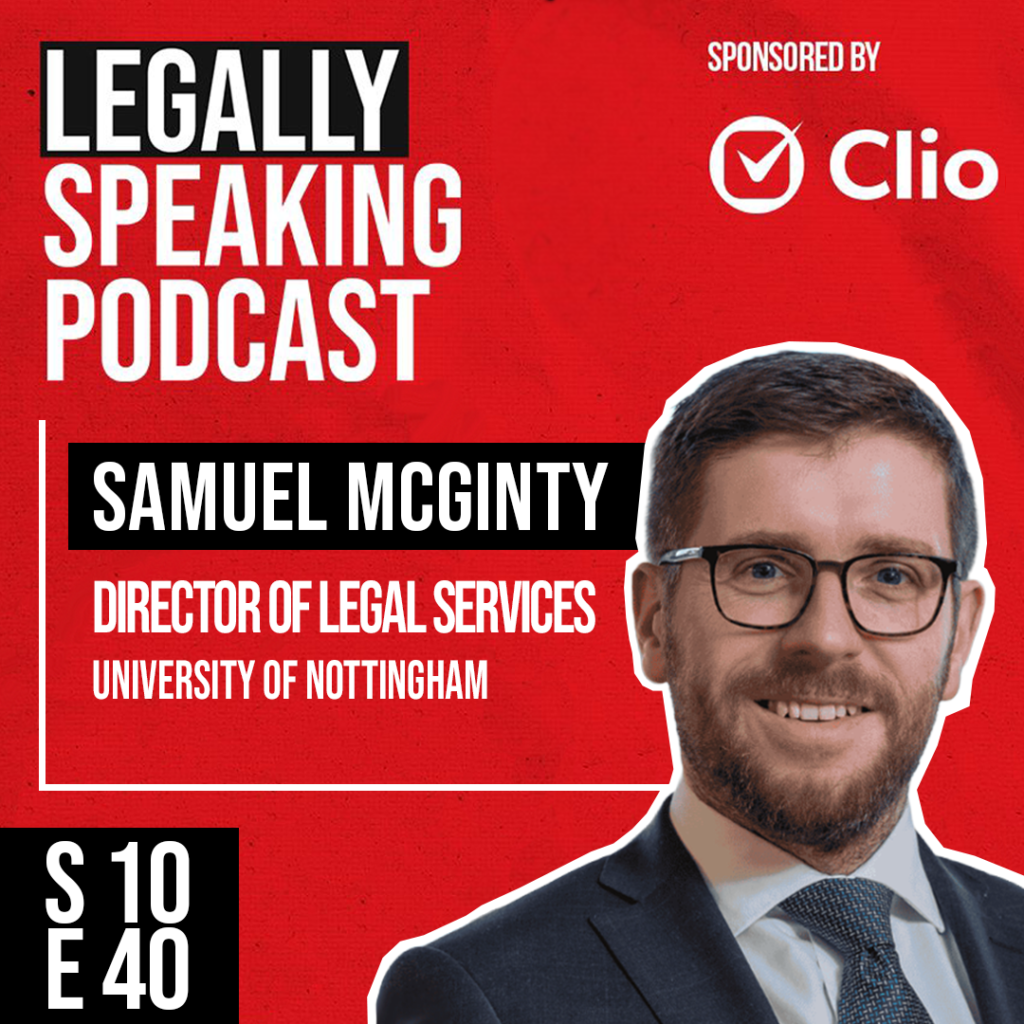
“The road less traveled is so much more interesting than that very traditional linear path that people lay out for you.” – Samuel McGinty
On today’s Legally Speaking Podcast, sponsored by Clio, I’m delighted to be speaking with Samuel McGinty. Samuel is the Director of Legal Services at the University of Nottingham, he shares a candid account of building a fulfilling, non-linear legal career across private practice, local government and higher education. He also argues that the right workplace culture and values alignment matter more than prestige or salary alone, highlighting the breadth, purpose and development opportunities available in public-sector and in-house roles.
Today, our discussion explores leadership, psychological safety, mentorship, professional community, parenthood and mental health, alongside the need to make alternative legal career paths more visible. Samuel reflects on AI’s potential to improve legal work while stressing the importance of securing learning opportunities for junior lawyers.
So why should you be listening in?
You can hear Rob and Samuel discussing:
– Your Environment Mattering More Than Your Job Title
– Life Beyond Private Practice
– Your Legal Career Not Needing to Be Linear
– Building a Culture of Psychological Safety and Authenticity
– Prioritising Wellbeing, Relationships and Life Beyond Work.
Connect with John Hutchinson here – https://uk.linkedin.com/in/samuelmcginty
Transcript
Samuel McGinty (00:00)
What you want to do is be able to come to work and not have to put a mask on. When I look back at the times where I thought I’m not sure this is for me, it’s not been about the law. It’s actually been about the environment or the organisation I was working with. I didn’t shine with my values or the culture wasn’t for me, but it took me time.
actually quite a long time to realise that was what it was about and it wasn’t really about the law at all. The fundamental thing is that my client is my colleague and I can build a really close and productive working relationship with them and help them share the burden of decision making. There’s a lot when you work in private practice around waiting for your client to make a decision to give you instructions. Here we work with them through that because we’ve got the context.
Rob Hanna (00:40)
On today’s Legally Speaking podcast sponsored by Clio, I’m joined by Samuel McGuinty. Sam is the Director of Legal Services at the University of Nottingham. He’s spent more than fifteen years building a very impressive in-house legal career, spanning from local government to higher education. He is passionate about broadening access to legal careers and a strong advocate for opportunities available beyond private practice. Sam is keen to help lawyers discover careers where legal advice shapes public services and education.
Alongside his director role, Sam is an executive committee member of the Association of the University of Legal Practitioners. He champions collaboration, professional development and community across the legal profession. Today we’re exploring hidden legal careers, leadership, workplace culture, well-being and what it means to build a fulfilling career. So Sam, a very big warm welcome to the
Samuel McGinty (01:31)
show.
Thank you very much, good to be here. Gosh, it sounds like we’ve got a lot to cover, doesn’t it?
Rob Hanna (01:36)
It does indeed. And before we get into all of that, we have a couple of quick fire icebreaker questions for you. Firstly, what’s your favourite beverage and what’s your preferred choice of footwear on a typical work day?
Samuel McGinty (01:47)
So my favourite beverage, so I don’t drink but I really like the non-alcoholic gin and tonic. So it’s the Tanqueray Fleur de Seville orangey one with tonic and I really like a broke boot actually. So that’s my preferred footwear for the office.
Rob Hanna (02:03)
And then one piece of legal technology, or indeed any everyday technology you use, which you now rely on, which you would have thought would have been unthinkable at the start of your career.
Samuel McGinty (02:13)
So this might be a little unimaginative compared to some of the other people that you’ve had on the podcast, but I really like the speech to text function and I use it a lot because when I was coming up we had dictation, we had actual cassette tapes and things like that before digital dictation and so there was a big gap in my life for that but I now use speech to text a lot.
Rob Hanna (02:35)
Good stuff. And we haven’t had that answer before. So good answer and very, very creative. So we’re happy with that. And with that we’ll move swiftly on to talk all about you, Sam. Could you talk us through your journey from training in a law firm to building a very successful career in local government and indeed higher education? So
Samuel McGinty (02:51)
I took a very traditional route into the law. I got a training contract while I was doing my undergraduate and trained in a regional law firm. I don’t know that I enjoyed that that much and I don’t think it was necessarily the firm’s fault. I think it’s more about the fact that I perhaps wasn’t made for private practice or certainly wasn’t at that stage of my career. So I trained during the 2009-2011 era just after the 2008 crash.
so there wasn’t an awful lot of jobs going. So whether the firm would have kept me otherwise became a bit of a moot point. So I found myself on qualification looking for opportunities in different settings. And somebody pointed out to me this role that had come up not far from home, working for a local authority, but it was as the sole contracts and procurement lawyer for the local authority, which seemed like a lot of responsibility for an NQ. What was different about this was that it was supported with a mentoring package and a development package.
with another law firm, was Brown Jacobson. And so during my first sort of year or so there, I had supervision and mentoring coming from one of the partners and was buddied with one of their associates who’d also had background in local government. That was a great foundation for me, gave me lot of confidence to be able to develop as a newly qualified lawyer, because as we know, you don’t just flick a switch on the day that you qualify and go from being incompetent to suddenly really competent and confident.
there’s a long journey that goes with that. And the support that I had both internally within the local authority and from the firm was phenomenal. I’ve built friendships out of those relationships and Annie Barrero, who is one of the partners at Brown Jacobson, she’s a very good friend of mine. We studied for the local government diploma in law and practice, I think that’s what it’s called, together and we’ve continued to work together ever since. So after I’ve done…
done that role for, or versions of that role for about six years. I’d managed to cover contracts, procurement, a bit of European Union law. I’d become an elections law specialist, which didn’t even know that was a thing when I first started, which is one of the things that I think is really interesting about working in-house. It’s the areas that you wouldn’t normally touch on. I then said, right, I need to go and work at a bigger local authority. If I’m going to develop my career and I want a career in local government, I need to go and work in a unitry.
authority. I could explain all the different tiers of local government, but it’s all going to change now, isn’t it? So it’s a of a, that would be a pointless exercise. So I went to work for a city council and I didn’t enjoy it. There was just something about it that wasn’t right for me. And after 18 months, which was sort of the minimum I was prepared to do, I have found myself slightly fallen out of love with the law. And I thought, do you know what? Maybe I don’t need to be a lawyer anymore. I’d spoken to old contacts who are actually on the academic side of things and said, what would it
mean for me if I wanted to go and teach and become part of the academic staff at university. So I did my masters and I dabbled in that while I was still working but this job came up at Loughborough University. Now it wasn’t on the academic side of things, it was in what we call the professional services. There was no central legal team at Loughborough at the time and I was going in to use some of my legal skills to professionalise how they did contracts. looking at
templates and training and guidance and actually a lot of legal operations stuff, but we didn’t call it that back then. I had the most amazing eight and a bit years at Loughborough after that, where I went from being head of contracts role to eventually setting up the university’s first legal services team in 2019 and then being made general counsel, which was a new role for the university in 2023. Higher education is such an interesting place. I thought local government was interesting and it is.
and it’s very fast paced and changing, higher education is very much in the same vein as that. When my current role, I joined in December 2025. So I still feel like I’m the new boy. I think you get to say you’re the new boy for about two years. And this time I’m working with a much larger team with an established legal presence, but in an organization that has got huge challenges in a huge period of change. And as the lawyers in your audience will know,
those kind of challenges and those big organisational shifts, they create really sexy problems for the lawyers. So it was kind of a challenge that I wanted and also couldn’t really turn down. So that’s where I am now.
Rob Hanna (07:14)
So there’s a really good cross section there, isn’t there? From law firm experience, district council experience, obviously being director of legal services. So you’ve talked about perhaps not enjoying some of those environments, but reflecting on some of those career moves for our listeners. have there been any skills that you have built through those moves that has helped equipped you as you’ve moved forward with your
your career or anything reflecting on that from those career moves that’s overall benefited you because so many people stick around in roles ’cause they think, I need to stay here or actually I’ll just give it another year and actually you’ve been quite decisive in making your moves. So just give us some lessons and and and reflections and and a skills that’s helped you as you’ve moved through those transitions.
Samuel McGinty (07:55)
probably the overriding one is networking and having those connections and having those people to bounce ideas off and who can counsel you through career changes too. I’m very lucky to over the years have picked up some really close friends who I can have very honest conversations with who understand the legal industry and can say actually Sam, I think that’s the bit that works well for you and that’s the bit that you’re telling me seems to be the challenge. So, you know, for those who don’t have mentors or coaches and things like
go get one because they are invaluable in helping you navigate those kind of transitions. I’ve been very proud to have been involved in mentoring schemes, particularly with students at undergraduate level and postgraduate level who are looking to enter the law to try to dispel some of the assumptions and misunderstandings that can carry through law schools into candidates as they’re applying. I think the other thing as well is realising, and I think this comes with experience, don’t think you can acquire this overnight.
is being able to know what the right things to worry about are. part of that self-reflection, when I look back at the times where I thought, I’m not sure this is for me, it’s not been about the law. It’s actually been about the environment or the organization I was working with. I didn’t chime with my values or the culture wasn’t for me. But it took me time, actually quite a long time to realize that was what it was about. And it wasn’t really about the law at all.
Rob Hanna (09:17)
It’s so true. We’ve had guests on before in the past, it’s quite hard hitting, but you’re not a tree. If you don’t like the environment, move. And I think there’s so much truth to that. And I think that echoes what you’re you’re saying there. I want to go now to somewhere which I know you’re very passionate about and and really why we were quite keen to hold today’s discussions is what we’re sort of labelling hidden legal careers. Because you speak very passionately about how the local government you’ve been touching on it on some of your answers previously, and indeed universities are often overlooked as career destinations. So
Why do you think specifically these sectors receive less attention than other roles in private practice?
Samuel McGinty (09:53)
I think there’s two elements to it. So one is money. You’re not going to earn the amount in a public or charitable body as you would working for a big corporate. And the second thing, which is kind of linked to that, is that if you’re working for a big corporate, you get to say, work for a big corporate, household name, it’s sexy. I think what’s the problem with that is, that neither of those things talk to the quality of the work, the quality of the environment,
ability to work within it with a team of people. I’ve worked in legal teams that there’s been five or six of us and I’ve worked in legal teams where there’s been 70 of us. And obviously culture can appear at different levels and will manifest differently within big teams and small teams and sub teams. But across all of the different environments and team sizes I’ve worked in, the quality of the work is so, so high, so interesting, it’s so stimulating.
It’s a cliché when people say no two days are the same. It’s true. There is always something new coming across the desk. But I do think when you trace it back to law school and you’ve got law firms who funded to come in, who have got funding to come in and do talks and try and win students over, none of us in quasi-public sector bodies have got that money, got that budget to do it. And that’s where some of these representative bodies that are around these different sectors come into play. But again, they’re limited with funding too.
Rob Hanna (11:22)
Let’s hope Legally Speaking Podcast and yourself we can bang the drum to to raise that visibility ultimately to give people you know access to to new opportunities. So diving down deeper then on on what you’re sharing, I can see that you’re passionate about the work you do, you like the opportunities, but to maybe give a few more tangibles to people, what opportunities do these legal roles in the Council on Higher Education offer to solicitors that perhaps they can’t get or just different to the traditional private practice?
Samuel McGinty (11:49)
I think the relationship when you’re a private practice lawyer with your client is very different to when you’re an in-house lawyer. The fundamental thing is that my client is my colleague and I can build a really close and productive working relationship with them and help them share the burden of decision making. So there’s a lot when you work in private practice around waiting for your clients to make a decision to give you instructions. Here, we work with them through that because we’ve got the context and what
we talk here about this concept of the higher education lawyer. The higher education lawyer being a lawyer who might have a specialism or have some specific background, but who brings the context and the regulatory context to the sector, brings the organisational context of where they’re working to provide really fully informed advice to help make, help the organisation make quality decisions. Within that covers such a breadth of stuff. We’ve got, if you looked at
the variety of work that comes through our legal team here. It would tickle the boxes for a full service law firm. &A, charities, wills and trusts, big corporate work, commercial property, residential property, we do it all. And we don’t do it all ourselves, obviously, because we’ve got professional standards and things. that made it sound like very dismissive, professional standards and things like that. We take those very seriously. But we don’t have enormous budgets. And so perhaps we do more than
other people might expect us to, which can be done safely, it can be done under supervision, but it creates such great opportunities to learn and to develop. And what I found in local government and in higher education is that the development opportunities that sit alongside the legal work are also enormous. So I have had the benefit of coaching, I’ve had the benefit of public speaking training, media training, which is…
probably shouldn’t say because by the time you’ve listened to this, you probably know how on earth, whether I was asleep in class. But to develop out as a fully rounded lawyer when you’re in-house, it’s probably not dissimilar to some of the skills that you need as a senior lawyer in a firm. But I don’t think you necessarily get those until you reach like senior partner level. Whereas here, we’re building development frameworks for our juniors so that they can move through their career from an early stage.
understanding the difference between mentoring and coaching and being able to pass their learning on to others more junior than them, to be able to go and do public speaking and deliver training, to up their tech skills so they can do more exciting things than I do with legal or general technology. And I think it’s those broader development opportunities and experience that are the sort of secret source of why a career in local government or higher education or indeed in the charity sector more broadly.
are really, really rewarding.
Rob Hanna (14:41)
Yeah, and you you’ve articulated that that so well in terms of, you know, the the breadth of work, the the fulfillment you get and just ultimately giving that positive in environment. And I want to go back to environment ’cause I know it’s something you’re very passionate about. And actually a mentor said to me very early on to my sort of setting up businesses, he says, Rob, just remember one thing. It’s better to have a hole in your business in terms of talent than an a a hole. And it’s been so true throughout my career, you know, and I I think sometimes, you know, from my legal recruiting side and just filling a hole the the environment is
Paramount, but I want your words for this. So in terms of careers, you have shared, it’s not about what you do, but where you do it. So what’s your meaning behind that? Explain more.
Samuel McGinty (15:21)
You’ve got to work in an environment or for an organization that chimes with your values. And I, at the risk of making myself sound like an old fogey, I think the new generation of lawyers and graduates coming through get that so much more than when I was coming up and training. To be able to go to work every day and be proud about what you do. for some people, that’s human rights law, that’s immigration law, that’s family law. They need that connectivity to a…
individual life and to be able to deliver that. For some people it’s about the mighty dollar right and I know that sounds like a dirty word but it’s not if that’s what motivates them and that’s what they feel passionate and that’s what connects them to. We need &A lawyers and corporate lawyers who work for big companies but you’ve got to work in an environment and that can be the firm culture as well that works for you and that because if you go in every day
not feeling comfortable. can’t be your authentic self. You can’t bring your best version of yourself. And you’re not going be happy. Isn’t life short enough that we don’t need to go to work and be unhappy?
Rob Hanna (16:31)
not agree more and I I speak very openly about, you know, to people, don’t necessarily let your wage be your cage. You know, there are other opportunities out there. And I I use the sort of expression of if you’re having there’s no perfect day every day, you know, that’s life. But if you’re having more good days than bad days, you’re probably in the right environment. Where actually if you’re having more bad days than good days, perhaps it’s not the right environment for you and you should
Look elsewhere. Let’s dive in on culture then because you you so touched on it then. How important has workplace culture been for you in shaping your own enjoyment in the legal profession?
Samuel McGinty (17:03)
It’s huge, as I sort of alluded to earlier, it’s not something that I have perhaps been conscious of until much more recently. I’ve been lucky to work in environments where there’s a great culture, it’s very open, it’s very supportive, that I’ve been able to have the development opportunities I need and also to be able to, building the team at Loughborough meant that I could bring the people in.
who chined with our values and we had used to do, you we do behaviour based recruitment here and we did it at Loughborough. So you’re testing people for their ability to work the way you want, recognising that you can teach them stuff. When I was interested in the job here at Nottingham, I was coached by various people to interview them, you know, go in and know the questions that you need to ask to get the answers that will give you the confidence that you are going to work somewhere that’s the right place for you.
I had a one-to-one with my boss yesterday and he said, let’s just go for a walk and talk. And it was just, you know, we’re blessed with a very beautiful campus here at Nottingham. And it was just a very relaxed adult to adult conversation. And I’ve not always worked in environments where you can have an adult to adult conversation. And I, you know, I encourage that, that to within my team as well. Yes, there’s a structure, but we don’t think of it as a hierarchy because actually what’s really important is that anybody in the team feels that they can go and draw on the support of anybody else.
because people have annual leave or are away and things like that. So I want to work in an environment where everybody knows as much about each other as they feel comfortable with because it builds that sense of team. the team that I have inherited here, they are so tight with one another. They are so supportive because they’ve gone through a bit of a rough time over the last couple of years. And they’ve really had each other’s back, which has been absolutely brilliant.
Rob Hanna (18:54)
Yeah, nothing better than that is there than like a well cohesive gel team and everyone lifting one another up, particularly through good and indeed those those those tough periods. Okay, you’ve mentioned openly falling in and out of love with the law. I think many lawyers will probably relate to this. So what were those moments and what ultimately kept you committed to the legal profession to not go elsewhere?
Samuel McGinty (19:14)
So I would say that I thought I might have been turning my back on the legal profession when I took my job at Loughbrook because it didn’t need me to have a practising certificate. But it kept those skills and it was, I said to myself at the time, I’m going to take this job and if I hate it, I’m going to have do something totally different. And I was ready to sell my house, probably move back in with my parents, go back to uni. But luckily I didn’t cut that cord completely and I was able to sort of swing back into it in that way.
think the bit that I really, really enjoy about my job and always have done actually is the problem solving bit. it’s, you know, you can have loads of knowledge, you can be able to recite the subsidy control legislation off the top of your head and blah, blah, blah. But actually the bit that I think gives you job satisfaction is being able to help solve a tricky issue with a colleague when you’re in house or a client when you’re external and being able to bring you context, your lateral thinking and support that tangible outcome. That’s the bit that gets me switched on, I think.
Rob Hanna (20:13)
Yeah, and I can just hear that in your voice as well, the the the passion. Okay, to to help other leaders, managers, partners listening and watching to this, what does creating a psychologically safe and indeed high performing legal team look like in practice?
Samuel McGinty (20:28)
I’m going to borrow from somebody else and I can’t attribute where I’ve heard it from, but I think it’s absolutely right. I think psychological safety sits with being in an environment where everybody feels safe to fail. We’re all going to get things wrong sometimes. I will get things wrong. I say the following very firmly with my tongue very firmly in my cheek that I’m always happy to be wrong. I’m just not used to it. And I say that to my team to try and make them laugh, not to put the fear of God in them.
But because I want everybody to feel they can come to me and say, this has gone wrong, Sam, because I will focus on how do we fix it. And I like a lessons learned experience. I want us to be able to go back around and say, OK, where’s the gap here? Is this a training gap? Is this behavior gap? How do we make it better? Because then we all go together as a team. will collectively, the boat will go faster. So having an environment where people can be really open and honest about their failures.
as well as being able to bring their authentic self to life. I’ve got a wonderfully diverse team in terms of age, gender, race and background. And people bring a bit of all of that into the office. I’ve got a lady in the team who is Serbian and she’s Orthodox. So she brought the, she brought red eggs in, which is part of the tradition around Easter.
actually goes very well with the branding of your podcast. You can think about that for an Easter episode next year. And it’s just that we are, not everybody wants a family at work, not everybody wants friends at work, but what you want to do is be able to come to work and not have to put a mask on and be yourself, even if it’s a professional version of yourself.
Rob Hanna (22:13)
Such a weight off your shoulders if you can do that. I think if you can be in that environment, you know, not having to put on the mask, because ultimately you you you’re doing two jobs, your job and also not being yourself, you know, so you’re having to you know so I think there’s some some real richness in that. Okay, let’s go to career development then because one advantage you have highlighted about the sort of in-house public sector roles is the opportunity to develop skills way beyond solely just giving legal advice. I think you’ve given some general examples. But for you, what skills have become the most valuable throughout your career?
And what are the top three skills you think junior lawyers should be developing to be successful in this group?
Samuel McGinty (22:49)
I think good communication is the key skill in so many professions. And being able to tailor that without negating my answer to your earlier question around being your authentic self. I probably can’t talk to my boss in the same way that I would talk to the vice chancellor. Not totally millions of miles away actually, because she’s very accessible. But being able to tailor it for that environment or when I’m delivering at university council or where I’m working
with a colleague who’s feeling very emotional because of the particular circumstances. We have to deal with some quite difficult stuff, including student deaths, as well as discipline cases, as well as lots of joyous things, I should say. But being able to tailor your communications to those different circumstances and environments, with that becomes that emotional intelligence piece, which I think is within the context of communication.
What’s the top three skills that lawyers coming up should have? So yeah, going to say communication. I’m going to say curiosity. And we came up with a behavior framework for our team recently under the guise of, I’ve forgotten the author’s name. He’s another Sam who does Be More Pirate. So we wrote Sam Coniff. So we wrote a pirate code for ourselves. And one of the key elements of the code was be curious about each other.
about new areas of law, about new developments, and about other skills and things you need. And then the third skill, I think, again, these probably all press up against each other like a teepee, but it is that being able to build a network, be yourself, meet people, and work out who your tribe are within your environment and your areas of interest.
Rob Hanna (24:37)
Today’s episode is brought to you by Clio. If you’re spending more time managing your practice than practicing law, it’s time for a change. Clio is the intelligent legal work platform built for modern solicitors, combining context-aware AI with trusted legal research to help you work smarter, not harder. Switching is easier than you might think. Clio’s dedicated migration teams handles your client and case data every step of the way.
So you can focus on what matters most, your clients. Plus award winning support 24 5 via live chat, phone, and email. Means help is always on hand when you need it. Visit Clio.com forward slash UK to find out why thousands of UK solicitors trust Clio. Now back to the show. The more that you are yourself, you will attract the right tribe, won’t you? Ultimately along the way. Okay, universities as businesses now.
‘Cause people often think university lawyers only deal with education law, but in reality they’re very complex businesses, organisations. So can you tell our listeners sort of the type of work you’re involved with as a sort of director of legal services at the University of Nottingham and perhaps what a typical day looks like ’cause you’ve referenced it’s not two days the same, but just gives a bit of a flavour.
Samuel McGinty (25:52)
Okay, so universities tend to operate around a group structure. So we have trading subsidiaries and we have work that goes through the university body corporate, which is a Royal Charter company. So where that differs is that we are regulated as a university by the Office for Students, but also have to follow Charity Commission guidance and various other government edicts, none of which were actually designed for higher education institutions, which brings interesting challenges. And then of course we’ve got corporate activity then. So we’ve
Most universities will have a trading subsidiary where they run their hotels, catering, campus facilities through, as well as being involved in joint ventures around things like student accommodation, or perhaps working with their local councils or other bodies to develop our different initiatives and basically take the really whizzy, exciting stuff that’s in the brains of our academics and get them out.
into the world to create some impact. So almost every bit of exciting tech and things that we use and we take for granted on day-to-day basis, most of it will have started fundamentally at a lab at a university somewhere in the world. So if you then think about that R &D pipeline from there through to actually getting it licensed out into the marketplace or partnering with a global company, there’s so much corporate stuff that happens along that.
line. Flipping over to the student and the civic side of things, we have thousands of students. We have two international campuses as well, I should mention, well in China and Malaysia. So the student work can vary from student complaints or student disciplinary cases. And if you were working in, a sports environment and you were following disciplinary rules laid down by national governing bodies,
very similar transferable skill set that goes into those. So there’s a lot of analysis of our internal rules as well as government rules, whether that be around national security or public funding, or as I say charitable elements of it or free speech, which has been a huge, huge area of growth for universities over the last couple of years, which was a policy under the previous government. So.
What does that then translate to on a day-to-day basis for me? This morning, I have dealt with some information governance related matters. I have dealt with a messy, potentially tricky, perhaps is a better word for it, contract termination. I’ve had some chats with colleagues who are dealing with some complicated bits of work that they just need a view on. And then fielded lots of queries that need.
everything from an NDA adding into or can you look at these really horrible long letters? We’ve got no idea what they mean, Sam, we need you to translate that for us. So it is very varied and within my team, we all have had lawyers who have spent the morning working on contracts and we’ll have had lawyers working on employment tribunals this morning. So it does vary, but we then make sure that we bring all of our different work together into our team meetings and through our one-to-ones so we can get that visibility.
of what’s going on within the team. And we’re trying to embed that a bit more as we filled vacancies in our team.
Rob Hanna (29:19)
Yeah, definitely no two days the same. Very rich, very rewarding, particularly the impact, like you say, from infancy stages to where things go. yeah. And I think so much you know, richness you can get from from from from a career. One thing I know that, you know, you’re passionate about doing, hence why we’ve got you on the show today as well, is is community and giving back. And during your career you’ve invested quite about a large amount of time actually supporting
the wider legal profession through organizations such as, you know, the Junior Lawyers Division, the Lawyers and Local Government and the Association of University of Legal Practitioners. So why has professional community been important to you and what have you personally gained from your involvement in these organizations?
Samuel McGinty (29:59)
think it was one of these things that I’ve had cause to reflect on recently actually. And we talk about community a lot now, but I don’t think we did a few years ago. And at the point at which I was getting involved as a trainee with things like the junior lawyers division, it was because it just sort of instinctively felt like the right thing to do. And if I go back to my childhood, I was always in like one of the uniformed organizations, like I was in the air cadets.
or the Scouts or things like that. And there’s a big kind of community element to that and representative element. So I think I’ve always needed to feel like I belonged to that kind of community, perhaps greater than my school class or my workplace. Over time though, I’ve realized that it’s actually particularly for when working in local government and now working in higher education, it’s particularly important that as teams that are generally small,
and don’t have the funding available to them than other organisations, that we pool our resource. In local government, it’s all public money. In higher education, some of it’s public money, but we all have these fiduciary duties to use our assets, our funds effectively. So that power of bringing people together around a problem, sharing it, verifying over it, has become so valuable. I’m really proud to be involved with organisations
during periods of change actually and periods of growth when I worked for lawyers in local government and sorry, worked for when I was a member of and since joining the Association of University Legal Practitioners Committee. The potential is huge and I get very enthusiastic about it and I have big ideas and I think people groan when they get an email from me but I also love executing them too. So I’m not that irritating person who says you should do this, throws a bomb, runs off. I like to…
to be involved in it. And when I joined the AULP executive committee, I sort of joked that I was in a sleep deprived paternity haze as I was on my pat leave at the time. But they’d just gone from being an unincorporated association to joining an umbrella organization, which just opened the opportunities up hugely. And that’s an organization that has now been running for 30 years and started 30 years ago in a pizza express in Cambridge when a couple of lawyers got together and went, God, this is hard, isn’t it? How do we make it better?
And it’s just, I think that is the ethos that runs through it. But now our members absolutely say to us, it is the chance to meet other people in the sector and get to know people and get to share those problems that is so valuable. And I just find it so satisfying when we pull off a conference or an event and you just see people enjoying themselves. I love it. Maybe I should be in events instead of the law.
Rob Hanna (32:49)
I know. I think you’ve got it a good good balance there. I think that’s what it gives you you know opportunity to give back and you obviously get that self fulfilment and that’s coming through loud and clear. We we touched on this off air and you were touching on it there about parenthood and and and family. So whilst being a parent, you know, holding a director role, that can come with a lot of its own challenges. So how has becoming a father changed your perspective on success, ambition and perhaps work life balance as well?
Samuel McGinty (33:15)
I absolutely want to preface this by recognizing that I am a white, ostensibly middle class male. So things are slightly stacked in my favor in this regard, but I absolutely have done what I can to share the parental responsibility with my wife. I don’t want to miss out on it. And I’ve been lucky, I think, to find myself in an environment and in a sector where being a working parent is absolutely respected.
It’s absolutely, I’m celebrating isn’t the right word, but it’s held up as something to do. There’s no shame about sneaking out and things. And I’ve been really heartened by the support that I’ve had from my bosses over the years about putting family first, but also really kind of in awe of people like Elliot Ray, who leads the Parenting Out Loud campaign and the work that him and many others are doing around encouraging us to wear our parenting responsibilities on our sleeves.
so that nobody feels that they have to hide that. And actually, one of my responsibilities, I see it as a leader and as a senior leader within the university, is to make sure that I don’t hide the fact that I will take time off to go to sports day or building wooden huts out of pallets at my daughter’s school just before the summer holidays and things. I think I’ve always understood the value of work-life balance, but my…
really suffered with my mental health after becoming a parent and at various different times I’ve tried to work out whether it was postnatal depression which is obviously not that common in men or perhaps not recorded that often in men but I think actually it was overwhelmed and when I made the choice to come to work at Nottingham I did so on a part-time basis so I’m not fractional in the way that there are lots more fractional GCs and things out there now but I work a nine day fortnight.
I’m not compressed because that’s quite a common pattern. just, I work at 0.9 and I have every other Friday off and it’s either time for me or during the school holidays time for me and my family. My wife is very good at holding me to account about things. So we will almost always have a family dinner together. So I have to get back at a reasonable time. And if she thinks I’m working too much, she will sort of tap me on the shoulder and buddy up. Now we know that the…
that workloads in the legal environment are very rarely static. There’s peaks and troughs. So there will be times where I have to tag her in and say, need you to do a bit more, but you know, I will always try and do the bedtimes whenever I can, which is, we alternate it. We have our family time at weekends. I will almost never work at a weekend. And if I have to work at a weekend, it will never interfere with family time because it does. It’s the whole thing. Nobody gets to the deathbed and says, I wish I worked more.
Although obviously I get a lot from my professional identity. It’s not, that’s not all of me.
Rob Hanna (36:16)
And it’s such a key point, I we’re again gnathing about that off air and it’s something we’re very passionate about, you know, stressing of course, you know, and we’ve got a show all around Legal Careers, Future of Law, Guiding, Helping, Shaping People, but we are humans first. And you know, that family time is is particularly at the young ages, is time you never get back. And it was really for me I made that decision. you know, and I I I sort of again a mentor said to very bluntly, Don’t bring children in this world to not spend time with them.
and you know that was a a commitment I made to be a present father to do the bath times and various things that y you referenced there to be part of the life. you shared openly, you know, sticking with mental health ab about your sort of journey of on on on LinkedIn and elsewhere, sort of balancing those responsibilities of family life and the pref ultimately the professional pressures that parents carry and indeed others. So could you tell us what prompted to share your own experiences and have those conversations then shaped
Or change the way you lead others.
Samuel McGinty (37:11)
So I suppose I was inspired by the people I’ve seen other people sharing openly about their journey with mental health and it took me took me a couple of years I Came to the realization that I needed some help very privately with my wife I then went and got counseling. It took me time to talk to anybody at work about it and I’d seen people like Helen Bennis posting on LinkedIn and
being quite candid, a post that she did that stays with me is maybe she’s born with it, maybe she’s sertraline, which I think you can get away with for the parody exception. So I don’t think Maybelline’s lawyers are gonna come after you for that. I had the luck to bump into her and Patrick McCann, who obviously you’ve had on the podcast before at Grafty Fest.
Rob Hanna (38:02)
And we’ve had Ben White as well, shout out to Ben in Crafty Fest.
Samuel McGinty (38:05)
Of course, mean, the community that they’ve built there is amazing as well. I was gutted that I couldn’t make it to Crafty Fest this year, but maybe next time. But we had a conversation and I said, I’m not out about my mental health if you, we use that phrasing. I said, it was so good for me to see somebody else posting about it. And then one morning, a few summers ago, maybe two years ago it was, I got up and went for a run.
And then I came back and I just wrote something and press send and was so moved by the response it got from very senior colleagues who just stopped me in a corridor and said, good work on your post. Well done. Well done for sharing. Well done for having that realization that you needed to spend some time working on yourself.
as well as people just being like, do you want a beer? Do you want to go and chat about travel and things like that? You can go for a walk and talk. everybody is going through something and everybody knows what it feels to be down. We so, so often feel like we have to deal with it ourselves and it’s just not true.
Rob Hanna (39:23)
One of my farmer friends hit me between the eyes with it saying, Rob, everybody’s got problems. Some are just better at hiding it than others. And I challenge that because I think the more that we can openly share I think it was very there’s a lot of truth behind that and absolutely hit me between the eyes with it. But actually the more that we can share, you know, like you say, you you would have touched so many other people perhaps suffering in silence because they felt that they couldn’t be seen or or heard. And again, that’s why we’re so imp why we’ve done work with with LawCare as well. you know, shout out to LawCare obviously former CEO.
Elizabeth Rimmer and we’ve had indeed Mark Evans, current president of Law Society of England World who’s going to be assuming that role, come on to the the the show as well. It’s it’s so important to have these conversations. So, you know, we’ve got safe spaces and yeah, we just all come together during the good periods but also the tough periods as as as as well. So thank you for the work that you’ve done in that as as well. going to junior lawyer advice now, because you know there’s a lot of
You know, anxiety, you know we haven’t even mentioned the words AI, believe it or not, throughout this throughout this podcast as yet. And yeah, we’re not not not telling you to go down that that that route just yet. But what is the biggest misconception you want to challenge and perhaps tell solicitors about building a legal career?
Samuel McGinty (40:33)
that it has to be linear. I think that’s the biggest myth. I had a great boss mentor and who is now a really good friend of mine, lady called Elizabeth Warhurst, who’s now general counsel at the University of Leicester. I worked with her in local government. Elizabeth articulates to the students that she mentors. And so again, I’m shamelessly stealing her advice, which is don’t consider opportunities as they present to you.
in the way that does this get me to the outcome as quickly as possible? Ask yourself, does it stop me getting there? And if it doesn’t stop you getting there, you should give it due consideration. You should think about it. There are amazing lawyers out there whose career have been so wibbly wobbly along the way. It doesn’t have to be, I’m going to get a training contract and I’m going to be an associate, and then I’m going to switch from associate to director, and then I’m going to make partnership there. I’m going to do all of this by M32.
Life bowls curveballs at you. You have to learn to work with that. I think it takes a lifetime to learn that. But also, sometimes the road less traveled is so much more interesting than that very traditional linear path that people lay out for you.
Rob Hanna (41:53)
I think if you watch a movie and you know how it’s gonna start and how it’s gonna end, it’s boring.
You know, you y y maybe I’m being a bit flippant with that, but the point is life’s chapters, isn’t there? And you’re gonna have some pretty tough chapters, and you’re gonna have hopefully some exciting chapters, and as long as you wrap yourself around good people and you know, try and try try and stick to what’s true to you, you know, hopefully overall you have a a fully enriched and, you know, positive positive life. And we try to bring positive energy obviously to the show, bring on great people like yourself to to share that wisdom, but also just the raw authenticity which we which you very kindly have thus far, about life.
you know, and business and and everything else. let’s look forward now in the future of in-house legal careers, ’cause I know again it’s something you champion. Do you think we’re beginning to see more graduates actively choosing in house careers from the outset and what still needs to happen for sectors like higher education and local government become more visible careers?
Samuel McGinty (42:45)
I think absolutely there’s a lot more entry roles available and the development of the Solicitor Apprentice Pathway has been really helpful for that although obviously the Level 7 funding being pulled for most Solicitor Apprentices is a real blow to that. I think that means, know, is it one in four Solicitors in the UK now work in-house? That could be a totally made-up statistic, Google it. There are clearly more roles now than there ever were and people are more
aware of it. if you think about the work that people like Simon Marshall have done around the Legal Linked Influencers reports, where you have a GC specific one to highlight the voices that are in-house who are sharing about their experience, that’s just going to put it on more people’s radar and demonstrate the validity of it. I think there are two things that need to happen to be able to ensure that sectors like higher education, local government, and indeed
the in-house world overall is, it continues to be visible and continues to grow. One is we need to talk about it more. So, you know, I’m thrilled that you’ve made space for me today to be able to talk about local government and higher education, the people using LinkedIn, people taking the opportunity to submit for national awards and things to sort of talk about the amazing work that they’re doing for their organizations. But we need to…
where you’ve got bodies like AULP and lawyers and local government, and there will no doubt be other representative bodies for other organisations and sectors. We need to be talking to the law schools. I had a call with the head of our law school this morning talking about how we work more closely with them. I need to have a stand at their careers fair this year. We need to make sure this is in front of students from an early stage, so it’s not alien and unknown. And I am fully committed to that.
Rob Hanna (44:38)
And you do such such worthy work as well. And y you’re right. You know, it was an absolute pleasure to to to host you and we wanted to do it because, you know, we have to hold ourselves accountable as a as a show as well. If we’re for the legal community, we’re for the future and we’re for diversity and we are for different routes, you know, we’ve done ten seasons, five hundred episodes, and this is the first time having a conversation really in depth linked to
higher education and you know local governments and and how fulfilling those careers can be. So absolutely want the voices like yourself that are shining a light on it and and giving us those rich stories, the lessons, the learnings. So it was an absolute pleasure to to make this happen. And you know, again, it’s just making sure us as a community, global community, that we’re sharing and giving spaces and places and platforms for people to get educated so they can make their own view on what their career
should or shouldn’t look like moving forwards. I teased before AI. Of course I have to ask you a question about AI and tech, just given the world that we live in. But also getting it from your sort of, you know, the university side of things, technology and sort of what the modern university lawyer looks like. How is AI and technology changing the way you work at the university? And where do you see human lawyers adding the greatest value and what’s perhaps been taken away?
Samuel McGinty (45:45)
I think we’re behind the curve on AI adoption and as that’s a generalism for the sector and I’ll speak for my team specifically that we have dabbled at the edges and we are playing with it but we haven’t done it with any level of confidence. I have recruited head of legal operations into the team whose role is going to be looking at how we deploy that technology more effectively and I want us to be able
because there’s not many legal operations roles exist in higher education in-house teams. I really want us to be sector leading on that and be able to share our learning, which will include bitter experience, no doubt, as well as positive experiences with the sector more broadly. It’s here. We are using it indirectly through the firms that we work with and then sometimes through how do we just use Copilot to help us.
set an assessment task for an assessment center or something. But we haven’t unlocked the efficiencies that we can from it. I am not a Luddite, but I’ve never had the head space to get my head around AI. And I’ve been listening to people like George Hannah’s podcast, trying to understand a bit more about AI. And I’ve just read Andrew Grill’s book, Digitally Curious, to try and some of the gaps in my knowledge. I think the
question that I have that I don’t think anybody’s been able to answer yet is when we start to use AI in a more embedded way and we triage away some of those simpler tasks, how do you learn to do the work? If you’re a junior lawyer coming through, if all these NDAs and all of these MOUs and simple agreements and tiny adjustments to standard vendor terms are going to just be dealt with automatically, where do you cut your teeth? How do you get to the mezzanine rather than starting on the ground floor?
come across anybody giving me a convincing answer to that. So before I will get really comfortable with AI in the workplace, I want to know that it’s not going to damage the pipeline of talent coming through, because I just think that would be irresponsible and also entirely self-defeating.
Rob Hanna (47:53)
Yeah, no, and and great points. And yeah, give a shout out to George Hannah as well. He’s been on the show doing some great content and yeah, he had a great episode. And also on on the extension of that, I think people like Wendy Jepson does a lot of great work. She was a g on the show as well with her business, about the cognitive thinking and how not to lose that within legal teams and how that can be passed down and how the utilization of AI and technology are. So folks, go and check out that episode as well. Sam, some leadership lessons now. Looking back at your career, what’s the
Biggest leadership lesson you have learned which you’d hope someone had taught you earlier.
Samuel McGinty (48:29)
it’s okay to get it wrong. I had a conversation with a partner from a law firm at a conference earlier this year who said there’s so much pressure when you’re in a senior visible role to just have all of the answers and I just said I just don’t agree because that’s not authentic, it’s not sustainable and you’ll burn yourself out thinking like that. So being able to say I don’t know the answer to that but let’s go and find it out together.
and not feeling that you had to have all the answers at the outset. I just wish I’d known that a bit sooner. And actually, when I reflect back on some of the bosses and the mentors I had, they didn’t pretend to have all the answers, but I felt like I needed to. And I think a lot of people, when they get into management leadership roles, I think they feel that way.
Rob Hanna (49:15)
Well in reality is, you know, we’re not we’re not programmed to know absolutely everything and we hire great people also to to teach us things and also, you know, lean on them as well. so yeah, I think that’s a really good lesson. Thanks for sharing it. Okay, future now of higher education. What future developments in higher education are you looking forward to the most?
Samuel McGinty (49:32)
What am looking forward to? There’s always the thought that when you have a new Prime Minister, if not a new government, things might change, but that has been dispelled quite consistently over successive governments. So I’m not expecting anybody in Whitehall to wave a magic wand and make it more interesting for us. They will make it more complicated, and that will make it more interesting for us. So the regulation is not going anywhere for higher education, and our relationship with our regulator, the Office for Students, is
changing all the time and I’ve been very privileged to be involved in some of the conversations working with other sector bodies. So we’ve got the AI generation coming through, that’s going to need different regulation. We’ve got a changing local government landscape with local government reorganisation and universities play a massive part civically as well as large employers and bringing that demographic change by having during term time of having students coming and going. All of that is going to spill over into what it means for higher education.
It’s just going to mean more interesting problems to tackle. So I think that’s a really long-winded way of saying more of the same, I think.
Rob Hanna (50:42)
But you made it sound very interesting, like you said. So I I I was listening in grip, so I’m I’m happy with that. And before I let you go then, Sam, some final piece final piece of advice. It’s I sort of finish the sentence. If you had to complete this sentence, how would you finish it? The most rewarding legal careers are not found in the biggest organizations, they are found
Samuel McGinty (51:03)
in the relationships that you build with people along the way.
Rob Hanna (51:08)
That was phenomenal. And folks, just so you know, the guests do not know what the question is before coming on to the show. So the fact that rolled off the tongue and absolutely nailed that sentence. Ten out of ten. Well done. And that just leaves me to say how how how how wonderful it has been having you on the the show, Sam. And I’m sure our listeners will want to know more. So if they do want to follow you or indeed learn more about yourself or indeed the association of
University of Legal Practitioners or your role at the University of Nottingham, where can they go to find out more? Feel free to share any relevant websites, social media handles, resources. We’ll also include them in this episode for you too.
Samuel McGinty (51:40)
I’m very easy to find on LinkedIn, which I’m just Samuel McGinty, I use my Sunday name. And if you’re interested in learning more about higher education in particular, visit aulp.ac.uk. And there’s a wealth and growing bit of information on there. But if you are interested in careers in higher education, drop me a message. I’m always happy to have a coffee.
Rob Hanna (52:04)
Yeah, and I’m sure people will be, that’s for sure. So thanks so much, Sam. It’s been an absolute pleasure having you on the show. And I think folks, this conversation is a powerful reminder that there’s no single path to a successful legal career. It’s about having the most rewarding opportunities coming to those people that are not just talking enough about them. And I think Sam’s been very open with his journey and we’re grateful for that. It’s giving back to the community and the legal profession. You’ve had lots of
you know, fulfillment from that. And it’s about giving and building careers in a public service to create healthy workplaces, environments, and where actual individuals can thrive. So from all of us here on the League Speaking Podcast, sponsored by Clio, wishing you lots of continued success with your career and future pursuits. But from now, from all of us, over and out. Thank you for listening to this week’s episode. If you like the content here, why not check out our world leading content and collaboration hub, the Legally Speaking Club, over on Discord.
Go to our website www.legallyspeakingpodcast.com. There’s a link to join our community there. Over and out.