“You’re going to need the human to decide what to build.“ – Adam Billing
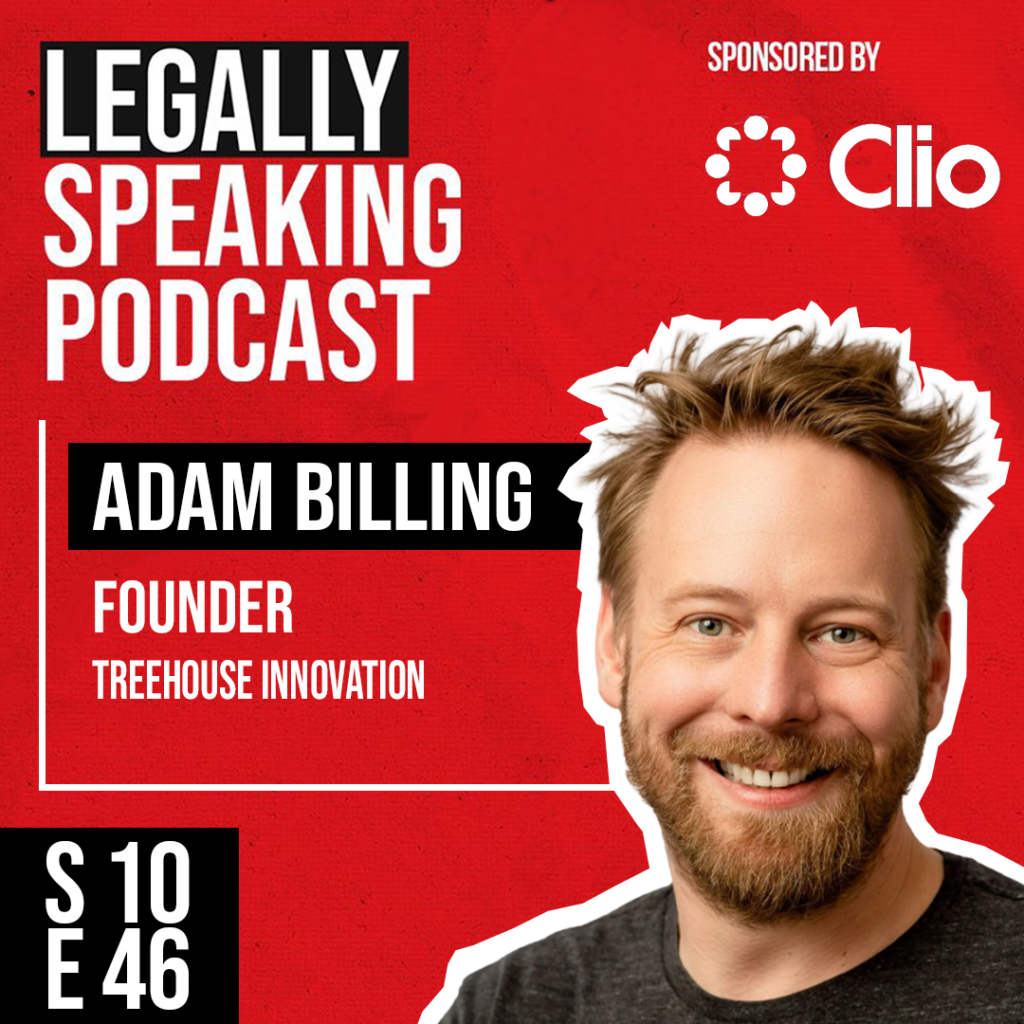
On today’s Legally Speaking Podcast, sponsored by Clio, I’m delighted to be joined by Adam Billing.
Adam is the Founder of Treehouse Innovation, a London-based innovation agency. Based on human-centred design, the agency embraces emerging technology and organisational culture. Founded in 2010, Treehouse Innovation helps organisations develop new products, services and strategies. With more than 2 decades of experience in innovation, Adam has worked as a strategic advisor to CEOs and innovation leaders at companies including Sky, Sony PlayStation, DLA Piper and AstraZeneca to create new opportunities.Today, we are exploring what innovation means in 2026. We will discuss how businesses can become future-ready, the impact of AI on emerging technology and how human-centred design can drive better products and services.
So why should you be listening in?
You can hear Rob and Adam discussing:
– Making Innovation Everyone’s Job
– Designing Around Genuine Customer Needs
– Building Trust For Safe Experimenting
– Reimagining Work While Centering People
– Growing Foresight, Agility and Resilience.
Connect with Adam Billing here – https://uk.linkedin.com/in/adamrbilling
Transcript
Robert Hanna (00:01)
So a very big warm welcome to the show, Adam.
Adam Billing (00:03)
Hey Rob, very happy to be here. Thanks for having me.
Robert Hanna (00:06)
it’s an absolute pleasure to have you on the show. And before we get into things, we’ve got a couple of quick fire icebreaker questions for you. Firstly, what’s your favorite beverage? And secondly, what’s your preferred choice of footwear on a typical work day?
Adam Billing (00:20)
Oh man. Okay. Favorite favorite beverage. I mean, that is a that is a really, really, really, really tough one. But I tell you what, I’ve actually gotten kind of addicted to protein shakes. I don’t know, I don’t know how it’s happened, but like the it’s it’s the first thing when you said favorite beverage, maybe it’s just a period of time, but I’m just thinking a protein shake. I’ve been like going on a health kick, about three of them a day, and I I might it might be turning into an addiction. Um
Robert Hanna (00:47)
Well,
there we go. Ages and stages and we’ll take protein shakes. What about footwear? Is that running gear w to support it or something else?
Adam Billing (00:53)
So here’s the thing.
You know, I know this is this is all about honesty, transparency.
Robert Hanna (00:57)
Yep.
Adam Billing (00:58)
And I’ll tell you this is this is shameful. I’ll never live this down. But uh man, I’ve I’ve mocked for years, but then last year my wife bought me a pair of crocs.
Robert Hanna (01:08)
uh Fair enough.
Adam Billing (01:10)
I just
I just may be sporting some crocs right this very second. Yeah.
Robert Hanna (01:15)
Absolutely. Okay. Comfort comfort
comes first. And then on a tech front, what’s one piece of legal tech or everyday technology you now rely on that you would have thought unthinkable at the start of your career?
Adam Billing (01:27)
Oh gosh. I mean, I think, you know, the the the go to is just just plain old chat GPT. You know, it is not even
Robert Hanna (01:35)
Yep.
Adam Billing (01:36)
unthinkable at the start of your career, but like unimaginable. yeah, I mean just the whole the whole suite is transformed, everything is an innovation business that we do, I do, everyone’s done. And maybe that’s maybe that’s a layup of an answer, but there’s it’s the only genuine truth for the to that question.
Robert Hanna (01:52)
Yeah.
I mean th the levels of adoption it had when it came out, the you know, the the wave ever since and with all the others following, I think it’s hard to ignore that. And good answer, and let’s get into you, Adam. So could you talk
Adam Billing (02:04)
All right.
Robert Hanna (02:04)
us through about your journey from working and consulting at EY and Cap Gemini to becoming basically the founder of uh Treehouse Innovation?
Adam Billing (02:12)
sure. I mean d I mean, it is I wish I could tell you that I had some like amazing career master plan, but like late nineties, I kinda you know, I got got a job at EY out of college. Okay, this is cool. you know, the dot com bubble thing was happening. There was loads of work. and I just kind of randomly met this partner out in California who I don’t know, he said, you know, we’re doing this new collaborative innovation thing over here. I think you’d be
you know, really into it, you’d be good at it. Come on out to California and yeah, get involved. And I was based in like Cincinnati, Ohio at the time. So suddenly I’m flying to California every week and doing this, you know, now looking back on it, really ahead of its time stuff. Like they had the like design shop methodology, which is all the fundamentals of like human centered design and design thinking, kind of before it was a thing. Like before, you know, IDEO had made it a big, you know
global phenomenon and all that. Um, but yeah, so just kind of got pulled into that world, uh, sort of fell ass backwards into it. I wish I could say there was a master plan. But sort of one thing led to another. And then kind of fast forward a few years, um one of the uh basically the senior partner of EY left and was starting to work with the University of Cambridge and helping them set up their um exec ed function. I got a phone call saying, hey, you did all this cool innovation work at EY. Why don’t you come on over here
UK for a little bit, join me and and and do s do this really cool work at Cambridge. And that was like in two thousand five, two thousand six. Thought I’d be here for maybe two years max. Fast forward sixteen years, still here. Uh but but but loving it. And and yeah, over those years, like about about fifteen years ago, started Tree House. Um, after that work with with Cambridge and yeah, you know, wife, kids, house stuck forever, but happy.
Robert Hanna (04:09)
Yep, life. Yep, the journey. Let’s go to building treehouse then innovation, ’cause you mentioned you I think you found it in twenty ten. So what
Adam Billing (04:16)
Yeah.
Robert Hanna (04:17)
prompted you to to take the leap to to start treehouse innovation and was there a gap in the market you particularly wanted to fill?
Adam Billing (04:24)
it’s a it’s a it’s a great question. I mean to be honest with you, the for me it was a kind of one of those moments in life where uh I had a big choice to make because very, very sadly the the the founding partner who who brought me over to the UK to do the cool work with Cambridge, he passed away. And and I had to make a choice like do I s do I stay in the UK and try to kind of build something on my own, or do I, you know, head back, you know, I didn’t have any kids at the time, but it was a
kind of a real moment. Um and also at the same time I’d I’d I’d been a musician, kind of in parallel. So we was actually in a like a a touring band and we were doing all this stuff, you know, back in the day. And that was sort of coming to an end as as those things sometimes do once you once you start to hit your you know, mid late thirties. Um, and I just had to make a decision like, okay, I need to, you know, what do I want what do I want to spend my time doing? Um
And at that crossroads, I thought, listen, I I the thing that just like gets me up in the morning, the thing that I actually get real energy from, the thing I care about, is bringing people together to just make things, to do cool things, make things happen, see some kind of you know, impact in the world. I mean, not any kind of not that it has to be always the most, you know, amazing and you know, altruistic thing, but just making stuff happen, making cool stuff happen. And yeah, I started building a
kind of a a band of of folks who were doing cool creative work. And over a couple years that sort of snowballed into what is now um treehouse innovation. And like you said, we’ve been it’s 16 years now we’ve been we’ve been at it.
Robert Hanna (06:05)
And what a journey and some some huge success you’ve had along the way. Um a bit of a tongue-in-cheek question now, but we’re seeing the titles Legal Innovation Officer, Head of Legal Innovation and so forth. But what is innovation? You know, it’s springing up everywhere, not just in legal. So how do you define innovation
Adam Billing (06:23)
Yeah.
Robert Hanna (06:23)
and what does it mean to you?
Adam Billing (06:25)
Yeah. man, that’s that’s a huge question. Um, so I think there’s I think that definition has been changing, right? It’s one of those it’s one of those words that’s been morphing around. I think there’s a amazing academic we work with named Jean Litka. Uh she was the dean at the Darden School Um of Business part of UVA in the States, and she’s one of wildly published and hugely respected and absolutely brilliant. And
She talks about like the change from what she would call innovation one to innovation two. And I’ll put a little context on that. So I think, you know, the kind of default thinking on innovation is like new products, new service, right? It happens in a lab or innovation team, creates new stuff and and you know, and goes out to sell it, make money, differentiate in the market, all that stuff. That is absolutely true.
And absolutely valuable. But that has been the kind of the traditional sense of innovation one. Innovation two is much more of where innovation stops being a function within the business and more of a characteristic of the culture, right? And that’s the shift I think we’re seeing. And Gene points out that something pretty similar happened a while ago in the world of quality. Like if you think about, you know, what was quality in most businesses? It was something that like it was a function.
Like you go back in the sixties, it was a function, it happened after something was built. There was like the quality check, the step, make sure it’s
Robert Hanna (07:57)
Yeah, control.
Adam Billing (07:58)
right. Yes, quality control. And if you fast forward, like TQM comes in, all that lean Six Sigma stuff comes in. And effectively it goes from being quality as a function that happens after the fact to quality as something that is now part of everybody’s job all along the journey of of creating something.
That same, you can call that a you know move from quality one to quality two. Same things happening with innovation. Innovation one, it’s a function within the business. Now moving to innovation two, it’s got to be integrated into everybody’s job. It’s got to just be part of the DNA. Or yeah, it it it organisations just and we’re just seeing this now more than ever. organisations just can’t hope to kind of keep up.
with with the kind of change that that that’s hitting them unless unless that’s really kind of everybody’s job at this
Robert Hanna (08:54)
And with that, you’re ultimately I assume getting fusion rather than confusion as well throughout with the innovation and that as a result of that, the innovation that’s actually being implemented, the adoption levels are higher, and as a net positive of that, everybody wins. Okay, so a close knit
Adam Billing (09:06)
Oh, that’s brilliant. I love that
fusion. So you know, you I might have to borrow that, Rob. I like
Robert Hanna (09:10)
Yeah, you can borrow it. You can borrow it. It’s absolutely yours to have. But let’s talk more about Treehouse Innovation, ’cause you the work you’re doing is super impressive. So a close knit, multidisciplinary team of talent, creative and helpful people committed to enabling clients to accomplish amazing things. So what do you do? Break it down to us.
Adam Billing (09:31)
Okay. So you can kind of say putting in the context, right? Um, we’re just talking about how it does need to be into the DNA, right? These methods, these behaviors need to be into the DNA. If you look at the kind of work we’ve done over the years, it’s it’s it’s changed a bit. So by the easiest way to think of it, we’ve we do innovation projects, right? That’s kind of the the the most obvious thing you would think of when someone says, we want to innovate in a new
Market, you know, or wanna, know, uh enter a new market, we wanna develop a new product, or we see a new opportunity, we want to exploit it. There’s a new technology, you know, let’s let’s you know, how how can we match it up with a a user need and steal a march on our competitors? Kind of again, a kind of classic innovation work. And we still do that work. We always have a couple projects going at any given time that is that. But what has changed is there’s been a much kind of dialed up increase demand.
For people to say, okay, we love bringing in Treehouse to work with us on these projects, but we we kind of want to do it ourselves without you, which is wonderful, right? That’s that we are absolutely we love that, right? Because that then comes into us sort of helping set up in-house innovation functions, right? Helping sort of create the create the process, create the the you know, think about the governance around it, you know, maybe setting up a lab, training people. And we’ve done that in the legal sector. We’ve done that um in a few places once w great.
Great work with DLA Piper. Uh with some amazing people there working right with the CEO Simon Levine and the and the head change maker Jenna Blount. to to to create that. They had DLA design really successful. Like they won the most innovative law firm of the year and everything. When not not that we’re taking credit for it was literally all their work. Helped. We helped.
Robert Hanna (11:18)
Take take credit. Take take credit. You were there advising, helping and implementing.
Adam Billing (11:23)
So yeah, it’s like they started with doing the projects kind of for the client, then it was
Creating those functions, those labs to to kind of be that engine that existed inside the the organisation, down to now we’re seeing so much more of it being about culture transformation, which again is going back to that innovation one, innovation two thing. Just that idea of like it everybody in the organisation, when things are moving this quickly, need to be able to kind of sense those, like what are those changing client needs? What new tech is coming? What impact is that gonna have?
And then how do we really, really quickly respond to stay relevant, to stay ahead, all that stuff? It just it just can’t work anymore if it’s, you know, that little skunk works or dedicated team that’s kind of in charge of innovation. It’s gotta be the whole shebang. So a lot of our work is taking those same creative methods and tools that we use on our projects or put into these labs, kind of distilling them down to the really specific changes that people can make every day.
to be able to spot opportunities, come up with better ideas, prototype get out, and turn into something that has some value.
Robert Hanna (12:33)
Yep, specific is terrific. I talk about it a lot on the show and that that’s so so so true. I mean the core values of treehouse innovation I really like. you know, curious, collaboration, passionate, fun, expert, and caring. Really like the the caring and the empathy parks. I think we need more of that in the world of work. But one of the things you’ve been talking about, and one of the core areas of um your work is human centered design. You touched on it before. So why is understanding people, customers, employees, stakeholders
important when organisations are actually trying something new and what do businesses often get wrong when they design their products and services without understanding the individuals they’re actually designing it
Adam Billing (13:12)
Yep.
Robert Hanna (13:12)
for?
Adam Billing (13:13)
No, it’s a great question. I mean, human centered design, you know is it’s it’s it’s simple, it’s common sense stuff and you’ve kinda nailed it there. It’s like don’t build the thing until you really know what people care about and need. And that isn’t the same as what they’re asking for necessarily, right? It but it’s about really understanding what the true need is and designing around that is like as you is your North Star. Um if you do that, there’s you know
of a cliche, but it’s like then you know you’re you’re you’re building the right thing, not just building a thing right. Right. And you talk about where mistakes are often made, it’s starting off with building a thing right without being sure it was the right thing to build to begin with. So you know, so often we’ll hear you know we’ll hear of you know innovation stories that just you know fell off a cliff, just didn’t deliver. And I’d say nine out of 10 times
It’s when they started with what was feasible. Like, like we’ve got this cool tech. What can we do with it? Or like they started with what was viable. Like, we know we can make some money here. Let’s put this thing here without going back to that starting point that should have been, which is what’s desirable, what do people care about? So much work can go into making something that’s technically beautiful that no one gives a damn about. And yeah, a lot a lot of dead ends show up when that when that little fumble was made.
Robert Hanna (14:39)
Yeah, it it it’s so true. And I guess it leads nicely to where I wanted to go next. I I I talk a lot about sort of, you know, perfect in action. Actually you want imperfect action. Where I’m going with this is ideas leading to action. You know, there’s often perception around innovation being brainstorming, workshops, writing your ideas down, chucking stuff on a post it note. So how do you actually ensure innovation moves beyond ideas and actually creates value for an organisation?
Adam Billing (15:04)
Yeah. Well man, th these are these are huge questions, Rob. But I think the um one of the things that we see a lot, and this is across sectors, across organisations, I mean we we work just to give you a sense of it, we work with everything from you know, we work with a lot of law firms, work some in house teams, but we also work with places like Sky, PlayStation, AstraZeneca, we work with regulators like the FCA and um and others. And uh but these same
kind of regardless of of what organisation is. There’s something about a human organisation that that’s kind of eternal and transcendent of of uh of of of industry. And one of the biggest things is when you see a mismatch between a it that almost like the innovation one and the innovation two. When you’ve got an internal team, for example, that is creating awesome stuff, right? Like it’s it’s awesome by all
you know, definitions, like it meets a real need. It’s, you know, technically elegant. It is, it’s got a strong business case behind it, right? But then it will be, let’s say that your internal innovation team came up with this thing, they develop it, and then they kind of go, ta-da. And the rest of the organisation, even though it’s an awesome thing, they don’t they don’t adopt it. It just sort of
Robert Hanna (16:24)
Mm.
Adam Billing (16:25)
bounces off the culture. And we see it so frequently. Um and and l legal is is is
Kind of notorious for this. The legal innovation is a big challenge because, you know, it’s that the creating it, you get loads of smart people, put a lot of resource into RD functions. But especially if it’s something that’s like a client-facing service, you got to get the partners on board. You know, often they’ll see this new thing and be like, is this going to cannibalize what I normally do? Or do I feel comfortable putting this in front of my client? You know, do I do I trust it? Do I know it? And getting that kind of adoption.
is is usually the biggest barrier to implementation of be it new, you know, new solutions, new products, new services, or even new tech. It’s this this like human change challenge thing that’s as old as time, but is where we see so many things fall down.
Robert Hanna (17:18)
Yeah, and i g it’s really important to to sort of highlight that point. And I think the other thing that, you know, we have a lot of conversations with law firms around is being future ready. You know, it’s the future.
Adam Billing (17:27)
Yeah.
Robert Hanna (17:28)
So, you know, you talk to and you mentioned some of those organisations. We’ll dive deeper on the sky glass story later actually. Um, you know, you talk about helping organisations become more agile and actually ready for the change. So what does future ready organisation actually look like? And what separates those
organisations from others that struggle when there is unexpected events along the way.
Adam Billing (17:48)
Yeah. I mean it is there’s there’s certainly no one size fits all formula, but I mean there are a few a few activities that are are pretty characteristic universally against those uh across those who are, you know, at least effectively working towards future readiness. And one of the first things is bringing in some foresight practice, right?
Whether it’s some you know, and you don’t have to have like, you know, your in ho an in-house futurist is wonderful if you if you have one. We work with an amazing woman named Jennifer Lowe. She’s the head futurist at IDEO. Um, you know, she advocates like every company needs to have like your in-house futurist. Like it just they have to be there. And but you think about what their job really is, they’re dedicated like picking up on these weak signals, like these little changes that are showing up that are in you know, indicators of a bigger change that might be right around the corner.
but someone who is engaged in doing that work. And if you don’t have that in-house team, even just doing some light like scenario planning work, just getting senior folks together to start looking at possible futures and stress testing what they do today against those possible futures, which is it’s just a much more kind of forward not to say that organisations don’t do this, but when they do it, they kind of have done it like every couple of years on their strategy.
This is something that needs to be brought in, and we’re seeing successful organisations bring it in as just sort of a routine, commonplace uh way of just thinking about strategy and thinking about it on much shorter time frames.
Robert Hanna (19:22)
And if nothing changes, nothing changes, right? And it’s to the point of, you know, chief AI officers. That was a title years ago that would have just been alien. To your point around the futurist, you know, things are moving and actually, you know, organisations, law firms need to adapt and understand like the power of these positions and the value that they can they can bring. You’ve mentioned obviously the the work you did with DLA, award winning, which you might add. You mentioned obviously PlayStation, Sony, Sky. These are huge AstraZeneca, huge, huge, like the best in the business, really. So what are some of the biggest barriers to innovation?
inside these log organisations you’ve seen.
Adam Billing (19:53)
Yeah. I mean I think the the across the board, again, it comes down, you know, saying given that example, yes, about what when things get implemented. And I gave you a story about what what stops them from being implemented. Um and so the kind of the the positive is the inverse. Um so let me clarify that. What we’ll s what we see is, you know, there’s still very much this notion that innovation is done by a small set of people.
And all and and and where the output of any good innovation is going to be something that is almost by definition new, different, unfamiliar, right? There won’t be structures in place to to deliver it and it’ll require some kind of change to adopt it. So you know, I saying how great solutions will bounce off of a culture, that’s often what we see, where the organisation just doesn’t have that change capacity to
to get things implemented. Now the ones that do it really well are typically those organisations that kind of have that, you might still have that engine that’s like really focused on driving innovation, but you have got a culture around it that is accepting of of sort of those those those new things. People are kind of brought along on the journey for things.
leaders actually model some of these behaviors like experimentation, like prototyping, like starting with empathy. Um, you know, and and and they start to measure the value of those things, right? So all that’s all that stuff sort of shapes the culture. And, you know, for the for the organisations that that really, really struggle, whether it’s, you know, in AstraZeneca or whether it’s in PlayStation or or where else, it’s, it’s where that where that misalignment happens, where you’ve got
Because you know, all these organisations have to deliver on their on their everyday. And that does create that sort of rigidity and performance is only measured on how well you deliver on the execution of your everyday business core. And then this the the new thing can bounce right off. Until you tweak that that culture piece, which is huge. That’s transformation, right? That’s at the leadership level down to how you know governance, incentive, infrastructure, all that stuff needs to be lined up.
So these two things are no longer at odds. Because they just they just can’t be when there’s so much pressure to, you know, spot the opportunity, move quickly, adapt and and and adopt. So it’s just getting those two things synced up. Doesn’t matter what industry you’re in.
Robert Hanna (22:33)
Yeah, y I guess you’re just trying to be as friction free as possible, right? So, you know, i it i i it
Adam Billing (22:37)
It’s a good way for them.
Robert Hanna (22:38)
it just works. I mentioned briefly, I want to ask about this, the the sky sky story, the sky glass story. ‘Cause, you know, one of the projects highlighted by, you know, Treehouse Innovation is is that programme inspired by Sky Glass? So would you mind sharing a bit more about the program and what do you see were some of the challenges and what did innovation process look like and perhaps what other organisations can learn from the project?
Adam Billing (23:01)
Sure. So I that s Sky is an awesome organisation. I mean it’s just as a quick aside. Like we’ve worked with them for years and years. They’ve got an incredible in-house innovation team called Sky Labs. And we’ve, you know, we’ve helped, you know, support them and you know over the years as well. But they they do really cool stuff. Um so they’re they’re I think just they’re I’ll get to the Sky Glass thing, but I think they’re a really good example of of having invested a lot in a culture.
That will accept those new ideas that come out of that innovation function because they’ve made that innovation function just sort of, you know, spread across the business, right? It’s like it’s integrated in everything and everyone sort of feels like they’re part of it. Um and that’s a really special thing, and they’ve done it really, really well. So just to acknowledge that. But Sky Glass, it was really incredible. The um we had a a a program called Better Innovation.
Everything at Sky is, you believe in better. That’s their thing. So this was the Better Innovation Program. We custom designed it for Sky. And I think we put the top 600 uh leaders through it, but it wasn’t like a your standard kind of like innovation training. It was very, very immersive. It was basically a short sprint. every every kind of these it was only two two days total for each uh each cohort. But you know, as they maybe have like 20, 30 people in each cohort.
But what they did is they anchored each one of these modules, right? Two-day modules, in a challenge. And the challenge was the same across, which was basically how do we engage millennials? Because millennials weren’t necessarily getting skyboxes and saying, How do we, you know, how do we how do we tap into this? So very much in the spirit of like human centered design, we invited in at the beginning of each of these, like 20 millennials.
Potential customers, maybe they were customers, maybe they weren’t customers. And they sat down. So the leaders actually sat down for, you know, a couple hours with groups of these millennials to find out what they care about, what they do, what they don’t do, what are they, what do watch, what are they not, all that. And then they would go through to learn some of these methods. You know, myself or one of the other tree house team would be in kind of facilitating and teaching, and they would go through.
You know, forming some insights from everything they heard, generating a lot of potential solutions, creating some rough and ready prototypes of those top solutions. And then by the end of that second day, we’d bring all those millennials back to give feedback on these solutions. And through that process, we know we we heard very famously from from the team, like again, the internal innovation team at Sky, that yeah, the Sky Glass concept.
Which, if you’re not familiar with it, is it’s basically Sky’s um hardware solution, right? So it’s the TV with the integrated box and all the services through. And it’s it’s been a big success for him. but yeah, that that came directly through that that process. So I think it’s just a really cool story because it shows how that the the the the germ of that idea can actually come from a highly compressed time, but when you bring in real user experience,
A good process with some, you know, strong facilitation to get there, that you can actually get to that that nugget fairly quickly. I mean, then it was handing it over to their internal team, the technical team to scope it out, build it out, and a whole other process kicked out. But the origin of it really just came from, again, like we started, immersing yourself in what’s desirable, what people really care about, as opposed to just what we do already that we want to make more money with.
Robert Hanna (26:49)
It’s so true, isn’t it? And it’s it’s it’s being open to that feedback as well, right? And and accepting, you know, actually we may have to to to move away from what we’ve been doing, you know, to the point nothing changes, nothing changes. And probably again leads to culture transformation because, you know, you work with organisations on culture and organisational development. Why is culture closely connected to innovation?
Adam Billing (27:12)
I mean, again, like when we started saying that the definition of what it means to be innovative is has changed so fundamentally and going back to what Gene Litka was saying about, you know, innovation one to innovation two, innovation as a function to innovation as a culture. And the reason culture and and innovation are inseparable, I mean they you know, they literally are. They almost it it’s it’s it culture is the mechanism through which innovation happens in
in in modern business today. And what I mean by that is like if you think about the rate at which customer expectations are changing, right? It is it’s it’s changing exponentially because it’s increasing the rate of change is increasing exponentially. Because you imagine you’re whether you’re you’re thinking about your law firm, for example, you’re not just judging the experience you have with your law firm’s service
against you know other law firms, you’re thinking about how your you know service experiences across all different aspects of your life stack up. So these ex expectations are just skyrocketing. I mean it’s a great time to be a customer right now. There’s so there’s just so many things enabled by by by technology in particular that are raising those expectations really, really rapidly. And that creates this need to keep what you are putting out there
You know, keeping pace with that exponential curve, right? And that is a really, really difficult thing. Now, if you think about an innovation one world where you’ve just got a small group of people who are trying to come up with that next solution, it’s too slow, right? It’s it’s your your curve will just always keep falling back down. It won’t be able to keep pace. But if you take a cultural innovation strategy and say, all right, listen.
Not everyone here needs to be a product designer or you know, some you know brilliant innovator to come up with the next big thing. But when you’ve got a whole organisation worth of people who kind of know what to look for, know how to probe, when they’re just having a normal conversation with their client, right? Know how to probe to what is that next opportunity, know how to spot weak signals and even are thinking about that. And then when they’ve got some insight.
They have that reflex of, okay, let’s let’s think about how we might respond to it. And then when they have an idea, their reflex is to let’s let’s experiment with something. Let’s kind of test our way into the unknown, you know, as opposed to maybe building a big business case or spreadsheet or some laborious time-consuming thing that we may have done 10 years ago. But when you get those habits baked, you know, baked into everybody’s everyday work, the whole organisation moves a lot more quickly. And then your kind of business as usual curve.
can kind of get closer to that customer expectation curve and and and stay there because again, like we were saying, innovation becomes a becomes a a characteristic of the culture, not just a function. So you are consistently spotting those opportunities and putting stuff out there that your clients really care about, value,
Robert Hanna (30:27)
Yeah.
Adam Billing (30:27)
want. Yeah. Exactly.
Robert Hanna (30:29)
It’s sort of in instilling a mindset, isn’t it, within the DNA, if you like, of of the organisation that becomes so natural and habit that perhaps people don’t realize they’re doing it with the culture’s been set by the people they’re around, they’re picking it up by osmosis, and as a result of it, the level of innovation and power that they can be can really supercharge from that. Okay, let’s go to the leadership side of things now, then because you’ve
Adam Billing (30:47)
yeah. All right.
Robert Hanna (30:49)
worked with top CEOs, you know, some of the senior legal innovation leaders out there in the world of law as well. What separates leaders who create a genuine environment for innovation from those who simply
simply say innovation is important.
Adam Billing (31:03)
Great question. Um so there’s definitely there’s a lot of cynic I mean, let’s just call it out, man. There is a lot of cynicism about innovation. It’s one of those words that’s been overused. I think a lot of organisations we talk to them all the time. They’ve invested in different initiatives and programs, and they’ve yielded squat, you know, in so many cases.
Robert Hanna (31:25)
Yeah.
Adam Billing (31:26)
Disappointment. We try, you know, and and if you kind of like to forensically look back at what happened.
Right. What what really didn’t work? What you see very often, and you just kind of described it, right? It’s where at a senior leadership level, someone signed a check, someone put the innovation word in their, you know, they’ve made it a strategic pillar. It’s a strategic pillar, everybody. You know, go for it. But what they what they never did, and this is that big difference, and again, all coming back to culture and behavior and mindset, is
If you want if you you know, if you want people actually to change the way they’re working right now, they’ve gotta see, they gotta really see your actions reflect that. You need to you need to know what those new behaviors look like so you can kind of recognize them, reward them, and you know, yes, that’s what we’re looking for as a leader. But the other piece, right, more important than anything, you gotta model it. You actually have to do it. It’s gotta, you know, it can’t be do as I say, not as I do. Um
Because the bottom line, and this is something I think people forget sometimes, is such a basic thing. If you’re working for some company, no matter how passionate you are, whether it’s a law firm or whatever, you know, you’re thinking about your job, you’re thinking about your reputation, you’re thinking about your salary, you’re thinking about your next promotion, right? Why would you why would you deviate from the thing that never got you in trouble? Right? Why would you deviate from that business as usual way of doing things?
If there was any chance it could bite you and give you any cause any reputational risk, right? So what we see so often is innovate, go forth. It’s a strategic pillar. We’ve signed the check, we’ve done the thing. But what they’ve missed is modeling it to prove it’s safe. And then that really important step of like being that bodyguard, right? So if someone does try something, does experiment in the unknown and it doesn’t work out, that they have complete certainty.
That their back is covered. It’s not going to blow back on them. But in fact, there’s going to be clear recognition of, hey, you, you know, you took a step into the unknown. We needed to go there. We learned that that wasn’t the right direction. Thank you for the learning. You know, praise to you. Not Bob failed over there. He doesn’t get a promotion next month. So I think that it’s it’s just it’s just talking, you know, walking and not just talking.
Robert Hanna (33:49)
Some could it not just
that? That’s such an important point. I I talk a lot about on talks that I deliver about the acronym of of LOES. You know, I I don’t believe you lose, it’s just life offering some experience is my sort of acronym on that. And I think that’s so I think that’s so true to where you’re going there. If you create that culture of actually
failing forwards or, you know, redirection, you know, from any rejections or things that have happened, then actually more innovation is going to happen as a heart of it. Whereas if you put the pillars up or the scares or, you know, they know that they’re going to get, you know, their knuckles wrapped as a result of it, probably bad expression, but you get the point. I think it’s really important that you create these sort of, you know, safe environments to enable innovation to to go forth. we haven’t talked a lot about AI, bizarrely, and emerging tech. it’s everywhere. And you know, we have conversations on every show.
about AI and it’s taking many different forms in many different sectors, including obviously the legal industry in a big way, and there’s huge levels of investments going into that. But how has AI actually changed the the work Treehouse does, if at all?
Adam Billing (34:46)
Profoundly, man. I mean profoundly. You know, I think there’s there’s there’s a great model out there. There’s a company called Experience Point that have articulated this really, really well. They they talk about this sort of change curve for AI where it’s sort of and we’re seeing this, we’re seeing this with our clients, and we’re seeing it at Treehouse, which like at first it’s just sort of like that basic adoption, you know, just sort of getting people to use it, getting people to kind of get over some of the friction of learning how to integrate this into the way they work.
Then there’s this sort of next step where people are starting to really optimize things in a really smart way. But that’s mainly just sort of automation, right? Automating the stuff that we do now. It’s becoming faster, it’s becoming more efficient. And we see a lot of firms who are, you know, past that, you know, getting past that that basic adoption into like really smartly automating some things. But then the next step in that is is reimagining.
Right. So actually reimagining how we create value and thinking about what this technology enables us to deliver. And I’m just noticing we might have a little bit of a connection issue there. Are you s are
Robert Hanna (36:01)
Yeah, I’m seeing reconnecting.
I’m just gonna make a marker for our editor there. Um thirty six minutes.
Adam Billing (36:08)
Mm.
Robert Hanna (36:09)
Uh did you want to maybe try and leave and come back? Um Robin, just gonna make Oh no, you’re back, you’re back. Okay, great.
Adam Billing (36:15)
That’s that’s
I wonder what that was all about. Okay, cool. So where was I?
Robert Hanna (36:21)
Okay, yeah, go for it. I I I think you you
you you answered that question. So let’s go, Robin, just for the for the edit. Um so building on obviously AI then, as AI is taking on more and more tasks, which human skills do you think are gonna become more valuable? ‘Cause you know, our soft skills, for example, curiosity, creativity, empathy, critical thinking, gonna become more strategic to businesses and valuable to businesses?
Adam Billing (36:49)
Oh, w without a doubt. And that’s that’s coming out. I mean there’s a great World Economic Forum report that came out earlier this year. It was just talking about the, you know, the human centric skills revolution. Um I mean if you really think about like one recognizing that AI is just gonna get better and better and better and it’s getting I mean, to not to date this episode, but like, you know, GPT six Astra has just been announced and apparently it is like an entirely new generation, you know, it’s a
It’s like the first step into AGI. Like this stuff is moving at breakneck speed. So it won’t I think a lot of folks that might be still clinging on to some of those. This is maybe sounds kind of scary, but like hanging on to just knowledge and technical um expertise as as your differentiator. I think those things are gonna erode very, very quickly.
I think in lot of ways those those are indefensible motes already. We just don’t realize it in in some cases. But I think what it’s doing is it’s shining a really clear light on those things that matter most for humans. And I think are probably the things that human beings have always been and will always be kind of destined to do. And and like yeah, you mentioned those things, like things about, you know, curiosity, uh, you know, connection, relationships, but you know, kind of to what end?
I think at least this is what we’re seeing, my point of view. I think the first bit is deciding what to build, what is worth building, what should be versus not, you know, being created. Because now anything can be built like that. Outputs are easy. You know, outputs are, you know, beautiful, elegant, wonderful things can be built in a second. So it’s much more of a question of, you know, where to focus, what’s worth doing. And again, that a lot of these human-centered
Practices of like starting with what people care about can be a really effective way of saying, this is what we build, this is what we, this is what we pass on. Um, and then once you’ve got that output, that thing, that solution or whatever it is, it’s the human relationship side, you know, connecting with people. Again, like we were talking about the the barriers to implementation of, you know, amazing solution, but the organisation rejects it. What what overcomes that?
You know, it’s trust. It is someone, you know, ch people rallying behind an idea and getting the momentum to actually make it come to life. Those things are irreplaceable. Like so no matter how great the outputs become and how quickly they can be achieved, you’re gonna need the human to decide what to build, and then those relationships and connections and the trust to actually turn those things into something that actually result in a in an actual change in in the world.
Um so I I don’t know, I feel good about it. I feel like I feel like this is the stuff we were always meant to do. The other stuff was the work of machines, but it’s not gonna be an easy transition.
Robert Hanna (39:51)
Exciting. And I think looking at it from a glass half full perspective and and loving the energy and and and thoughts a around it, we talk a lot about this on the show. Collaboration is domination. So, you know, Treehouse Innovation prides itself on being a collaborative organisation, with its services delivered with you, not just for you. So in which ways does co creation contribute towards successful innovation?
Adam Billing (40:14)
It is 100% essential. I mean, and I probably should have mentioned this from the very beginning. You know, we keep going back to these examples of amazing things that don’t get implemented. That’s often because they’ve been built in isolation and then suddenly it’s ta-da! Look at this, look at this thing we’ve created that we love and is magical, but it’s going to require you to change the way you work and you’re totally not bought into it. And wow, now we’re shocked that you don’t want it and you’re not adopting it.
So much of that can be avoided by it doesn’t take a lot of involvement. It doesn’t have to be, you know, that person has to be embedded in the product team from day one. But if you can build in some take this good old-fashioned stakeholder engagement into the innovation process, so they are following that journey from what’s the insight, what’s the need we’ve identified, what were some options that were developed, what were some
prototypes that we created and some experiments that we ran and what did we learn and how did we now end up at this ta da, then it’s no longer a ta-da. Now it’s something that they have collaboratively participated, you know, in in in the journey to to to create. And it the the adoption rates when when that kind of approach is taken versus the ta astronomical, it’s a whole different whole different universe. So whenever we do an innovation project, we always design that alignment
piece in that stakeholder engagement piece into the journey or, you know, we’ve been burnt too many times when we tried to move fast and skipped it.
Robert Hanna (41:47)
And going back to principles of your own within your own industry, right? Get the basics right. And you know, great example there of we is greater than me, isn’t I think if you bring all those people to gather. We talked a lot about future proofing. So it’s just sort of as we’re looking to close this, future proofing businesses. If you’re advising a CEO or law firm leader, what’s the biggest area they should focus on to ensure their organisation are resilient and ready for change?
Adam Billing (42:09)
Yeah. I mean it is it is a lot a lot of the things that we’ve been talking about here. I think the the two pieces of advice would be one, get intentional about the way you think about the future, whether that is having a sp you know, a team, a futurist, or just introducing those things into the strategy conversation and making it commonplace, right? Making it just a a reflex when people think about the future. They think about potential futures.
And and stress test where they’re heading against them. I think that’s one important shift. And then I think the other is just recognising that if you are going to keep pace with this kind of change, you cannot do it with just one small group focusing on what that change is going to be. It has to be much more organic. I mean, in a way, innovation isn’t even the right word. What we’re talking about is agility, responsiveness. And when you’ve got those things, resilience follows because when that shock comes,
Often it wasn’t quite as much of a shock. Or even if it was still entirely surprising, then the the the the the the organisation at least has that kind of muscle memory of being able to pivot more quickly without it just, you know, shattering under the weight of its own, you know, you know, heavy, heavy infrastructure of fixed systems. Yeah.
Robert Hanna (43:26)
And you’re you’re prepared for it then, I guess, if you create that as well, right? You you you’re more nimble and as you say, like agile. Great, great word to use. Okay, sort of where do you think innovation is heading? How do you see innovation developing over the coming years?
Adam Billing (43:37)
No, I think it’s uh becoming democratised. I think in a lot of ways I mean I can see a world where we’re a world where that word is really no longer used as a you know, as as a specific function. I can I think given the tools that are at people’s disposal now and given the the speed at which change is really happening, that innovation just really does become something that is
regardless of where you sit in the organisation, just sort of kind of an unspoken part of your job, very much the way the quality shift happened in in in in the you know, decades ago, I think we’re very quickly heading towards a world where just different baseline human skills that we once called innovation skills are now gonna be part of people’s everyday work.
Robert Hanna (44:29)
Yeah, I kind of get where you’re coming from and and and can see that happening too. Okay, final piece of advice. If you had to complete this sentence, how would you finish it? The organisations thriving in the future will not be those that predict what is coming, but those
Adam Billing (44:48)
yeah. I think going right back to it, it’s those who are able to pivot and quickly align their people around the new direction.
Robert Hanna (45:00)
Like it. Very neat and tidy and off the cuff. you had no prior knowledge that that question was going to be chucked at you and very nicely done. Um, Adam, this has been a wonderful conversation. If our listeners want to follow you or indeed learn more about treehouse innovation, where can they find you? Feel free to share any website, social media handles, resources we’ll also include them in this episode for you too.
Adam Billing (45:19)
Sure, yep. I mean, treehouseinnovation dot com. We’re out there. social media, just look at Treehouse Innovation. It’s you’ll find us very, very quickly. Um, and yeah, we’d love we’re always putting stuff out there, little thought pieces, some a bit more controversial than others, but we love getting people engaged in those discussions and uh and yeah, just kind of keeping the collaborative thing agoin. But hey Rob, thanks so much for having me, man. It’s been an absolute pleasure talking to you.
Robert Hanna (45:44)
we’ve absolutely enjoyed it. Thanks so much for joining us. It’s been a pleasure having you on the show. And I think this conversation is an important reminder that, you know, innovation is not simply about technology or having that next big idea. It’s about the people, it’s curiosity, it’s the culture. So from all of us here on the League’s Beam Podcast, sponsored by Clio, wishing you lots of continued success with Treehouse Innovation and all the great work you’re doing to help organisations become more innovative and as well as future ready. But for now, from all of us, over and out.