We are excited to be back in Boston for Clio Con Clips 2026! The Legally Speaking Podcast™ returns as an official media partner, bringing you exclusive interviews, fresh insights and behind-the-scenes conversations from one of the world’s leading legal technology conferences. Our Clio Con Clips series features Clio’s leadership, legal tech pioneers, Reisman Award winners and industry changemakers exploring the latest developments in AI, legal innovation, access to justice and the future of the legal profession.
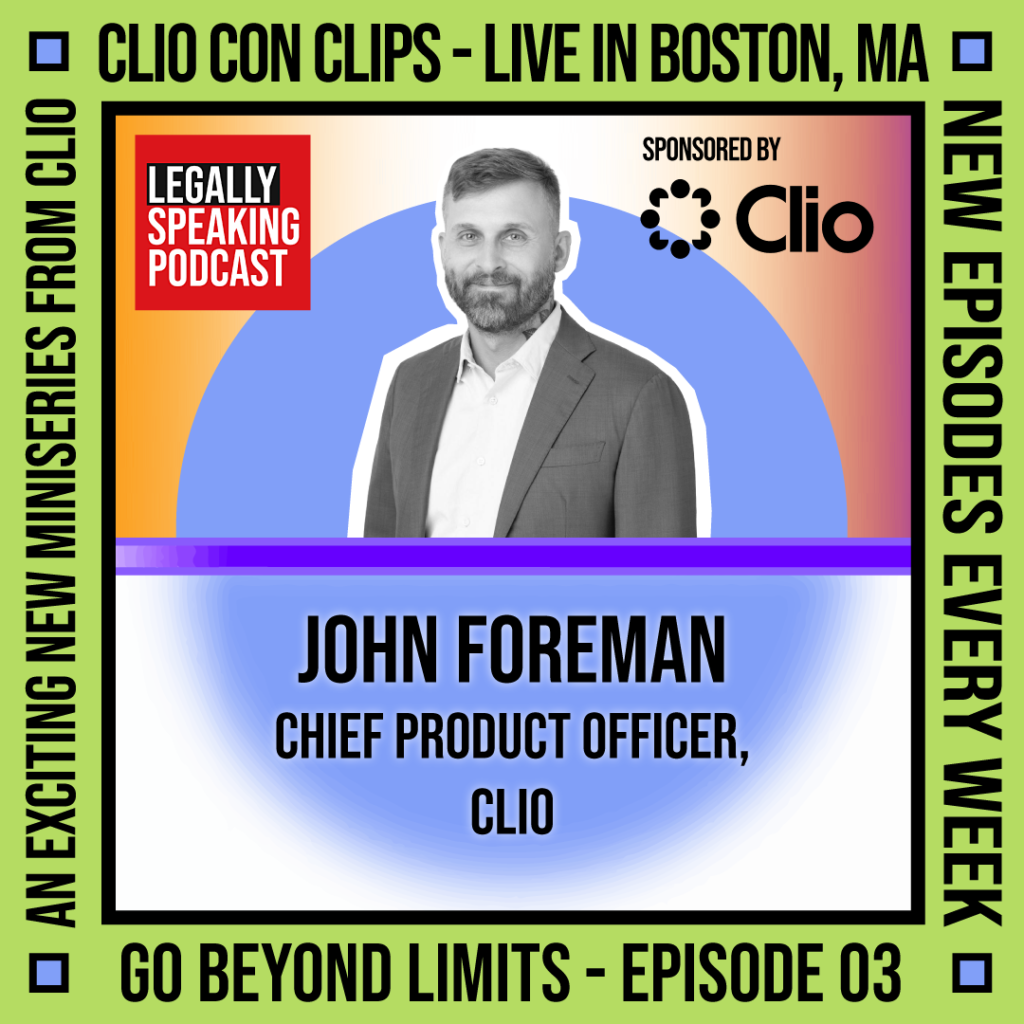
In the third minisode of Clio Con Clips 2026, we get to speak with returning guest, John Foreman, the Chief Product Officer of Clio. In our conversation, John discusses how AI can automate routine law-firm work, adapt software to lawyers and connect workflows across a secure, unified platform. He also shares how Clio prioritises product ideas and hopes to reduce the spreadsheets and follow-ups that burden growing firms to this day.
You can Hear Rob and John talking about:
– How Software Should Adapt To Lawyers
– AI Absorbing Complexity for Users
– Unifying Data, Users, Roles and Permissions
– Automating Full End-To-End Workflows
– Safe AI Obeying Privilege Permissions.
Connect with John Foreman – https://www.linkedin.com/in/johnwforeman
Transcript
Robert Hanna (00:00)
Boston, we’re back. Welcome to ClioCon Clips 2026, a special mini-series from the Legally Speaking podcast proudly sponsored by Clio. I’m your host Rob Hanna and we’re back in Boston for our fourth ClioCon once again as an official media partner. What an exciting time to part the global legal community. We’re bringing you exclusive interviews and behind the scenes conversations with Clio’s leadership, legal tech pioneers, Riseman Award winners, and changemakers shaping the future of law.
Groundbreaking developments, legal AI and innovation to the future of our courts and access to justice, we’re getting to the heart of the biggest conversations transforming the legal. Expect bold ideas, fresh perspectives, exciting announcements, and practical insights from the people leading the way. So, wherever you’re tuning in from around the world, we’ve got you covered. Welcome to ClioCon Clips 2026. Let’s get into it.
Welcome to the Legally Speaking podcast recording live here in Boston for our ClioCon Clips twenty twenty-six series and we are joined by name, title and organisation.
John Foreman (01:07)
I’m John Foreman. My title is Chief Product Officer. And I assume by organization you mean Clio. Yes. Unless you mean research and development.
Robert Hanna (01:18)
Yes, that is true. And before we get into the important stuff, you were on the show last year during this series with your CTO, John Watson, and you told me your favorite television show was the Gilmore Girls.
John Foreman (01:29)
Still is. Still is. It is fall in New England. It is Gilmore girls rewatch season. So
Robert Hanna (01:37)
Yeah, and they you also said if listeners could call your mum if they wanted to get hold of you as well. Is that also true?
John Foreman (01:43)
So, you know, we uh we at R and D we’re only let out of our parents’ basement once a year to come to Cliocon and otherwise we’re down there just writing code. So uh if you wanna find me I’ll be in my parents’ basement. Yeah.
Robert Hanna (01:56)
I mean all jokes aside you you’ve you’ve really moved forward since we last sat down in Boston. Yeah,
John Foreman (02:02)
Been a busy year.
Robert Hanna (02:03)
the level of product the innovation is truly inspiring and we we we love partnering with Clio. Last year you told me AI shouldn’t just be a chat bot, but it should genuinely take
work stress off people. So now Clio has obviously unveiled the AI experience that can understand context and coordinate across an entire firm. So what’s the biggest breakthrough in moving from AI that just answers questions to AI that actually does the work? Yeah yeah.
John Foreman (02:27)
Yeah,
yeah. I think on top of Clio, you you saw it in the keynote, we now have a platform on which you can easily build an AI automated law firm. Yeah. Right? I this it’s interesting to take something that seems kind of ethereal and maybe only the purview of
thought leaders on Twitter working in dark mode, uh command line prompts and be like, no no no no no no no no no. The complexity is on the AI to do the work. Yeah. We can make this simple for you and we can allow anyone with legal expertise to now automate their law firm. It’s especially automate those things that are not legal expertise. They’re just this drudgery. Let’s get them done. Exactly. So it’s cool to see that transformation over the past year.
Robert Hanna (03:15)
Yeah, and it’s been very successful and I’ve heard that from your customers. Ours at the channel Partner Day, like the the the the thirst for it is exciting. So Clio Works visualizations, lawyers can now describe the tools they need and have AI help them create, which again is cool. Are we heading towards a future there where lawyers no longer need to adapt to software because the software adapts to them?
John Foreman (03:36)
That would be the goal, right? Yep. What’s interesting working in software for so long is you come to a conference like this. Yeah. And you talk to customers and everyone’s got their list. Everyone’s got their sticky note. Yeah. It’s like and it and oftentimes it’s it’s little stuff, right? It’s hey when I do this thing, I need this notification. When I do this particular thing, I want this roles and permissions on so only
you know, Betty can do it. Yeah. You know, it’s always it’s just this little stuff. Right. And that’s I I actually think we’re getting to a point now where so many of those little tiny things can be customized and taken care of. Something like AI workflows that Clio released is now at a place where like you can you can articulate arbitrarily complex operational things and it can like take care of them.
Yeah. And that’s very gratifying as someone who spent, you know, twenty years in tech trying to get jobs done and hitting walls.
Robert Hanna (04:37)
Yeah, this is true. And I think I always talk a lot about little touches big impact. And you’re absolutely right. These little touches are having astronomically big impacts on these firms because removing the friction, they’re having a lot more success, happiness actually running the firms. You’re basically connecting the entire legal work through. So you’ve got the experience now brings in grow, manage, work together, while Vincent projects allows team to build on a shared AI work. What’s the hardest part of turning, I guess, a fragmented set of tools and individual knowledge into one genuinely connected experience? And what’s the transf what makes
What makes so transformative for firms? Mm-hmm.
John Foreman (05:09)
Yeah. Um what’s the hardest part of it? oh Every part of it, right?
Robert Hanna (05:14)
Choose your hard.
John Foreman (05:15)
The the the l let’s talk about what it took to produce this one Clio idea, right? You’re really talking about platform unification at several levels. Yes. You know, the way that Jack unveiled the user interface, you see the visuals, right? You see the GUI.
But underneath the hood, down at the platform level, we’re talking about a unification of uh data. When I talk about a matter, when I talk about a contact, when I talk about a document the same everywhere, we’re also talking about the unification of users, of roles and permissions. One I’m very proud of is the audit log.
No matter what the hell you’re doing in any product, you have an audit log of who’s doing it, whether it’s a lawyer, the system, the AI. So if you need to produce a report for anyone and like what the hell happened with this bill, it is there, including if an AI did something, right? So you’re unifying at the platform level, but then you’re also unifying at this product level that sits above our traditional grow manage work. And that’s where things like if you look at the new one Clio NAB, you can actually see it.
Automations, documents, unified communications, like the phone icon, they actually sit on the nav above these products because they now cut across. So you’re also building product that cuts across, right? That document, that document management system, no matter whether I’m in grow, manage, work, it’s the same. And automation can work across those products. I can talk to Vincent and no matter where I am, it can pull data out of those products. Phone call.
If I’m talking with a lead, naturally that’s grow adjacent. If I’m talking to an actual customer, a client, that’s sort of man that’s manage adjacent, but the phone system cuts across. So that whole one Clio release, you see it in the keynote and you’re like, hey, that’s a new interface. It’s actually like a metric ton of work at every level. Yes. and we got it out the door. And so I’m excited about that.
Robert Hanna (07:14)
And you smashed it. It has to it has to be said. I want to talk about adoption versus transformation. again at your channel part of the day, I quite like your your mini intro. You sort of teased that, hey, I wrote a book about AI which is pretty irrelevant now that, you know, over a decade ago, whatever it’s so it might have been. But I think this is quite interesting because the latest legal trends report shows that 85% AI adoption, but stronger commercial results when law firms connect AI across a legal workflow and operation. So as the chief product officer, how do you design technology that doesn’t just save time but genuinely improves how a firm performs?
John Foreman (07:43)
Yeah, yeah, yeah. This goes back to uh classic technology product management, honestly. Which is the idea at the end of the day of okay, what are we trying to do? And so often tech companies just they they they’re quite myopic. They’re like, let’s just do this particular small thing, you know, this task, this small moment of the day, as opposed to actually saying
Let’s look at someone’s full job. Let’s look at a full end-to-end workflow. Yeah. And when you do that, you often do weird organizational things, right? So you say, in order to accomplish this workflow, I’m actually gonna have to get a front office team doing communications and intake to talk to a billing and payments team in order to maybe collect a consult fee, et cetera. And so in order to execute where we’re at today in terms of AI workflows, what you’re having to do actually.
is break your research and development organization in ways that perhaps you never had to in the past because you say AI can work across all of y’all, you’d better talk to each other and build full jobs as opposed to working in your little tiny little task area, right? Because now you’re gonna build stuff for a human’s whole job and not just for like, yeah, I do this for five minutes after lunch. This moment. That’s not good enough. Yep.
Robert Hanna (09:04)
For whole shebang. And you know, that comes to the North Star of transforming the legal experience for all and everything in and around that, and the job and the firm, etc. Okay, big announcements this year, ClioCon, Clio phones being one of those, because you can now connect call summaries, client information, prepared time entries to your relevant matters. The research found, again, what we were looking at before here, an average of 4.6 billable hours a month through unlogged call time. Just gonna repeat that 4.6.
hours, billable hours, is the next major step I guess in legal tech about capturing the valuable information firms already have but perhaps kept losing. And as a follow-up to that, how do you build the privacy and accuracy that safeguards lawyers need?
John Foreman (09:46)
Yeah. That’s great. This is a those are like six questions, right?
Robert Hanna (09:51)
I guess I start with the the the the front bit about sort of you know, not losing, keeping pace with that with the valuable yeah.
John Foreman (09:56)
So it’s interesting the the four point six billable hours thing, right? Yes, I think one of the attractions for attorneys is right off the right off the jump is did you log your time on those calls, right? Yeah. Um but for us it’s it’s about so much more than that, right? It’s about um
I want to take that call and I want to make sure that anything that’s mentioned on that call, the AI has access to it if it needs to distill case facts out of that call in order to do legal research or drafting later. that person actually talked to you about their assets. They talked to you about uh how many kids they have and their names and their birthdays and that might actually be really relevant for filling out a template. You don’t to send them a questionnaire later. You already got it. Yeah. Right? You can actually just pull it right out of there. Talking to the official So that type of connection
Allows you to just it allows the AI, it allows you to just do work so much faster, which is what it’s all about. And it is quite nice, it allows you to sort of claim that time, keep track of that time. Yeah. Now you asked if we’re bringing all this in, how do we do it safely? I think your question was, how do you build it safely? I’ll tell you what’s not safe, which is the opposite of it’s not building it. It’s entering into a world where you’re just connecting a bunch of stuff from a bunch of disparate partners. Right. Right.
By Clio building it, the whole purpose of Clio building it is to make it safe. Yes. It’s to bring it all under a roof that is built for legal, that is governed by attorney client privilege, that has a roles and permissions system that is designed for law firms, where the AI actually obeys those roles and permissions. I mentioned audit log earlier. If it’s all in one place, you know who did what when.
You can actually construct that whole timeline. Our big concern, which is really attorney’s big concern, that’s why we’re doing this, is hey, I got a Rube Goldberg machine out there of this system and this system and this system and this system and this system. and by the way, these here, they’re not even legal tech. And in fact, I’m on a I don’t want to pay for the pro version of this, so I’m on the regular version of this, so they’re training models and it’s all discoverable. Like this feels very insecure. Yeah. And so
That’s why we’re building things like phones in the first place, which is let’s make it secure, let’s bring it in a place where we can actually govern security, you know, force things like MFA on it, et cetera. That’s the whole purpose.
Robert Hanna (12:22)
Yeah, and look, I think all the decisions you’ve made today have been smart, but also making decisions on products is is is tough. So you’ve obviously helped build products before, MailChimp, you know, now obviously Clio. Last year you spoke about putting early products into customers’ hands and learning from their particular feedback, which again I I hear from being at this conference you get all the time. Uh with so many possibilities in legal AI, how do you decide what not to build? And what’s been the toughest product decision for you thus far at Clio?
John Foreman (12:51)
I would say working for Jack Newton, it’s very difficult to say no. Yeah. Because Jack Jack is down for like, hey, let’s help lawyers in any way we possibly can. Yeah. Uh and so honestly, I don’t say no that often if this is a it i it it’s not quite improv class, I’m not saying yes and to everything.
But I’m saying maybe not yet. Yeah. Right? So there is an order in which you build. And that order is based on sort of governing principles in our strategy, right? One that you picked up in the keynote would have been AI does its best work if it has all of the data it needs to do its job. Yep. it also actually needs to have all of the surfaces to execute actions. So for instance, phones gives you both. It brings in call data. It’s also a place where the AI works.
It picks up the phone, it talks to leads, it does intake, it does both. So it’s a it’s a place where it does work, it’s also a place where it gets data. So what you’re really doing is not saying no to things. What you’re doing is you’re burning down the list. We go and we talk to law firms, we say like where do you do most of your communication?
well phones and email. Now what what channel do we not yet support inside of Clio? Well we don’t actually have a good zoom integration yet. But we’re gonna. Yeah. But we just prioritized it. It’s coming next, it’ll be here before Q one, right? Yeah. So that’s the type of thing that I’m doing. I’m not saying no. I’m just saying not yet. Yeah. Which is not quite yes and, but like just hey, not yet, but we’re gonna get to it. Yeah. And so that’s what a lot of my work is, is just
It’s disappointing people by saying we’re gonna get to it rather than being like hard no. Um but we are fully legal. So when someone tells me we’re gonna start a barbecue restaurant, I will say no to that. Right? Like we are here to serve the legal community, let’s get everything done that they need.
Robert Hanna (14:44)
Civic
is terrific, just stay in your lane, focus on legal, double down on that mission to transform the legal experience for all. Completely agree. Okay. Let’s look at the future of legal work now. Imagine we’re at 2030 and I know things change rapidly, so you can caveat this response next time you come on the show in a year or so’s time. What’s one thing lawyers will spend hours doing today that you’ll find extraordinarily we ever expected humans to do manually?
John Foreman (15:09)
I mean, when I speak to law firms today, what I find is that as the law firm grows, you know, we have a lot of we have a lot of firms here that are, you know, fifteen attorneys, twenty attorneys, thirty attorneys, forty attorneys. I’m I’m bumping around as I’m not talking necessarily large law, just even sort of just scaling law firms, they start to accrue operational complexity. Uh and what I find in speaking to them is
They talk a lot about, I’ve got this spreadsheet, I’ve got that spreadsheet, I’m pulling this report, I’m staring at it, I’m chasing these people down. I think that twenty thirty, a lot of the like I’m staring at this report, I’m pulling this data, I’m chasing this client down, I’m chasing this partner down. The introspecting on spreadsheets, spreadsheet hell in the chasing of people to get what you need. I think these
Coily tasks go the way of the dodo. Yeah. That’s my hope for people. As firms scale up, it actually gets worse. You start to encounter people, it’s like, yeah, I got you know twenty attorneys in my firm and let me take you through the operational nightmare that is my life. I have to do all of this stuff. I want that to get a lot better.
Robert Hanna (16:26)
One thing that I get every year is I’m just impressed by the Clio C suite. You’re all commercial, you think big, you believe in the mission, the vision. I’m more just curious, where do you get your wisdom from? Do you have mentors? Where do you seek, I guess, your own development in in yourself? You mentioned obviously it’s great to hard say no to Jack, but to maybe inspire other CPOs that might be struggling a little bit right now or maybe thinking they’re not making the smartest moves. What what do you do?
John Foreman (16:54)
I don’t know if you want a good answer from me on this one. Um well we already talked about it. It’s Gilmore Girls. Uh I get most of my wisdom from television. Um no, but in all honesty, I am an oddball for this. You can check out my second book, Leadership Wise, to understand more about my philosophy on this. I actually believe the best product people are omnivores. They engage in a practice called um
So French filmmakers, this that makes me sound so snooty. French filmmakers called it bricolage, which is this idea of I’m gonna take disparate ideas together and combine them to create something new, right? And this is what you you see when you read the story around the invention of the iPod. Yeah. It’s like, hey, I got this software, I’ve got this tiny hard drive, I got this battery, the screen, like what could we do? And they bring these sort of disparate things together.
In order to be able to bring it together, you have to eat all of these things. And what that means is you can’t be, as a product person, necessarily heads down in a niche all the time. You should be out consuming all sorts of culture. You can’t just be on X reading about technology. Right? I think you gotta engage with the broader culture. Whether for you that’s media, TV, politics, food, sports.
All of these things provide metaphors, they all provide you with a new way of doing things. Like what can I learn from the way that baseball uses data now? What can I learn from the way that fast casual dining is evolving? I I get my ideas, I I sort of grow how I think about things by just looking around and be like, what is Taco Bell’s method of now asking everyone if they want to add jalapenos to their order?
What does that say about how I should be building product? Um, so that’s me. I don’t know if anyone can learn anything from it, but that’s how I do it.
Robert Hanna (18:54)
There’s
that always on and being curious, you know, sort of mentality that sh comes through from that and you know, it’s clearly working because the products that you’ve brought out and the speed and velocity since we last sat down is is genuinely impressive. So congratulations on a a a truly, truly phenomenal year. And I know it
John Foreman (19:09)
Coffee.
Yeah. This is coffee. Maybe that’s the one thing people should be doing. Your tea works as well.
Robert Hanna (19:14)
Yeah, I’m I’m living by that. I’m Yeah. English breakfast tea. uh
But John, in case people have been listening under a rock, where can they find you? Is there any particular social platforms if people want to connect or chat with you?
John Foreman (19:26)
You
can find me all over the place providing really bad takes. Um I am on Twitter at at John Foreman with the number four J-O-H-N, number four M-A-N. I am of course on LinkedIn doing silly thought leadership. Uh track me down, you’ll find me there. Hopefully being entertaining, if not being helpful.
Robert Hanna (19:48)
Yeah, I find your posts entertaining, and I think sometimes you’ve got to have fun along the way as well, and it brings a smile to people whilst doing cool stuff. So, John, it’s been an absolute pleasure having you back from all of us here on the Leeds Beam Podcast, sponsored by Clio, over and out. Thank you for listening to this week’s episode. If you like the content here, why not check out our world leading content episode? Collaboration of the Legally Speaking Club over on Discord. Go to our website, www.legallyspeakingpodcast.com. There’s a link to join our community there. Over and out.