We are excited to be back in Boston for Clio Con Clips 2026! The Legally Speaking Podcast™ returns as an official media partner, bringing you exclusive interviews, fresh insights and behind-the-scenes conversations from one of the world’s leading legal technology conferences. Our Clio Con Clips series features Clio’s leadership, legal tech pioneers, Reisman Award winners and industry changemakers exploring the latest developments in AI, legal innovation, access to justice and the future of the legal profession.
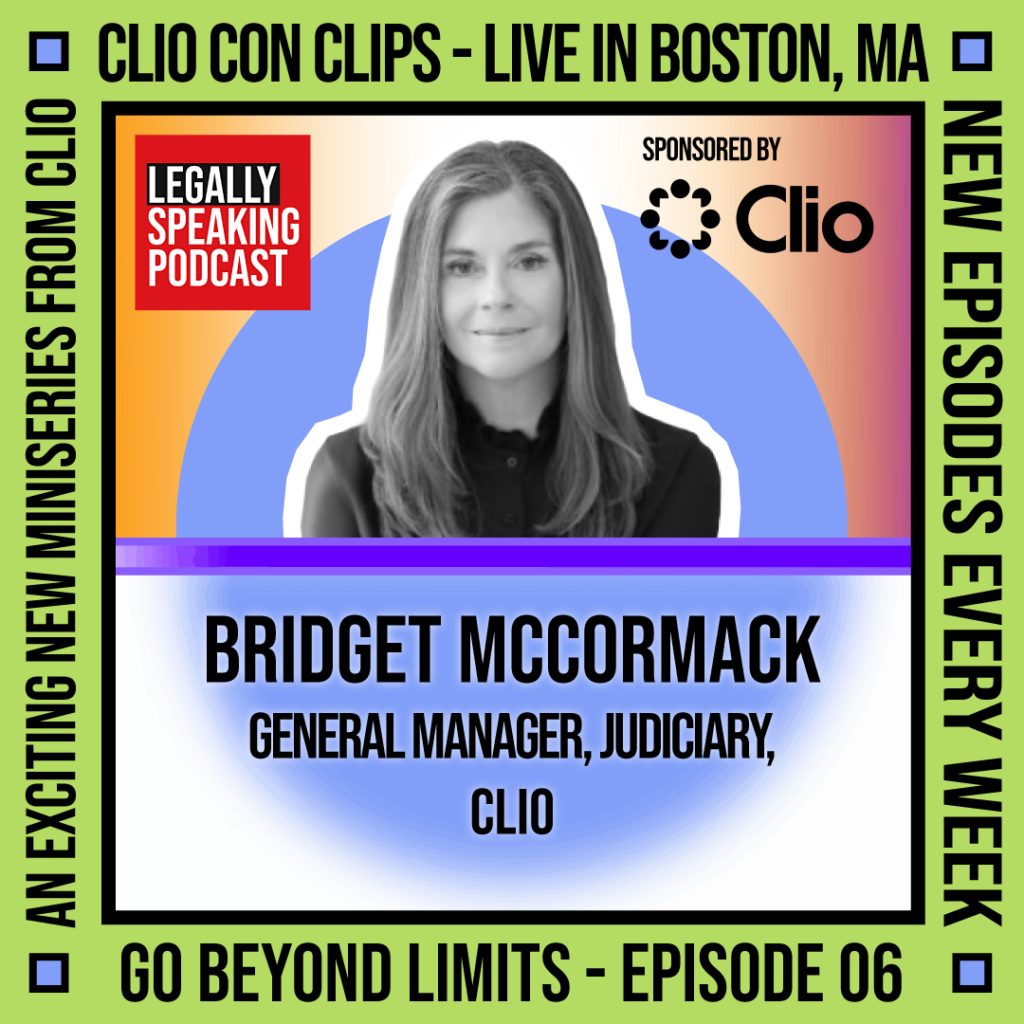
On today’s minisode of Clio Con Clips 2026, Bridget McCormick, Clio’s General Manager of the Judiciary, brings her experience as a law professor who founded the University of Michigan’s Innocence Clinic, Chief Justice of the Michigan Supreme Court, and leader of the American Arbitration Association. In this incredible chat, she explains why she joined Clio to help courts address limited capacity and unmet legal needs—including that, by her account, about 92% of Americans cannot afford help with civil legal problems. She sees AI as a way to reduce administrative friction and manage growing caseloads, while preserving human judgment and public trust through secure technology designed with judges and court staff.
You can Hear Rob and Bridget talking about:
– Expanding Justice Through Legal Tech
– Supporting Courts Through AI
– Preserving & Encouraging Human Judicial Judgment
– Designing Trusted Court Technology
– Transforming Courthouses Into Places of Service.
Connect with Bridget McCormack –https://www.linkedin.com/in/bridget-mary-mccormack-26700b30
Transcript
Robert Hanna (00:00)
Boston, we’re back. Welcome to ClioCon Clips 2026, a special mini-series from the Legally Speaking podcast proudly sponsored by Clio. I’m your host Rob Hanna and we’re back in Boston for our fourth ClioCon once again as an official media partner. What an exciting time to part the global legal community. We’re bringing you exclusive interviews and behind the scenes conversations with Clio’s leadership, legal tech pioneers, Riseman Award winners, and changemakers shaping the future of law.
Groundbreaking developments, legal AI and innovation to the future of our courts and access to justice, we’re getting to the heart of the biggest conversations transforming the legal profession. Expect bold ideas, fresh perspectives, exciting announcements, and practical insights from the people leading the way. So, wherever you’re tuning in from around the world, we’ve got you covered. Welcome to Cliocon Clips 2026. Let’s get into it.
Welcome to the Legally Speaking podcast recording live here in Boston for our Cliocon Clips 2026 series. And joining me is Name, Title and Organisation.
Bridget McCormack (01:07)
Bridget McCormick, I’m the general manager of the judiciary at Clio.
Robert Hanna (01:11)
You sure are, and congratulations on recently joining Clio and what an incredible career you’ve had today. Very excited about this discussion, from obviously helping Michigan Innocent Clinic to then serving obviously as Chief Justice of Michigan Supreme Court, then leading the American Arbitration Association. Now you’re helping Clio bring legal AI into the judiciary. Big, big challenge, big opportunity. Let’s get into it. You up for it? Okay.
Bridget McCormack (01:36)
I’m up for it.
Robert Hanna (01:37)
So you’ve obviously experienced the justice system from almost every angle. I have. What made joining Clio the right next chapter for you personally and what opportunity did you see that others might be missing?
Bridget McCormack (01:49)
I don’t know if I saw anything others were missing, but it certainly was an extraordinary opportunity that I felt like I couldn’t say no to. So I’ve I’ve definitely been I’ve I’ve had a really interesting career and I’ve been able to focus on the ways in which the legal system in the United States falls short of meeting the needs of the public. Um and there are lots of p pieces in that puzzle. Um but an important one is what the courts have the capacity to do. Um I don’t
I know a lot of judges, some of my best friends are judges. Um and uh to a person, they all, you know, wake up in the morning and want to serve the public and they want to serve the public well. but they’ve been pretty overwhelmed for a number of decades. Um in this country about ninety-two percent of Americans can’t afford any help with their civil legal uh civil justice needs. Yeah. And the courts do their best to help them through that. Um
Uh and when Clio decided it was going to, you know, put some real effort behind figuring out how to help the courts and the judiciary with meeting the needs of the public because that’s of course part of and central to a a mission of transforming the legal experience for all. Yes. Um and then they were able to hire uh Pablo Aredondo who I think is sort of the OG of like legal AI.
Um and he is passionate about this particular submission of the big Clio mission. Um and they thought I might be a good addition to the team, which is hard for me to say no to that. I I I d I can’t think of any more um deserving, you know, sort of stakeholder in the in the legal e ecosystem and one that’s underserved right now, frankly, by the market.
Robert Hanna (03:26)
Yeah, we talk about dream teams and it absolutely is a a dream team in
Bridget McCormack (03:29)
Waiting
Populism, I always it’s like uh it’s like I signed up for a neighborhood mixed doubles tournament and like Roth Nadal is my partner. I was like, wow, we’re gonna win. I got Roth.
Robert Hanna (03:37)
We’ve got
Okay, let’s um what about a justice t a system, I guess, that we should never forget? Because you helped establish, as I said in the intro very briefly, the Michigan Innocence Clinic, which secured twelve exonerations during your leadership. So how has that experience shaped your thinking about technology, fairness, and indeed the consequences of getting justice wrong?
Bridget McCormack (03:59)
So I so appreciate this question ’cause it like I
My I I I established a Michigan Innocence Clinic when I was on the faculty at the University of Michigan Law School and it was the first non-DNA innocence clinic in the country. there were lots of DNA innocence clinics and we had learned a lot from those clinics because they both both about sort of the rate of wrongful conviction and the causes of wrongful conviction. And and what was clearly obvious was the kinds of things that go wrong to cause wrongful conviction didn’t only happen in cases where there was some kind of biological evidence to test. Those things go wrong.
In every kind of case. And so we thought, uh, University of Michigan law students are really smart. Let’s focus on those cases where there is no biological evidence. They’re harder. It’s harder to like prove innocence, and which is what you have to do once someone’s been convicted. Um, but incredibly important. And we saw there
Um where those gaps in uh the in the American justice system were having, you know, devastating impact on people, not just the people who are wrongfully convicted and their families, but imagine them a victim of a crime that’s had the wrong person locked up. You kind of want the right person locked up, and then the rest of society, you know. So seeing the the places where the gaps in the American justice system uh needed closing was a really important perspective. I took to me, took with me to the court, and then I did 10 years on the court.
court and and we and and use technology pretty regularly to address those needs. Um but uh but there’s just more opportunity now than there ever has been because of what’s happening with the technology. So it’s it’s a it’s a really nice time to return to that work.
Robert Hanna (05:34)
And it’s gonna have such an exponential impact of that, I I have no doubt. Okay, so you you obviously served as Chief Justice, you know the challenges of the courts, you know, firsthand. If you could then eliminate one major bottleneck in the justice system tomorrow, where what would it be and where could technology make the biggest difference?
Bridget McCormack (05:57)
I mean I think one of the bottlenecks that I have spent a lot of time thinking about and focusing on and which still needs some work is the i is is is is allowing people who can’t afford legal help to to still um have access to justice solutions, right?
Um it doesn’t make a lot of sense that um that just because you can afford a lawyer you have more access to understanding what your legal rights and responsibilities are b on both sides of the both sides of that equation. it I we’re there you know there’s lots of there’s lots of empirical reasons to understand that if everybody had better information and better access to how to exercise both their rights and responsibilities, um economies are stronger and communities are stronger and they’re safer and so there’s like lots of like good in the
barrier to entry coming down. The barrier to entry has come down significantly because of AI, right? That now now more and more people have
um ways to figure out like what the law allows them to do and what it requires them to do. And that’s overall a good thing. Yeah. It does mean that courts are being flooded with um with pleadings. Yeah. That and and and we can respond to that in in in in one of two ways, right? Like you could imagine responding by just building new barriers. Like let’s build new barriers to entry. You could say like no it had to be in this font and it had to be, you know, either ways to like probably shut people out. Or
You could say, what are the ways in which technology can help us manage this like very um e this escalating caseload so that people um actually can get justice? And that’s that’s the question we’re all facing right now, courts are facing right now, and that’s where technology is gonna be able to help significantly.
Robert Hanna (07:38)
Yeah, one thing you were talking about was was obviously the access to the information and I’ve studied the Clio Legal Trends Report, you know, which is f a fantastic piece of just work generally that goes into that. It’s very in-depth. But obviously one of the biggest annual rises in recorded billable time in history, but courts, as we say, don’t necessarily have more judges or capacity. At all. At all. So could we be making lawyers faster and actually make the justice system slower? Significantly. How do we prevent that?
Bridget McCormack (08:06)
Well, I I mean,
Robert Hanna (08:09)
Chicken and egg, I know.
Bridget McCormack (08:10)
Yeah, exactly. I mean we’re we’re already in that world. Like we the the data we have is pretty clear that the filings are um increasing pretty significantly and the state court filings significantly more than federal court filings of course because that more cases are heard there. Yeah. Um and I I I haven’t found a court yet that has that has gotten like extra resources. Like no no legislature has gone to a court and said, like, hey, I see you’re tr struggling. Here’s some money. Here’s some like that’s not happening. We had a judge say to us recently,
in a very, very large trial court. Um we need you guys to succeed because we don’t have a plan B. We don’t have a plan B. We’re not gonna get like twenty new judges, we’re not gonna get twenty new research attorneys. um So we need you to succeed in helping us with like front end um technology solutions to at least
Um getting rid of the noise so we have time to do the human part of the job that we need to do, that we need to keep doing. Um so I think there is like endless opportunity. One of the hardest decisions for my team is gonna be what do we not build? You know, like how do we how do we prioritize um what the courts need, which is more than we can do right this second.
And do it in a stepwise way that we can build on top of what we what what we build today will be a good foundation for what can build from there because the technology’s gonna continue to get better and there’s gonna be c more and more filings. Um so I I think the courts have to be building a foundation upon which they will also be able to construct new services, new ways of responding to incoming, you know, matters and and and handling them.
Robert Hanna (09:50)
Yeah, and I think one thing that goes hand in hand with technologies and conversations trust. Okay. So, you know, you’re obviously helping lead with Pablo, you know, the judiciary business. Uh very exciting time. You’re shaping the technology around that. If I look at this, what will earn the trust of judges and the court leaders? And what safeguards would you never compromise?
Bridget McCormack (10:13)
Yeah, so actually I think this is like the a really a really critical design question for us. Um and one of the reasons why we are pretty committed to designing I mean extremely good designing with the judges and their and their staffs. Like there’s no other way to do it here. Um Jack might have said something about this in his keynote. It it it may well be true when you’re building for lawyers and their clients that they might think they want faster horses and the cars are already here, so you have to build the cars, right? That’s not true in our in our our
Our judiciary business is first of all segregated from their lawyer businesses. We are our own little team doing our own little thing and our security has to be s you know judicial security grade. It cannot be intermingled with the rest of the uh the rest of the uh products that Clio does a great job with. Um and we can’t build cars until courts want cars. We have to build with the courts and the judges, and that might mean faster horses today. And faster horses will
Get folks used to better speeds, which will then allow us to build new functionality along that. We have to build, uh we have to have an iterative process that is really responsive to the judges and their staff who know how to deliver um public trust, which is their whole currency. That’s all they they don’t have an army, they don’t have any money, that’s all they have is trust. And so we might be building faster horses for a while.
Robert Hanna (11:33)
No.
Very good ones and very, very high quality. Everything Clio does is is is absolutely spot on. You mentioned it earlier, access to justice, you know, this access to justice for everyone. Jack talks about it a lot of the time. Um it’s a big North Star for Clio. Um absolutely understand that. So from the research that was shared, just sixty six percent surveyed consumers are comfortable with AI being used in high state’s personal legal matters. Yeah. Yet millions of people actually struggle to access legal help. So yeah, how can AI ultimately close that gap
while giving people the confidence that human judgment and fairness will remain central.
Bridget McCormack (12:09)
I think this is a conversation we’re gonna keep having over the next few years and I have a feeling that there will be like we’ll have more and more data that will shape opinions as technology changes. For now, um there are a lot of there’s a lot of functionality that technology can um can provide to courts and their judges and their staff that are that are sort of like no brainers and and and and and all they’re design all it’s designed to do is to
Um remove a lot of the friction to give the humans that are part of this process the time to do the things that humans should be doing. So if you imagine there are a lot of courts right now, most
don’t have hyperlinking. So pleadings come in, the cases are not hyperlinked to the uh to the citations are not hyperlinked to the cases. The e the exhibit sites are not hyperlinked to the exhibits. Um hallucination detection, for example. You could imagine building building in, and we’re working on this, an ambient functionality so that judges don’t have to drag and drop anything in any other program, but it just like spell check
Um uh does these things that may that allow you as a human judge to do your human judge job instead of spending a bunch of time figuring out like how do I find that case, how do I find that exhibit, did I print it out, did I bring it home, you know. Yeah. You can build in that sort of usability um functionality that’s kind of a no-brainer um foundation upon which you can then build what I would call more robust, you know, services that
Some courts and judges want yesterday and some might not want until tomorrow. You know, there are some courts that right now have zero research staff uh that are already interested in, you know, uh y some of the r reasoning and research and drafting um functionality that’s possible, um, and others that are not. But they all want that that early stage foundational, ambient functionality that lets them do the job that they, you know, swore an oath to do.
And the one they want to do.
Robert Hanna (14:11)
Yeah, and I think Damian Real talked about this in the channel Partner Day, it’s about bringing the fun back, you know, almost to the what you know you want to do and removing a lot of the drudgery and and and so forth. Okay, what are you most excited about in your role over the next twelve months?
Bridget McCormack (14:23)
Oh, I’m just excited uh about the ability to deliver um like high quality services to the this this the stakeholder at the center of
the business of law and the practice of law that I think needs it most. I mean and one I care deeply about. So it’s it feels like a once in a lifetime opportunity to you know, to literally like take an arrow and shoot you like sh hit a bullseye like in this access to justice problem. Um I need And I can’t think of a better team to do it with so
Robert Hanna (14:54)
Yeah, it’s a rock star team for sure. This is your first ClioCon as a Clio team member?
Bridget McCormack (15:01)
It’s my first Cliocon period. I’ve been to every legal tech conference so many times, but not not Cliocon.
Robert Hanna (15:07)
And so describe it.
Bridget McCormack (15:09)
It’s amazing. I mean I had no idea what I was getting into. It’s really impressive. I mean uh ev everything about it is is is really impressive.
Robert Hanna (15:19)
Okay,
imagine we’re in twenty thirty then. Yeah. What’s one change you’d ordinarily expect people to experience when they interact with the justice system in twenty thirty? And what would you say joining Clea and would you say joining Clio is absolutely the right decision?
Bridget McCormack (15:33)
So I think in twenty thirty everyone should be able to navigate a courthouse as a service and not a place, right? So they can figure out what the right door is for them because people come to court with really different kinds of issues, right? And they don’t all need the same front door and they certainly don’t all need the same back door. And and if and if a courthouse becomes a service and not a place, which the technology will
allow um you will have significantly more satisfied um
uh members of your public um because they will be able to come in and out the right door, get what they need and get on with their life. People don’t usually come to court because like something h something happy is going on. There are a couple of exceptions. Like every once in a while we get to like do a marriage or like sometimes an adoption. Those are like happy days. Very few of those. For the most part people are coming in and out into court because something traumatic has happened. Yeah. You know, to them or to someone they love. Um
And right now it’s hard to meet their needs given the volume and the resources. Technology allows us to change that, and I think the team that we have assembled at Clio um has such ambition that we want to be part of building the the the courthouse of the future that is really a service and not a place.
Robert Hanna (17:00)
And we fully support that and I think you’re absolutely gonna achieve that and beyond. I think the team that you have and the ambition and obvious the wisdom you have is very exciting. Uh it’s been an absolute pleasure having you on the show live here in Boston for Cliocon. If folks have been living under a rock, where can they find you? feel free to share any social media handles LinkedIn and we’ll share them with this episode for you.
Bridget McCormack (17:19)
Yeah, I’m on LinkedIn Brid Bridget McCormick. I am on X at Bridget Mary C Bridget Mary Mac. Um and Instagram, Bridget McCormick, I’m everywhere.
Robert Hanna (17:31)
There we go, you can find Bridget everywhere. Thank you so much once again. Congratulations once again on joining Clio, wishing you lots of continued success and indeed doubling down on that mission to transform the legal experience for all. But from now, from all of us here live over and out.
Thank you for listening to this week’s episode. If you like the content here, why not check out our world leading content and collaboration hub, the Legally Speaking Club, over on Discord? Go to our website www.legallyspeakingpodcast.com as a link to join our community there. Over and out.