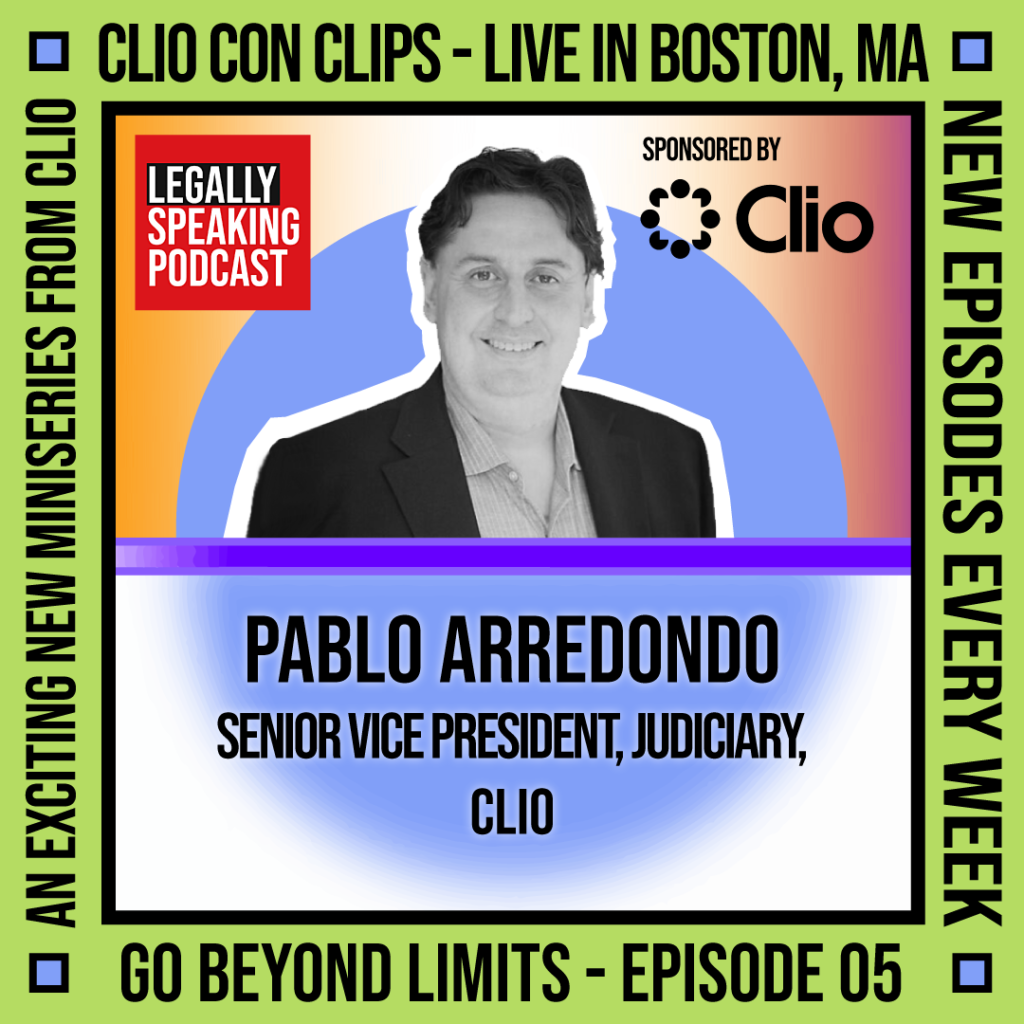
We are excited to be back in Boston for Clio Con Clips 2026! The Legally Speaking Podcast™ returns as an official media partner, bringing you exclusive interviews, fresh insights and behind-the-scenes conversations from one of the world’s leading legal technology conferences. Our Clio Con Clips series features Clio’s leadership, legal tech pioneers, Reisman Award winners and industry changemakers exploring the latest developments in AI, legal innovation, access to justice and the future of the legal profession.
On today’s minisode of Clio Con Clips 2026, Pablo Arredondo, SVP of Judiciary at Clio and a pioneer in legal AI, joins our discussion! Today, we get to explore how artificial intelligence could transform the future of the courts. We discuss the development of judiciary-specific AI, improving judicial efficiency, detecting errors and inaccuracies in legal submissions, protecting fairness and human judgment, as well as the potential for AI to make justice more accessible, accurate and efficient by 2030.
You can Hear Rob and Pablo talking about:
– Transforming the Judiciary Through Artificial Intelligence
– Building AI Specifically for Judges
– Detecting Legal Errors and Inaccuracies
– Protecting Fairness, Ethics and Human Judgment
– Making Justice Faster and More Accessible.
Connect with Pablo Arredondo – https://www.linkedin.com/in/pablo-arredondo
Transcript
Robert Hanna (00:00)
Boston, we’re back. Welcome to ClioCon Clips 2026, a special mini-series from the Legally Speaking podcast proudly sponsored by Clio. I’m your host Rob Hanna and we’re back in Boston for our fourth ClioCon once again as an official media partner. What an exciting time to part the global legal community. We’re bringing you exclusive interviews and behind the scenes conversations with Clio’s leadership, legal tech pioneers, Riseman Award winners, and changemakers shaping the future of law.
Groundbreaking developments, legal AI and innovation to the future of our courts and access to justice, we’re getting to the heart of the biggest conversations transforming the legal profession. Expect bold ideas, fresh perspectives, exciting announcements, and practical insights from the people leading the way. So, wherever you’re tuning in from around the world, we’ve got you covered. Welcome to Cliocon Clips 2026. Let’s get into it.
Welcome to the Legally Speaking podcast recording live here in Boston for our ClioCon Clips 2026 series. And I am joined by Name Title and Organisation.
Pablo Arredondo (01:07)
Pablo Arredondo, Senior Vice President Judiciary at Clio.
Robert Hanna (01:11)
It’s an absolute pleasure to have you on the Legally Speaking podcast and congratulations on recently joining Clio as well. You’ve absolutely been one of the pioneers in modern legal AI, that’s for sure. I’ve followed your journey from afar, so it genuinely is an honour to have you on the show. Let’s talk about co-counsel to the courtroom to start with, okay? Because you’ve already helped transform how lawyers use AI. What made you turn your attention specifically to the judiciary and what’s the opportunity that excites you the most?
Pablo Arredondo (01:39)
So it’s funny, um I actually can trace back some of my AI judiciary efforts to way before Chad G V T there was an earlier language model called BERT. Okay. And we had built something called Parallel Search. that was just a little Bert based search engine that, you know, could transcend keywords. Right now of course now by today’s standards that’s so quaint. And I remember when we saw the user logs that courts were using it. You know, we saw the.govs and kind of things like that and just this feeling of
How cool it felt to be making a difference for the actual adjudication for actually like finishing things. And after we got early access to GBT four and it sort of just launched co-counsel, I met with the Chief Justice, then Chief Justice of the Massachusetts Court of Appeals, Justice Mark Green, and some of his colleagues, and we started talking about like, okay, how could we use AI to do this or that? And so we ended up working on a a streamlined uh
system for eviction of appeals. You know, doing nothing so cont that controversial, right? But just sort of doing it. And again, just that amazing feeling of like helping judges save time. It’s just, you know, as a former litigator, there’s just something innately very uh satisfying about that. And so then we continued to prototype um with them using reasoning models that could do fancier things. And um you know I guess to me it’s just something that it’s so important we get rights.
It’s endlessly fascinating, right, to think about the different uh tensions that are at play when you’re doing it. But also kind of builds on a lot of the skills and, you know, expertise that we developed building legal tools for for lawyers. So, you know, a lot of different dots of my life connected uh to come together for it.
Robert Hanna (03:21)
Yeah, and it’s a very exciting time. You’re putting together a a dream team over at Clio, but you’ve spoken about the extraordinary volume of information entering the court dockets. Clio’s latest legal trends report now shows recording more billable activity as AI adoption grows, which is interesting. Could AI make judges’ workloads harder by making lawyers more productive? And if so, what’s the solution?
Pablo Arredondo (03:46)
So there’s no could about it anymore. It’s happened and it’s happening. Both lawyers and pro say litigants. I think this study was out of USC, I wanna say. I think there was one other call collaborator, but you know, filings are up, n more lawsuits, in those lawsuits there’s more motions filed, and in those motions there’s more arguments being brought, right? So sort of at every level where you could suddenly increase Hello. All right. So uh
Uh it’s absolutely we’re I think the just the first few drops of what’s going to be a um monsoon. Uh and so I think it’s a very critical time right now for courts to begin to put into place technology that can help them with exactly that kind of problem.
Robert Hanna (04:28)
Yeah, agreed. And Jack said in his keynote, uh judiciary grade, we should trademark that. That was good. But for folks that may be less educated on this, you’ve argued again that the courts need technology specifically designed for judges, not just repurposed tools for lawyers. So what makes judiciary grade AI fundamentally different and which standards should be a non negotiable?
Pablo Arredondo (04:50)
Right, and to be clear, I mean I think uh for a lot of these dimensions we take it just as seriously with attorneys as you would security and privacy really matter. But judges, you know, for one thing, judges are not advocating a certain side, right? They’re looking at the entire motion cycle, the opening, the opposition and the reply. Yeah. And so, you know, it’s a different uh information posture, if you will, in terms of what you’re trying to to find for them.
Um they’re often working on many more cases at a time than a lawyer, right, who would would be doing it. there’s just different flows in terms of uh clerks and the way they interact with the clerks versus uh research attorneys. So there’s sort of sometimes different nuances to the the way that things are staffed. Um I think that they’re most of all they’re completely overburdened, right, with how much stuff is coming in, and so I think um you know that’s a difference. Uh and
Obviously privacy and security s security are of utmost concern. So some of it is just, you know, the stuff that’s there inherent in doing law. Yep. But there is a lot of it that I think is directly about judges. And also it’s about what not to show, right? Don’t show deposition tools. Yeah. Right. Don’t show billable hours. Right, like you we need to I and my hope is to create an environment that’s just for judging, right? And then to not have things that they don’t need just adding noise.
Robert Hanna (06:08)
Very true, particularly there is a lot of noise out there. Um one thing Clio has been very aggressive, I’d say, in recent years is acquisitions, right? And I think Clio is connecting legal intelligence, court information, AI, while its new platform can understand context and carry work forward for lawyers. So with LearnHow now, obviously part of Clio, what’s one opportunity you’re most excited to unlock for the judiciary?
Pablo Arredondo (06:30)
So I think there’s two things that I really want to focus on right now. So one is what I’d call ambient error detection.
Robert Hanna (06:36)
I like that. Tell us more.
Pablo Arredondo (06:38)
I I um you know, I I think that uh if you look at a sort of a chart of how controversial and how useful, right, is two different dimensions, right? There’s a lot to be genuinely, you know, um uh
concerned about it, the top right are the most concerning things we could do and there’s a lot of very powerful things you can do. But there’s also very useful things I think that are less controversial. So I think that if a brief has hallucinated sites, it’s okay to flag that for the court automatically. If a brief has the wrong pin site and so it’s like, you know, the judge would have been wandering around saying, where is this thing? I think it’s okay to suggest the right pin, you to to at least flag it and let you see it.
Um and so I think that what I what I hope to see is a world where the courts sort of are protected, everything flying in, there’s an AI layer that will find gross distortions of the record, misquotes, these sort of objective things. Yeah. Um and so that that’s something that excites me a lot. And uh, you know, on the other side of the spectrum, you know, there’s early attempts with certain judges who want to see how can this help us, you know, guiding our decision process.
Never deciding but helping just kinda tee up and facilitate my decisions. And I just think there’s a tremendous amount of work that’s gonna go into that as well. Yeah.
Robert Hanna (07:54)
And you’re doing a tremendous amount of work. I think one couple of things that get banded around a lot is around ethics and judgment. So where I want to go now is you’ve ex well, we know explored for centuries the of judicial um ethics through your work with obviously Cornell’s Legal Information Institute. But what did that history teach you about redesigning modern AI and where should technology never replace human judgment?
Pablo Arredondo (08:16)
Hey, it’s not clear to me that at least the rabbinical history that we studied would preclude completely for certain matters if there was user consent, like litigant consent, right? So so I don’t I don’t know if there’s anything that extreme. Um but that said I think you know the some of the things that they would look at in in rabbinical systems, like if a judge had been flattered by one of the parties, that was considered enough to bias them.
Right. And so you know, this really sensitive sense of like not messing with a judge’s discretion. And so then when you bring in something like a an AI system, it’s like that I think they would look at that as a rather seismic shift in in what they’re doing. Um so I d I do think, you know, it’s uh Bridget and I were kind of laughing, like looking at like, you know, what are the design principles that you would get from
looking at centuries of of judicial ethics. Um but you know a lot of it I think you don’t even need the centuries. So just you know, think if it was somebody you cared about. What environment would you want the judge to be in when she was reviewing the case, right? You would want her to have an easy way to navigate between the brief and the exhibits. You would want her to have a layer of intelligence that was catching if there were these kind of mistakes.
Um and you’d want calm design without a bunch of noise distracting her. So I think that’s another way to kinda look at it is just like think about it if it was something that impacted you personally, how would you want the judge to be able to proceed? And if you look at what current technology is, I think it’s very far from what you would want uh to have your case resolved with.
Robert Hanna (09:51)
Yeah. Well I guess leads on an extension to where I want to go in terms of, you know, courtroom AI and whether it’s working. You know, AI can obviously help judges research, organise records, understand complex submissions, but how do we measure genuine improvement in fairness, accuracy, and access to justice rather than simply simplifying the processing of more cases?
Pablo Arredondo (10:13)
It’s a really important
question. And again, I I think it dep I think those are three different ones with different answers, if you will. Yeah. you know, accuracy. So a couple of things on accuracy. So first, I think we also have to remember that humans don’t have perfect accuracy either.
Robert Hanna (10:27)
I must say, it might shock you I’m not perfect.
Pablo Arredondo (10:30)
Actually, the the master of the roles over back in England. I guess the number two judge has actually yeah, I have a slide about this, you know, talking about look, we can’t compare it to this platonic ideal of perfection. We have to be like really what’s happening right now. Um, but I think that at least for the foreseeable future, uh I believe oversight will be a critical part of it. I don’t see any system that I would trust completely to go off and just do things. Right. Um, but uh you know, the question is, you know, how much oversight is needed for what’s
specific task and I think we’re just recalibrating this constantly as we’re as we go. Um but the you know in terms of what’s fair it’s interesting that there’s you know studies that look at party satisfaction and you can actually even if the outcome was in your way if you felt that you were heard, if you felt that you were see kind of seen given your fair dance court you know you’d be amazed how big an impact that has on your satisfaction even if you lose, right? Yeah. And so the question then, you know, can you sort of cut both ways. On one level
Like you brought out the state of the art fable to review this every single line right and you could feel more heard. Yeah. Or you might feel that you were just passed off to an AI system, right? So I think again a lot of it’s in how we design things. I think we need to think about litigant psychology. Um and uh but you know, the truth is these models are getting good enough that for accuracy I think they can hold their own, certainly with clerks. Yeah.
Robert Hanna (11:55)
I agreed. I’m gonna get you to get your crystal ball out now and given your track record, I’m gonna be really curious to see this. We’re in 2030, okay? You’ve obviously helped shape major breakthroughs in legal AI over the years. What’s one thing judges could routinely be doing with AI by 2030 that sounds perhaps extraordinary today?
We’re going beyond limits is the theme, so
Pablo Arredondo (12:21)
So
you might start to see for certain types of matter. Okay. Lemon law or something like that. You know, lemon very high volume that it’s sort of like a Waymo setup where like it’s not that there’s no human involved, yeah. But there’s like a human who’s just there to be flagged if something weird happens, but mostly they’re just watching it happen, right? Um again, I think with litigate consent, I think you might see something like that. So it is possible that there’ll be some aspects of this where
they actually prefer the the the speed and the low cost and you know for whatever reason. I think it’ll be very different in things like criminal law and you know family law other aspects of it I it’ll be slower. So yeah, if you if you said what’s the most like I can ency in envision it would be something in that in that in that fan
Robert Hanna (13:07)
Interesting. Okay, this is your f first Clio Con as a Clio team member. Yeah, absolutely. How’s it been?
Pablo Arredondo (13:14)
It’s been
amazing. this conference is something that I mean I remember Jake and I being so blown away when we came to the first Cliocon and realizing like that, you know, wow a startup can do this? Like you know like this. Um they’re always so much fun and I I’ve had the pleasure of being at a couple of them and uh this one’s great. This one feels amazing. Yeah.
Robert Hanna (13:32)
It’s
an exciting time. Okay, last question. What are you most excited about in terms of your role over the next 12 months and the impact you’re going to have with Clio?
Pablo Arredondo (13:40)
Well, it’s just so great to be able to focus a hundred percent on the judiciary. first nobody makes me talk about transactional law anymore, which was always a pain about the systems. Uh and uh I think um I’m you know most excited I think is to you know, again, I it’s not let’s necessarily go find the most controversial, spectacular kind of thing, is what are the like easy wins that help a lot of courts around the country. Uh uh and I think that that that sort of ambient error detection I think would be really
I feel very good if they were left all over the place we were just catching all these mistakes uh and saving a lot of time and irritation.
Robert Hanna (14:18)
Here’s to that. Well look we wish you every success. Um Pablo, if people want to know more about the work you’re doing, um where can people find you? Feel free to share any social media handles and we’ll show them several
Pablo Arredondo (14:28)
You
know, I mean you can do LinkedIn, you can email Pablo at Clio dot com. There we go. em
Robert Hanna (14:32)
Simple as that. It’s been an absolute honor hosting you live here. Thank you so much.
Pablo Arredondo (14:36)
My pleasure.
Robert Hanna (14:36)
Wishing you lots of continued success and indeed doubling down on the mission to transform the legal experience for all. But from now, from all of us on the Legal Speaking Podcast, sponsored by Clio, over and out. Thank you for listening to this week’s episode. If you like the content here, why not check out our world leading content and collaboration hub, the Legally Speaking Club, over on Discord? Go to our website, www.legallyspeakingpodcast.com. There’s a link to join our community there. Over and out.