“There’s a very different skill set in leading people remotely.” – Adrian Bell
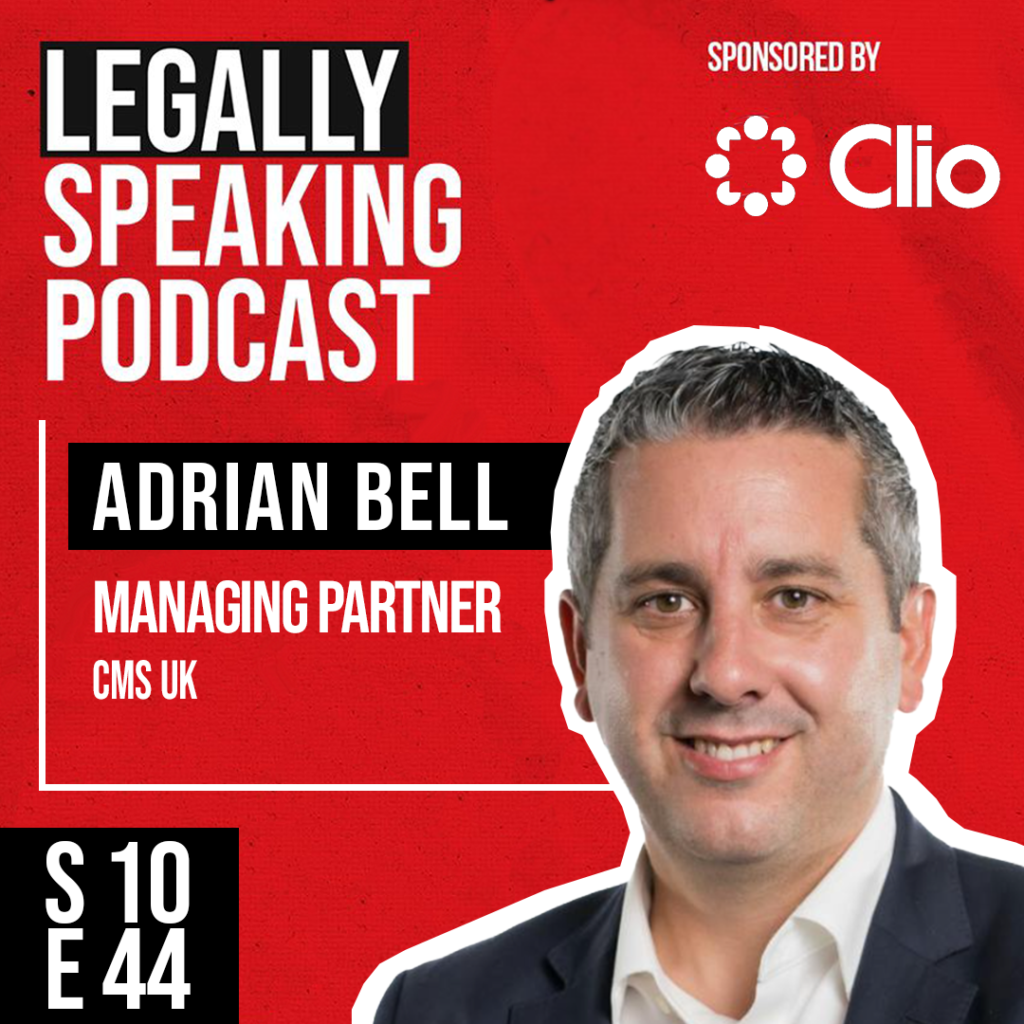
On today’s Legally Speaking Podcast, sponsored by Clio, I’m delighted to be joined by Adrian Bell. Adrian joined CMS in 2002, building a career spanning international disputes, business development and law firm leadership. Before becoming Managing Partner, he was Co-Head of CMS’s Infrastructure, Construction and Energy Disputes Group and Managing Director for Asia and the Middle East.
During his leadership of the Asia-Pacific and Middle East regions, CMS expanded its international presence, opening offices in Abu Dhabi and Riyadh. In April 2026, Adrian began his 4-year term as Managing Partner at CMS, overseeing the UK, Middle East, Asia, Central Europe and Eastern Europe. Today, we will explore Adrian’s journey from practising lawyer to Managing Partner, leading an international law firm, the challenges of balancing commercial success, and his vision for the future of CMS.
So why should you be listening in?
You can hear Rob and Adrian discussing:
– From Lawyer To Managing Partner: Adrian Bell’s Journey Leading CMS
– The Business Of Law: Driving Growth and Building Client Relationships
– Leading Through People: Attracting Talent and Building Strong Teams
– The Future of Law: Embracing AI, Technology and Innovation
– Building a Legacy: Leadership, Confidence and Learning From Failure.
Connect with Adrian Bell here – https://uk.linkedin.com/in/adrianjamesbell
Transcript
Rob Hanna (00:00)
Not every relationship is gonna give you an instant return. What I like about CMS, you’ve got really good expertise, but people are just really responsive and they get back to us and they give us the quality of service, the responsiveness that we really value. Invest in relationships, some of them for the longer term, be inquisitive. People should try new things. It’s not just AI and innovation, it’s new ways of doing things, get people to push the boundaries and to fail fast. You won’t get everything right, but learn from what you don’t get right and sort of develop and pick yourself up and move forward.
Adrian Bell (00:29)
On today’s Legally Speaking podcast, sponsored by Clio, I’m delighted to be joined by Adrian Bell. Adrian joined CMS in 2002, building a career spanning international disputes, business development, and law firm leadership. Before becoming managing partner, he was co-head of CMS’s Infrastructure Construction and Energy Disputes Group and Managing Director for Asia and the Middle East. During his leadership of the Asia Pacific and Middle East regions, CMS expanded its international presence.
Opening offices in Abu Dhabi and Riyadh. In April 2026, Adrian began his four year term as the managing partner at CMS, overseeing the UK, Middle East, Asia, Central Europe, and Eastern Europe. Today we’ll explore Adrian’s journey from practicing lawyer to managing partner, leading an international law firm, the challenges of balancing commercial success, and his vision for the future of CMS. So a very big warm welcome to the show, Adrian.
Rob Hanna (01:21)
Thanks Rob. Great to be here.
Adrian Bell (01:23)
Absolutely pleasure to have you on the show. And before we get into your illustrious career and all the great stuff you’re doing at CMS and beyond, we’ve got a couple of serious icebreaker questions. First things first, what’s your favorite beverage and your preferred choice of footwear on a typical work day?
Rob Hanna (01:39)
well think beverage is a tricky one and it’s very much seasonal dependent for me. So now we’re moving into the autumn, it’s a glass of Malbec. If you’d asked me a few months ago it would have been a nice cool glass of lager. again very much dependent. Um I’m working from home today, so I’m wearing a pair of crocs.
Adrian Bell (01:55)
I am amazed and I’m not just saying this Adrian the amount of guests that we’ve had on that are flashing the Crocs. They are definitely winning, I think, on the typical football.
Rob Hanna (02:04)
They’re really versatile, aren’t they? I mean you can just slip them on and off as you sort of go in and out and I think um although if I was in the office I’ve got a trusty pair of Hugo Boss black leather shoes that have lasted me definitely since pre Covid. So I feel it’s probably time for an upgrade, but they’re very comfy, so yeah, I alternate between the Crocs and and those shoes.
Adrian Bell (02:23)
Good for you. Okay, and another quick five before we get into it. What’s one piece of legal technology or everyday technology you now rely on that you would have thought unthinkable at the start of your career?
Rob Hanna (02:35)
Um my latest bit of technology is hardware. I know sort of some of your guests give their usual Harvey answers, but I’ve just invested in uh Remarkable Pro um and the sort of A five version. So I’ve replaced my uh trusty notebook um and it fits in my suit inner pocket, which is very handy. So it wouldn’t be anywhere without it these days.
Adrian Bell (02:55)
Love that. Yeah, that’s a great tip. I’m sure people will be catching up on that one. Um thanks for sharing. Okay, Adrian, let’s let’s talk about you, your journey from obviously studying law and business at the University of Warwick to then joining CMS in two thousand and two, building a very successful international disputes practice and ultimately becoming managing partner of the firm. Talk us through it.
Rob Hanna (03:14)
Yeah, well was saying to someone the other day, I think sort of when I started out, um my dad was um a magistrate. So um when I was from about fourteen decided it would be a good idea to go into the law, albeit obviously that’s more the criminal side. I I quickly realised there wasn’t as much money in that side of things. So it’s um but it gave me a sort of taste for the law early stage and then did a Lore A level again, sort of many people do because they want to sort of test out whether actually they’re gonna like it. Um
did quite like that bit, but but also I did an economics A level and I I realised at an early stage I found actually the business much more interesting than the law. Um so I went off to Warwick and it was one of at the time one of the only universities that did a sort of joint honours in law and business. Um I was conscious I didn’t want to spend too much time doing the law, but equally I wanted to make sure it was a qualifying law degree, so I didn’t need to do an extra year at law school. so I was quite sneaky in that respect. Um but really enjoyed the business side of it. So I think, you know, again fairly uniquely um
came into CMS as a trainee, always at even from that early stage in two thousand two, thinking, Yeah, one day I might want to be a managing partner. Um so I haven’t necessarily sort of fixated and designed my whole career around it, but I think um yeah, I did have that early indication that sort of the business of the law was much more interesting to me than the sort of law itself.
Adrian Bell (04:31)
Yeah, and obviously I appreciate that. So we’ll talk about that a bit later on. A huge part of what your role as a managing partner will be around. Just sort of going back, just to get our listeners to understand a bit about your decision making and thoughts at the time. You’ve kind of touched on what inspired you to have a career in the law, that sort of family connection. But why did you choose your area of law specifically? Because you’ve been very successful in infrastructure construction and energy disputes. And perhaps just give us a bit of a flavor of that for some of our guests who may not be too familiar with that part of law.
Rob Hanna (04:59)
Yeah, again it wasn’t sort of intentional. So um I started off my training contract actually um doing a seat in corporate, which I really enjoyed. Um I was lucky enough to um go overseas, so I did um what was supposed to be a first six months in Prague, but actually turned out to be nearer a double seat. So I did about ten months in in Prague and in Bulgaria doing a bank privatization. So I had a very um a lot of responsibility from a very early stage and worked for a great partner out there who sort of
trusted me to run the team on the ground. So from then on I thought, right, I’m gonna be an MA partner, I’m gonna come in, I’m gonna do the big deals, you know, I’m gonna be a big hitter. Um and at the time I’m not sure if it’s still the case, but you had to do six months in a contentious seat. So I left my contentious seat to my fourth seat at CMS because I thought, you know, I don’t really want to do it. I want to be this big picking transactional lawyer. Uh and then when I went into my fourth seat um to do disputes,
Um I just absolutely loved it from day one. Um again worked with a really good supervisor. Um we worked really hard, so we were in the middle of a big construction arbitration. Um he was an absolute workaholic, which, you know, probably could have put you off as much as making you love him. I remember um we were sat there on New Year’s Eve, um, preparing for this arbitration hearing we had coming up, and I plucked up the courage to say to us at half eleven at night.
Is it okay if I go out and meet my mates? Because they’re in the pub. He said, Yeah, yeah, fine, fine. And then the next day when I went in, or or two days later, whenever it was, I Tomorrow, what did you do to celebrate sort of New Year at midnight? And he said, Well, you know, after you left, next thing I realised it was three o’clock in the morning and I went home. So, you know, we worked on we worked really hard, but it was really fulfilling. And I think the thing I particularly like about sort of construction infrastructure um is
Yeah, you can you can feel it and you can see it, I think, which is quite unusual for many of the sort of laws that we practise. You know, the big sort of ticket disputes work obviously is a bit sort of hard to visualise. Whereas, you know, we were di working on roads and railways and airports in some quite unusual countries, so often got to do some site visits and that’s really what gave me sort of a taste for getting into that area of law.
Adrian Bell (07:08)
Yeah, and obviously you’ve been hugely successful throughout your career and I can see you’ve had, you know, strong ambition, you’ve had good people around you that have inspired you, perhaps pushed you as as well. Um upon joining CMS in two thousand and two, obviously you’ve been with the firm, you’ve experienced the evolution over more than two decades now. What attracted you to CMS originally? What was it about the firm that’s also kept you there?
Rob Hanna (07:31)
The honest answer is I made twenty five training applications um and that was the only offer I got. So um uh it’s fair to say that I wasn’t necessarily sort of honing in on CMS um at that time. You know, I’d been through university, I just wanted a training contract. Um, albeit that when I did go for an interview there, I did get a number of interviews, um I did have a sort of particularly positive
feeling about it. That’s why I joined the firm. It was the only option. Um but I’m really pleased that I did. And over the years, you know, like like many people, I’ve had some opportunities to to move elsewhere. I’ve sort of had approaches from other firms. But having sort of carefully considered those at the time at particular junctions of my career, you know, I’ve always come back to the fact that I really like CMS, I really like the people, the DNA, I think it’s an ambitious firm. And for me doing sort of the international construction work, yeah, we managed to get
It’s a tier one in terms of what we did. So there was sort of no better firm for the type of work I was doing i in my mind. Um, which was pretty exciting. But you know, as I said to people, don’t think I lack ambition just because I’m still here. I did sort of look at other opportunities, some pretty seriously, but always came back to the sort of better the devil you know in a sense.
Adrian Bell (08:41)
And there’s something in that for loyalty. You know, my my older brother, you know, is in the the property space and he’s been with the same organization since since a graduate, first job and now director that does all the various things. And I think, you know, obviously we I talk a lot about building blocks actually with your career moves and every move you make can you know as a building block, you’re adding skills and transferable experience. But actually, if you find the environment, you find the firm that’s right for you, it presents the opportunities, you put your hands up, you have that ambition, and good things happen, and you’re a great success story.
For that, I want to talk from lawyer now to leader, because before becoming managing partner, you were co head of the CMS infrastructure, energy and construction disputes practice. How did that specialist practice prepare you for the role of managing partner, if at all?
Rob Hanna (09:22)
Yeah, so so that was a sort of feature of the three-way merger that we did with Nabara and Oldswang. I was running essentially I was the only partner in doing construction disputes at sort of the legacy Cameron McKenna firm. We merged with Nabara and Oldswang and sort of ended up co-heading that. So it was a sort of merger of three teams, albeit there was only one person from Oldswang. And I think bringing all those people together, I think, needed quite a lot of planning and I think it brought quite a lot of leadership skills. Cause we had to there lots of people um
didn’t necessarily see sort of the overall prize that we were trying to achieve. So we we we came into it setting some pretty ambitious targets. Yeah, we we told people what we wanted to get the revenue to in three years. And we really tried to inspire people and get them bought in to this context. So I think, you know, in that sense it was good. And also at the same time I was doing a sort of overseas leadership role. So I had the two that complemented each other. I was looking after Middle East and Asia. Um
And again, sort of the the the the reason I was given that role is because I sort of helped set up the office in Dubai and that was really sort of led by my clients who were very active in the Middle East and they said, you know, we really need CMS here on the ground. So that was the sort of background to setting up that office. So wearing well having those two leadership roles I think complemented each other very well. I think there’s a very different skill set in leading people remotely. People in the Middle East and ABAC, I wasn’t on the ground. So you have to
You have to sort of get people bought into a very strong vision, uh, so they can co covalence around that. ‘Cause I think otherwise the risk is that particularly kind of that remote leadership, that people just go off and do their own
Adrian Bell (10:53)
Yeah, I think that’s a really important point. And you make a big point, you know, that the meaner disputes um business is it’s big business. You know, you’ve got to get out there. There’s a lot of work out there and it’s only going to continue to grow. Um, okay, becoming managing partner now, you know, you began your four year term, I think, in April twenty twenty six. So what was your initial reaction when you were appointed? Um, what appealed to you about taking the role?
Rob Hanna (11:14)
What appealed to me about taking role is is just the business of law. I think I’m much more interested in sort of running a law firm and the mechanics and the sort of fundamental sort of business skills that you need um to essentially make money. You know, I’m I I would regard myself as being pretty entrepreneurial. I think if I hadn’t become managing partner, um, and this is a sort of plan B that I was looking at pretty actively with others, I probably would have left the firm and set up my own firm because
You know, I have that entrepreneurial instinct. I’m always looking to build business. And I think, you know, in that sense, that’s why I wanted to go into this role because you know, having invested so much of my career and time and energy um in CMS, I felt it had immense potential to to to move up a level um and to be a better version of itself. So so that was kind of why I wanted to do it. It was a pretty tough process, I think, in terms of it was a contested election, there were four candidates.
Before it officially started, obviously he kind of unofficially started. So the the contest itself probably went on for about six to eight months. Um and the way it worked is sort of the person who had the fewest votes got knocked out, and then you kind of moved to the next phase, and the the phases were kind of a a week apart. So when I um in in the first round I knew sort of it was five o’clock on this Wednesday, we were gonna find out one way or another. I was actually in Cornwall because it was half-term with my family. Um
And my partner had booked this restaurant. She was very delighted with us. She’s like, I booked this restaurant at five o’clock at night. I’m like, Oh no, that’s find out. You know. So this this meal could have gone way one way or another, but um and I was looking at my phone waiting to to ring and it the senior partner rang about twenty past five and said, good news and bad news. Good good news is you’re through, bad news is there’s another round. So then sort of fast forward a a week
Um around the same time the week after. It was actually my daughter’s birthday party and I was c came home early to attend it. Um was upstairs getting changed and it sort of got to around the same time. I thought, well the phone hasn’t rang, that’s weird. You know, maybe I’m not through this time. Maybe the senior partner’s going through kind of the the people in order to get to me at the end. And then sort of finally the phone rang and he was like, yeah, congratulations, you made it through. At the same time and everyone was shouts at me downstairs saying, What are you doing upstairs? We need
The party started. So um yeah, I had to sort of obviously exceptionally delighted, but then had to sort of go down and flip into being dad mode and be the sort of, you know, the the fun maker at the eight year old’s birthday party.
Adrian Bell (13:41)
I think that’s refreshingly honest. And thank you for sharing. That is the reality. You know, you’re a you’re a city executive at the top of your profession. And sometimes that’s just that is real life balancing. You know, then you are dad. You know, you want to be there for you, you want to be present. The fact that you’re there, I think is fantastic given the other demands. So I think that’s a great story. And great that you mentioned Cornwall. Shout out to Cornwall. My mum used to run a tea shop down there at Port Isaac and Fisherman’s Friends and all of that. So very fond of Cornwall. So uh yeah, before we go down that rabbit hole, I’ll leave that there. New level, new devil, right?
You’ve kind of gone from partner to managing partner. But just before we talk a bit more about what a day in life looks like, what did you actually do to prepare to get through those levels? For people who might have similar ambitions to you that might be thinking, I can go out and do this myself. You know, boot seek firms are easy to pop up and do nowadays. What did you do that got you there at one of the best firms in the world that would be helpful for other people to understand?
Rob Hanna (14:30)
It’s a of combination between sort of lived experience. So I always look for those roles that I could take on and and demonstrate my kind of leadership and managerial experience. They obviously started off being much smaller roles, but they were things that I could still do, you know, even sort of very early stages. I offered, for instance, to sort of take on a particular B D initiative and to show leadership. So I think one thing I would encourage people to do is to take those early opportunities, even if they’re fairly small, pro prove your kind of worth and that you can do it.
And then sort of the the bigger ones I think will sort of lead from there. But in terms of actually preparing for the job, also I did quite a bit of um you know going off and reading. So you know, I’m in my home office now. I’ve got um if you can see it to my left, a bookcase full of lots of management leadership books. Um well actually part it’s half management, half leadership and half Lego models, because I’m a big Lego builder. So you know, e every year I build myself a big model and now I’ve got somewhere to pick it.
put it on my bookshelf. So it’s a combination of things. I I I enjoy reading, I enjoy listening to podcasts about management and law firm leadership. Um but also I think going back to the day job, it was about creating um you know a solid business. Because I think you know if you are going to take on a role such as this managing partner, I think you have to have a credible client following. I think you need to be building up that really strong core business. So when I said I didn’t like the law too much, yeah I still did a lot of it.
you know, I built up these client relationships and I built a strong practice that, you know, went up the rankings and and other things. So I think y it’s much easier to have a lot of the more complicated, difficult dis discussions and conversations you need to have with partners in when you’re a leader, if you’ve had that strong practice in the outset. I think it just gives you that kind of authority and credibility.
Adrian Bell (16:15)
Well said. And I’m I’m loath to say the corny phrase, but it’s such a true example of your network is your net worth. You’ve been building right at the start of your career and you’ve been very intentional about that. And it’s almost become habitual. And as a result of that, you know, you’ve probably been operating at the level. I always say to people, if you’re looking to try and go for the promotion, operate at the level already. So it’s almost a no brainer and you’re ready for the next level and the next level, the next level, and you were clearly doing that. Before I completely sideways this podcast, Lego, what’s been your favorite model that you’ve uh you’ve built? Gotta ask. I’m a Lego fan over here as well.
Rob Hanna (16:45)
Well, I’m in sort of the the at the moment I’m building a lot of the the big cars. So this Christmas I built the AMG four wheel drive, the big orange Mercedes, which is good. Although last year I was sidetracked, I had to build the home alone house ’cause my one of my kids got it and he was like, Dad, can you help me? And then I sort of get in the zone over Christmas and do sort of two or three day build. So vehicles are my thing at the moment. Um although one of them I’m just uh a as you said sort of what’s on you but I kinda looked to the side, one of them’s gone missing, so I suspect one of the kids has taken it. So
I’m gonna have to go and reclaim that from a bedroom later on, and hopefully it’s still in one piece.
Adrian Bell (17:19)
Yeah, and I’m sure the Legoland visits fun for all the family, literally. And and talking of AMGs, I’d encourage folks to check out we did a legally on the move, Drive to Thrive series last year at Mercedes-Benz World and we did track days and we did some interviews with AMGs and with some of the um the bigger cars. So go and check that out on our previous mini-sodes on the Legally Speaking podcast. Okay, back to life as a managing partner. What does a typical day look like for you?
Rob Hanna (17:44)
There isn’t a typical day. I think that’s that’s part of the excitement of it. I was saying to someone the other day, I mean, I can wake up thinking I’m gonna do this, this, this, and this. At the end of the day, it’s been completely different. I think it’s complete variety. Um, one of the things I’m trying to do is make sure that I still sort remain very accessible. So, you know, I lot I I’ve enjoyed traveling around to the offices. I want to hear from both the partners, the fienders, the business services colleagues. Um, but there is no one day that’s the same. I think, you know.
Some days I’m lucky enough to get some food to eat. Some days um yeah, I’m desperate for the toilet at the end of the day because you just literally and back to back. Um get a lot of curveballs thrown in during the day, you know, you have to reschedule. I’ve I’ve got a terrific MPA who’s sort of constantly juggling my diary in a way that um I couldn’t possibly do. Um yeah, even to the extent sometimes I’m gonna join a call and it’s a different call to the one I was expected because she’s had to sort of move things around. But um
I think the thing that is constant is yeah, there is a lot of human interaction, particularly with with partners. I do spend a lot of my time talking to partners and particularly about you know how I could help them grow, how I can help them with clients. Um I try not to sort of spend all my life getting drawn into sort of the operational parts of the business. And I think one thing I’ve done different from the previous managing partner is introduce a COO. So I brought somebody in to to look after the operational side because
You it is quite a complex business. I didn’t want to spend all my time doing that. I wanted to make sure I had somebody doing that to also free me up to spend time with partners, clients and and other stakeholders.
Adrian Bell (19:16)
It’s a really important point. It leads nicely to where I wanted to go next in terms of actually the realities of running a law firm, because being an excellent lawyer and running a successful law firm are very different, aren’t they? So what do you think are some of the misconceptions or the biggest misconceptions individuals have about the role of managing partner? And what challenging decisions does a law firm leader have to make that others may not necessarily be overly aware of?
Rob Hanna (19:38)
think some of the most difficult decisions relate to partners. I mean, you know, whilst you’d like to think that sort of it’s all plain sailing, we’ve got five hundred and thirty eight partners. There inevitably issues come up. It’s a people business, you know, if it’s not just partners, it’s Viennals or other people. Some of them are you know nice, joyful things you can get involved in and you can celebrate. Some of them are tricky things that you know, not many things keep me awake at night. I think the people things do, you know, when you know some of the decisions you’re gonna have to make for the right reasons in
the right interests or best interest of the business, but have such a personal impact on people I find you know quite challenging and that obviously is one of the toughest parts of the job. But I mean the other thing is that I think I I have a coach now which we may come on to in a bit, but my coach said to me, you know, the key thing is managing a partner is to be on the business, not in the business. So don’t get too drawn into all of the sort of operational details. You know, you don’t need to know every single point, which for a disputes lawyer is quite
difficult because I think you know particularly in my background and you need to know all the details of the case. Whereas now for me it’s a ta taking much more of a kind of helicopter view and and knowing who to ask and who I can rely on and who I can get support from for particular pieces of information as and when I need them.
Adrian Bell (20:54)
Yeah, and I love that you talked about having a a coach as well. You look at any professional sports athlete, you know, any any team, they’ve got great coaches, right? And they bring out the best in them. So I love that you you’ve mentioned that. And perhaps this has helped you with your um your vision and your your your focus, because your CMS profile describes your focus as delivering sustainable growth through focused, consistent, and intentional execution. So, what does sustainable growth mean to you in practice? And how do you decide which opportunities the firm should prioritize?
rather than simply pursuing growth.
Rob Hanna (21:26)
Yeah, and I think sort of picking up first on the coach piece, because it has been really helpful and I was very clear with sort of people that I didn’t want a coach who’d been another managing partner or another senior partner of a law firm. I wanted to make sure that my coach could bring a different perspective. So um my coach is actually someone from commerce who’s run, you know, big businesses and startups, but nothing to do with the law. Um so we we have a lot of sort of conversations around sort of business as opposed to partnerships and law firms. But in terms of sort of the prioritization, I think
Yeah, one thing I observed when I came in is that we had lots of projects. You know, our list of projects was was sort of immense. And I think in a sense, my observation was kind of it was quite hard to achieve a lot of them because we almost had too many and and people were getting too distracted easily. So I wanted us to focus really on on what mattered and and what would enable us to grow. I think probably the best example of it is with our clients. So, you know, historically we’ve had a very big roster of clients.
you know, some of them we can bill, you know, hundreds of millions, others we can bill, you know, hundreds of pounds. And traditionally they’ve all kind of had a similar level of attention and care, um, which isn’t a sustainable way to run a business. You need to make sure you’re focusing your support and your energy and your efforts on those higher potential clients, I think, where there is that opportunity to grow. So I’ve come in and I’ve tried to be more focused and more disciplined, put in place those kind of analytics and again using a lot of AI these days, you know, looking at our client base.
Where do we get the sort of best addressable share of wallet? Where are the opportunities for our footprint? Where can we service these clients in multiple jurisdictions? And diverting more partner and business development and other time to those opportunities to grow, as opposed to just giving everybody the same level of service internally.
Adrian Bell (23:11)
Today’s episode is brought to you by Clio. If you’re spending more time managing your practice than practicing law, it’s time for a change. Clio is the intelligent legal work platform built for modern solicitors, combining context aware AI with trusted legal research to help you work smarter, not harder. Switching is easier than you might think. Clio’s dedicated migration teams handled your client and case data every step of the way so you can focus on what matters.
Most, your clients, plus award-winning support 24-5 via live chat, phone and email. It means help is always on hand when you need it. Visit Clio.com forward slash UK to find out why thousands of UK solicitors trust Clio. Now back to the show. Let’s stick with the international expansion then because you’ve obviously been managed director for Asia, Middle East. CMS is obviously expanded, its presence in the UAU as you’re talking, Saudi, Australia, etc.
What lessons did you learn from growing a firm across different jurisdictions? And how do you go about balancing the opportunities of international expansion with the practical challenges of building a very cohesive firm across very different legal systems?
Rob Hanna (24:24)
I think it comes back to the people again. So our Middle East business, when I took it on, was doing okay. It wasn’t spectacular, it wasn’t growing particularly rapidly. Um, there was profitability issues in in certain parts of it. It wasn’t particularly highly ranked for anything. So we we did quite a lot of planning and discussions as a group, and I remember sort of probably about two years into the role I sat down with the partners, and for the first time it was clear there was this shared ambition in the room that they wanted to grow and they wanted to move the
business to the next level. And I think without that it’s difficult to do. You know, if there’s splits in the room, different people some people prefer the status quo, other people want to grow, then it’s it’s more difficult to do. But having got that shared ambition, we then went out to find people. And I think the first person we brought into the business, a a partner, a guy called James Abbott, he’d been at Clifford Chance nearly twenty years in the region. He was head of their disputes and I actually met him through
a colleague who introduced him, who I know read a few beers, I sort of courted him, he decided to join us. And I think that really set our level high. And on the back of that we have managed to attract sort of many more laterals to come into the business. And I think frankly, people that we wouldn’t have got um had we not got James in. Um I mean to illustrate the point, I I got a um message from I think two recruiters the day that we announced today uh James had joined us.
w one of them said to me, How the F did you get James Abert? That just having brought James in is really set the bar high. And I think it is all about people because then one thing that we did in the Middle East and we’re we’re looking to replicate this now in Asia is have a really sort of big regional play. You know, it’s not about the different offices and the different silos and the people working in their own practices. It’s about how do we lift the region as a whole, how do we work together cross office, cross border, to really sort of, you know
I know it’s a bit cliche, but two plus two two is five, not four. I think it’s about the power of the people.
Adrian Bell (26:22)
Yeah, and collaborations domination say it all the time. And we is greater than me. If you can bring the team together and you bring the right people, it sticks. And it’s probably going to be your answer to this question, but feel free to to share. It’s a competitive market. It’s all sounding rosy, um, but it is very competitive international, you know, legal business services. So what do you believe differentiates CMS from the other major law firms out there?
Rob Hanna (26:44)
think it it is the culture and it’s having that sort of shared ambition because you know frankly we’re not the biggest payers. You know, when we entered the Saudi market, it’s a very competitive market. There’s a lot of US firms throwing money around to get the best talent. But we managed to we’ve got a very clear vision and we managed to sell people the vision. It goes back to the point you made earlier about sustainability. You know, we are building a firm that is is k heavily committed to being in those regions for a long time. We appreciate there will be ups and downs, there will be peaks and troughs financially, but
know, I think giving people that clear message that we are here, you know, we are here for a long time and we have very clear plans about what to do. Um and if everybody you know it’s not brainwashing as such, but if you know if everybody sort of gets around that point, um, I think it creates a really sort of sticky environment for people. So we, you know, touch wood, I don’t think we’ve lost anyone we haven’t wanted to lose in those offices. And I think, you know, we continue to add to them. But it comes back, you know, it is all about people. It’s a people business. I think it’s creating that really sort of
dynamic environment that people feel they are able to thrive in, but everybody else is sort of is doing so at the same time as well. So it’s sort of lifting them as a whole.
Adrian Bell (27:53)
Yeah, and you you you you’re obviously getting that momentum off the back of that. And you know, putting my my own legal recruiting hat on, you know, the people we’ve put into CMS, they’ve always spoken very positively, they’ve stayed, they’ve had opportunities, they’ve progressed. And I think it’s it’s great to hear that. Um, okay, changing expectations because we’re in an interesting legal market at the moment. Clients are looking more now than just legal expertise and you know
Technology coming in has has kind of put a foundational sort of view on legal knowledge, shall we say. So given your background in very complex international disputes, how have you seen client expectations evolve? And could you share how CMS specifically ensures its lawyers go above and beyond to meet those changing client expectations and demands?
Rob Hanna (28:34)
Yeah, I think clients are becoming, um, yeah, there’s obviously they have massive choice. I think sort of loyalty is in some places not as strong as it used to be. And I think they’re expecting things much quicker, particularly with AI. so they’re they’re becoming even more demanding. I think yeah, we say to people, we want to be the leading relationship law firm. And what we mean by that is, yeah, we’re really focusing on building those
ultra strong relationships with clients. I was speaking to some newly qualified the other day in turn in their induction. I was saying it just means doing the basics, you know, absolutely spot on. Now if a client emails you respond to it within half an hour. You don’t have to respond substantively with all of the advice, but you need to acknowledge the email and you need to say thank you, I’m going to look for this I’ll get back to you by X. And then you need to make sure you do get back to them by X. And it you know these sound very basic points, but
I think, you know, they are often overlooked or undervalued. And clients really appreciate them. So when we do a lot of our client listening exercises, they they say, you know, the one thing we like about CMS, you’ve got really good sort of expertise, but people are just really responsive and they’re kind of normal people and they get back to us and they give us the quality of service and the responsiveness that we really value.
Adrian Bell (29:44)
I think that’s so important. And I talk a lot about the importance of connection with communication. Like you say, stay connected and communicate. You know, like you say, maybe you’re not going to get them the answer in half an hour, but at least make them feel seen. You know, they get that client-centered experience. You’re at the heart of being their trusted advisor. You’re on it. You’re going to get back to them. You’re going to give them some guidance about when to potentially expect. And like you say, stick to the bases. I could do with that my own job at times as well. I think we overcomplicate things and sometimes forget the basics. And actually, if you just get the basics right.
verbatim, you know, everything else can sort of snowball from there.
Rob Hanna (30:16)
give
you a sort of real life example of it, which I’d give again to some of the to the the NQs and things. You know, I was I remember very ri vividly I was driving someone a Friday night about six thirty. I was probably going to pick one of the kids up. My mobile rang, it was a number I didn’t recognise and the temptation was just to think, oh, you know, it’s the end of the week. I can’t be bothered. It’ll be someone trying to sell me something. And I answered it it actually turned out now to be, you know, one of my best clients because, you know, they were in a distressed situation on the Friday evening. It’s someone that you know they they said
It was a construction project. They they phoned up someone that said, We need the best in the construction world. Who would you recommend? I mean, rightly or wrongly they recommended me out over the weekend. And I think you know, that built a really strong trusted relationship. And it’s you know, it’s those sliding doors moments, isn’t it? I sort of said, you know, how do I not bothered answering the phone? And, you know, that could have been, you know, millions of quid down the drain in terms of a client that then didn’t join us and went somewhere else.
Adrian Bell (31:11)
It’s it’s it’s always that always on, isn’t it? And I think that’s that entrepreneur in you as well. You know, there’s potential this could be an opportunity. You know, you’ve probably looked at it in terms of I’ll take it, I’m curious, I’m understanding of it, and that subconscious of you um took that. And yeah, there’s a reason we wanted you on the show. So we would agree with the people making that call that they definitely got the best um out there. Um let’s go to talent and attraction again because it’s so important. It’s something I’m very passionate about, and indeed retention, because that I think that’s the key point as well. It’s costly going out and getting talent. We ain’t cheap.
Yeah, legal recruiters. So, you know, getting the talent is important, but also retaining it and ensuring it progresses and and you know you get the the respective value is important. So as a managing partner, how do you go about attracting and retaining the very best lawyers in the marketplace? How do you create the opportunities for talented lawyers to develop into future partners and leaders?
Rob Hanna (31:58)
think the attraction piece is um goes back to the ha making sure you’ve got a really clear vision. So I’ve um hired quite a few laterals in my time. I’ve always made sure that the recruiters we use are fully briefed and the feedback I’ve had from the candidates has been, you know, we picked up the phone again similar to my sliding doors mate, we we picked up the phone, we’re not interested in moving, but we could tell
from the outset that this recruiter was you know speaking on your behalf, not saying they were speaking on your behalf. They just had access to information they wouldn’t have had, you know, had it not been a legitimate sort of inquiry. And I think making sure people are fully briefed, selling them the vision, you know, I do like to get in the recruiters and say to them, yeah, this is our strategy, this is our plan. They can talk much more authoritatively and convincingly. And I think you know also getting them to meet a lot of people. So I’m always very keen to um get laterals to to meet a wide range of
partners again without wanting to slow down the process. And then the other thing I like doing is um I like contacting the references. So we take we take references from partners, obviously laterals joining, but um only fairly recently, maybe the last two or three years, I’ve actually given a call to the to the referees myself. And again the feedback you get from the clients is really positive because a lot of the clients say, wow, you know, you must be investing really heavily in this person, in this process, because you you, the you know head of Middle East or head of Asia or managing partner
Took the time to phone me up, and again, that’s good for solidifying our client relationships. And I think then in terms of the integration, frankly, we haven’t been great at it in the past. I think you know we are putting a lot more process around it. Again, it’s one of my areas of focus. I think you know we invest so much time in laterals that we need to make sure that they do hit the ground running in and you’ll know through your work. But I think there is a limited window. You need to make sure when they start that they have all of those meetings and opportunities set up because
If you miss that window, then they start suffering from a lack of confidence. I think people don’t have the confidence in them and you can see things quickly go down here or at least not integrate at the rate that you would have liked.
Adrian Bell (33:57)
I think it’s just keeping that energy up, isn’t it? The positivity of coming in, the excitement, the experience, enhancing that experience, and then the impact from that. And you bring a very important point. A mentor said to me, Rob, in order to per you know, in order to perform, you must inform. You need the information. And the fact that you’re giving that information means the recruiters can go out there and you know they’re ultimately representing you an extension of your brand, an extension of the opportunity. The more that they can give substantive information in terms of the insights about why different, because the best candidates are very busy.
They’re not sat on job boards hunting for jobs, their partners are giving them promotions, they’re dangling carrots and why making them want to stay. Why on earth are they going to go and want to join your firm? And without that power for information, you can’t really go out there and attract the best talent. So I think it’s a really important point. And I think the other thing you’ve made very clear is you genuinely invest the time. You make those phone calls. You are invested. This time is the most valuable thing that I can do as people, as one of our biggest assets and commodities as a law firm, and going to lead to more profitability.
I’m going to put in the time to ensure we get this talent and we do our due diligence. And as a result of that, you’ve had exceptional results and and I appreciate you being candid. You it’s not always easy getting it right from the start, but you’re you’re you’re continuously working and finessing on it. Um okay, I can’t believe we’ve got to nearly at well over half an hour and we’ve touched on AI and tech, but we haven’t really gone into it. So of course we have to. We can’t get away from it. It’s the world, it’s where we’re going, it’s not gonna slow down. The ship has left the harbour. So AI and legal tech, very much changing how legal services are delivered.
What role do you believe AI will play in the future of CMS?
Rob Hanna (35:30)
As you said, I mean the the the the ship has sailed, hasn’t it? I think it’s gonna be sort of a a core part of what we do. The one thing we’re moving away from these days is almost treating AI and innovation as a sort of special project. You know, I’ve been very keen to make sure it’s embedded across everything we do, as opposed to just being, you know, go and speak to the AI people. You know, everyone should be an AI person. Um we’re very much also moving from adoption, I think, to adapt. And that’s a sort of phrase that I’ve been sort of adopting internally because
Yeah, historically we’ve been like, you know, how many clicks can you get on Harvey? And you know, how many how much can you use co-pilot? Whereas now it’s actually about adapting the way you work um to invest AI in it and and sort of co work. And I think the the most powerful uh way that I use AI is you know i is in that co working, co designing capability. You know, I’ll do a draft of a note, I’ll put it in AI, say, How would you refine this? I’ll go back to me. I think it’s that it’s that working together in partnership.
And I really want to see it in embedded and ingrained in in everything we’re doing there. I think, you know, we’re obviously having some quite interesting conversations with clients. I’ve got one tomorrow with a big client, you know, talking about value, risk sharing, you know, who who takes the risk. And I think that differs according to what we’re being asked to do, you know, how how you do the pricing based on value. I think it’s all about building those ruck relationships and trust with clients. I think it is such a dynamic conversation that we can be having.
Um yet the other interesting thing that we’re looking at is again the balance between build and buy. Um, you know, we’re we’re I think we’re Harvey’s big biggest user or we were historically, but also we’re looking to build some of our own products internally. We’ve got you know lots of people very keen to sort of productise their ideas. So we’re trying to bring in questions that can help us do that. So I think it’s just about making sure that we’re agile and we’re nimble, um, we’re not too reliant on one particular piece of technology, but we are making sure that we are
ingraining it in everything we doing as I said as opposed to s treating it as a who’s doing AI or who’s doing innovation.
Adrian Bell (37:28)
Yeah, I think that’s a really important point. And I love that you talk about working in partnership with the technology as as well. Cause it these are tools. And you don’t want to be an AI user, you want to be an AI operator. Um, you know, you don’t want to outsource your thinking. There’s a reason you as a legal professional have been instructed to work on the matter, be it from a partner, senior partner, managing partner, um, and from your clients. And so I love that you’re talking about actually how you’re working with the the these tools and not outsourcing that thinking. Cause I think that can lead to
almost going backwards for certain law firms if they start thinking they can just over rely as of today, I will put a caveat in as of today on the the technology and actually using it to enhance the experience or efficiencies, whatever it might be. So I love that point. We touched a little bit on this earlier, but I want a chance just to get into your your sort of mind when it comes to managing uncertainty, making difficult decisions, because it is a challenging market. I mean there’s loads of opportunities out there as well. But the times we live in at the moment, there is uncertainty. So
You’re responsible for making decisions affecting firms, people, clients, you know, long term direction, big, big things. So how do you approach difficult decisions when balancing competing priorities? And would you mind sharing your advice to other law firm leaders out there on making decisions that support the firm’s long term success?
Rob Hanna (38:45)
Yeah, I think sort of the best recent example of that is we’re we’re currently sort of going through a very major change program for our business services team. Um that’s in response to quite a lot of noise from the partners for quite some time about sort of the need to improve the level of service they get um and to reduce what they call the amount of admin. So, you know, the easy thing for me would have been just to chip around the edges there and think, well, I’m gonna just tweak here, there and everywhere. But you know, I took the view that it hasn’t really been looked at properly since merging.
So for nearly 10 years, and we needed to sort of do something on a on a sort of bigger scale. So it’s about getting, I think, the expertise in. We we’ve we’ve used one of the big four to help us design it, but also then you know not becoming too reliant on their advice. I think you know, I’m very actively involved in it. I think you know there are some difficult judgment calls you need to make. But again, I think the disputes background does help because you know we’re used to making, yeah.
not not that we sort of gameplay everything, but you are used to sort of I think looking further ahead in a slightly different way to to maybe some transaction laws. You know, it’s the disputes is like one big game of chess. And I think in a sense sort of running a law firm is the same. You need to think about the consequences of not just the next move you’re making, but the move after that and the move after that and the move after that. And again, not the direct consequences but the indirect consequences. So you know as I see it, it’s about sort of looking at every possible outcome. Um
assessing the severity, the ease of them, the cost of them, um and ultimately you do need to form the judgment. I think for me it’s about making the big decisions and then sticking to the b big decisions. And I think ultimately, you know, not every decision I will make in my tenure will will work out or will be a success. And I think you just have to where that’s not the case, you have to hold your hands up and say, you know, I made a mistake. Um
I’ll learn from that, I’ll do things differently going forward. Hopefully they will be in the minority rather than the the majority. But I you know, inevitably that not everything will work out as planned. I think you need to be able to adapt and be agile and pivot away from things and change course if you need to quickly.
Adrian Bell (40:50)
I love the refreshing honesty of that. As my late grandfather said, who who ran his own successful law firm for for many years in the nineteen fifties said, A person who never made a mistake, Rob, never existed. And I think it’s so true. Um, you know, but equally that self-accountability you set yourself there. If it’s meant to be, it’s up to me. I will own these decisions and you know, rightly or wrongly. And like you say, by on by and large, most will hopefully go go to plan, but it’s just it’s almost unthinkable for anyone not to make a mistake when they’re in a senior leadership position with so many variables, so many things going on. It’s how you learn.
How you adapt, how you improve, as you say. So sticking with that trail of thought then, looking ahead for the remainder of your four year term, what would you like to have achieved? What are the key priorities that will define your leadership and what your legacy would look like in terms of what you would look to try and leave?
Rob Hanna (41:37)
Well I think I’d like to sort of going back to my my last example, I’ve I’d like to have um fixed business services. Um but again I don’t want to spend all of my time going back to my earlier point. I want to make sure that we’re growing. I think, you know, I’ve just recently brought in a chief growth officer, which is a new role the firm has never had before. You know, we’ve we’ve looked very one or two dimensionally at B D and and and things like that. But you know, to me it goes back about my point about AI and embedding it everywhere. I think growth is the same. You know, we need to be looking at where growth comes from and
This person I brought in, you know, it is looking at it from every different dimension. Um, you know, it’s a combination of BD, it’s commercial finance, it’s looking at rates, it’s looking at new markets. Um so I want the firm to grow. I want the firm to be, you know, have but best in um market business services, I want it to grow, I want it to be uh recognized and sort of destination of choice for laterals. I think you have a really clear market narrative and proposition. I want I want people to be sort of coming to us saying, I want to join CMS rather than me.
going to them and say you should join CMS and these are the reasons why.
Adrian Bell (42:40)
Yeah, be the magnet, not the chaser. And I think you’re doing a great job of of that, un undoubtedly. Um, okay, some advice now. Just before we we look to close in a couple of questions time, to maybe future partners, managing partners, or CEOs or or entrepreneurs, for for our listeners who aspire to get to those levels, what three skills do you would you encourage them to develop very early on in their careers?
Rob Hanna (43:02)
touch on one of them already. I think networking. I always say to people, I think having that strong network or building your network from a very early stage, I think cannot be overvalued. I think it’s absolutely cool that people do it. And you know, as I said again to many people that um many of my current clients are my associates of the past. I think you know always recognize when people leave, you know, keep in touch with people, work your alumni network. Um and just as you said earlier, I think
The other thing is about not really you know, not every relationship is going to give you an instant return. Invest in those relationships, some of them for the longer term. I think the the other thing is to be inquisitive. you know, I think people should try new things. It’s not just AI and innovation, it’s new ways of doing things. I think people in law firms are sort of traditionally quite conservative, and I’m always keen again to sort of get people to to push the boundaries and to fail fast. You know, we picked up again on that in the past. You know, you won’t get everything right, but learn from what you don’t get right and sort of develop and
Pick yourself up and move forward. And I think the third thing is confidence. I think, you know, when I look at um CMS, um, we’ve got some really great people, but frankly, I’m not sure we’ve necessarily got the confidence to match the expertise we have. Um, we’ve recently recruited a bilateral partner, actually was in-house at Amazon, um, and he said to me, one of the reasons he wanted to join Jets CMS is because of the people, but he also said, um
Yeah, the quality of work that he got at Amazon from CMS was of a much higher standard than some of the sort of bigger competitors. And and I think people don’t always realise that. I think, you know, they they they think the sort of magic circle US firms are always gonna have better quality people, better lawyers, but that that’s not always the case. So I think we need to have more confidence as a firm.
Adrian Bell (44:46)
Agreed and I’ve always said if I could bottle up confidence and give it to everyone, I’ll be a trillionaire many times over. I think it’s so important. And I always use the acronym for people when they’ve had challenges or setbacks, you know, lose. You know, it’s not actually losing, it’s just life offering some experience. And if you can flip that mindset, I think it’s very powerful. And I
Always talk about NSN as well, never stop networking. And I think it’s so true that you you’ve referenced that point direct directly there. And even in my own legal recruiting business, which is now over a decade old, you know, I look at some of the NQs that are now partners, you know, candidate becomes client, that customer lifetime value extrapolates over time. It’s just investing because contacts are good folks, but relationships pay. Keep in touch with people, sprinkle value on them, be of service, be relevant, and good things will happen. Yeah.
Love that. Okay, final piece of advice. It’s been absolute masterclasses. I knew it was gonna be Adrian. Really, really enjoyed it today. If you could complete this sentence, how would you finish it? The future of the legal profession will belong to the firms that
Rob Hanna (45:43)
I’ll actually.
Adrian Bell (45:44)
Nice. Yep. And I think you’ve had that sort of theme throughout to today’s discussion. Um really enjoyed it. If our listeners want to know more um about CMS in case they’ve been living underneath a rock, or indeed yourself, um, feel free to share any websites or any social media handles for yourself, the firm will also make sure we share them as episode for you too.
Rob Hanna (46:02)
Perfect, yeah well if you Google CMS you come up hopefully with the law firm. Um sometimes it’s some other th acronyms, but um and on LinkedIn I’m I’m a big user of LinkedIn, so feel free to reach out, Adrian Bell on LinkedIn.
Adrian Bell (46:14)
Awesome. Well, it just needs me to say thanks ever so much once again, Adrian. It’s been absolute pleasure having you on the show. And I think this conversation has given us real insight into what it takes to lead one of the world’s best international law firms as a managing partner, Adrian’s journey from disputes lawyer to leader to the vision he has for CMS, his legacy. And it’s very clear it’s about building a clear strategy, sustainable growth, whilst balancing a lot of those commercial successes and about fostering collaborative partnership and culture and people and creating an environment where the people can thrive.
And it’s about leading with purpose, making those difficult decisions, preparing the firms for the opportunities that lie ahead. So from all of us here on the League of Speaking Podcast, sponsored by Clio, thanks so much once again, Adrian. But for now, over and out. Thank you for listening to this week’s episode. If you like the content here, why not check out our world leading content and collaboration hub, the legally speaking club, over on Discord? Go to our website, www.legallyspeakingpodcast.com.
There’s a link to join our community there. Over and out.