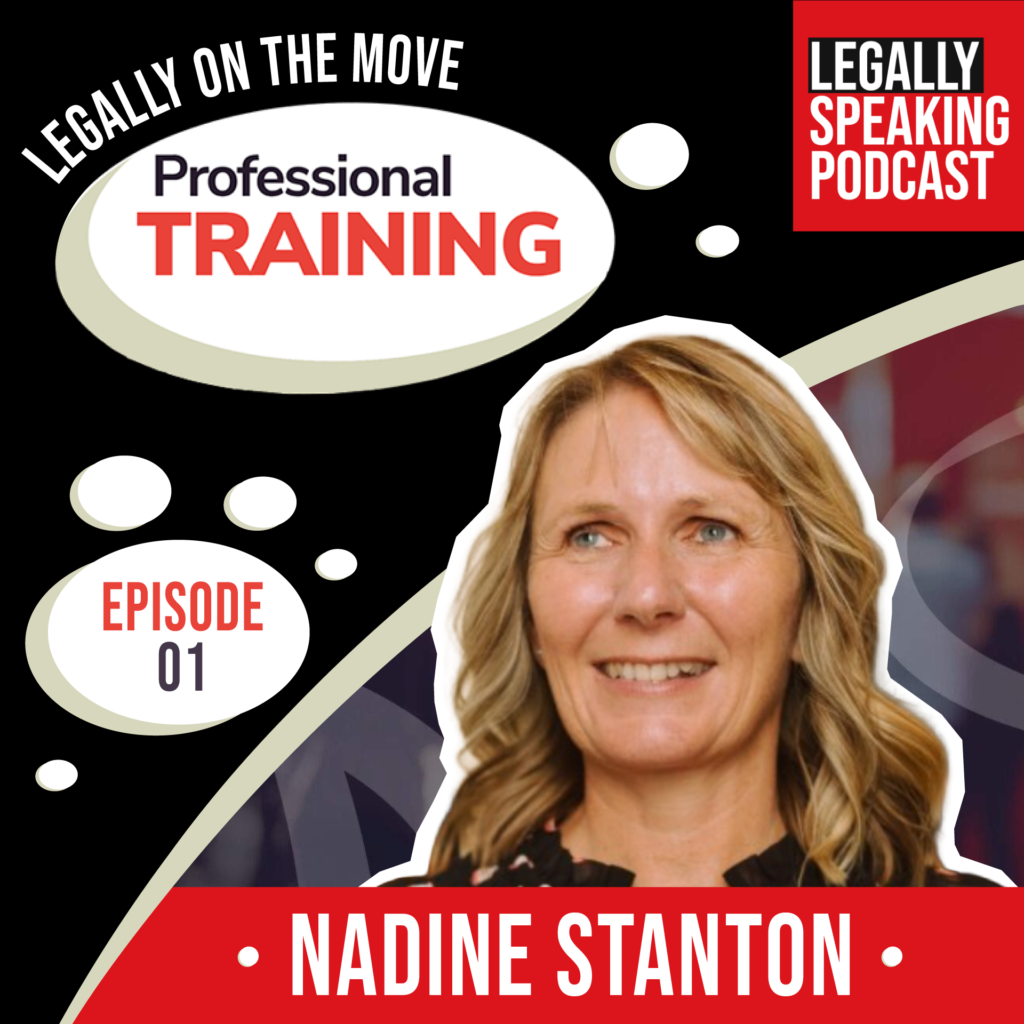
Welcome back to our 2026 edition of the Professional Training miniseries. We have a brand new regional edition continuing on from the last conference we attended, but packed with even more highlights and insights. Filmed at Manchester Hall, these minisodes explore high performance leadership, career growth, innovation and what it takes to thrive in today’s legal world.
Today, returning guest Nadine Stanton of Professional Training reflects on creating more engaging, regionally accessible conferences for law firm leaders. Nadine shares her perspective on what makes teams perform at their best: clear goals, strong communication, psychological safety, defined roles, and shared values. She also discusses the power of interactive learning, community, and creating spaces where leaders can speak openly, challenge ideas respectfully, and leave energised with practical insights.
You can Hear Rob and Nadine talking about:
– Aligning Teams Around Shared Goals
– Measuring Performance Against Personal Standards
– Staying Curious After Achieving Success
– Encouraging Respectful Challenge Within Teams
– Designing Events For Active Participation.
Connect with Nadine Stanton – https://www.linkedin.com/in/professional-training/
Transcript
Robert Hanna (00:00)
Welcome to our legally on the move professional training regional mini-series from the Legally Speaking podcast sponsored by Cleo. Recorded live in Manchester with Professional Training. We’re talking to leading voices across the legal profession about high performance, leadership, careers, innovation, and what it takes to thrive in a rapidly changing legal world. Short conversations, practical insights. So let’s get into it. I’m Rob Hanna and recording live at Manchester Hall, and I’m delighted to welcome back… name, title, and organization.
Nadine Stanton (00:31)
Nadine Stanton, Professional Training.
Robert Hanna (00:33)
Absolutely. And for our keen watchers and listeners, now remember Nadine, we first met in Ibiza for the Lawyers Retreat where we recorded in a yoga studio. We did. And then we went down to London for your professional training event earlier this year, the conference, which was super well in March. And now we’re back here. So firstly, the conference has just finished. How do you feel?
Nadine Stanton (00:52)
I have to say, so we run this in London in March and this is a mini half-day version of the same thing. And you kind of think, hearing the same workshops, hearing the same keynote, I took completely different things away from it. And I think it was such a, you know, the Manchester set brought the buys, they were really interactive. And I think, yeah, there was just new layers of learning. So it was really nice and really wonderful that rather than having everything London-centric,
we’re also now branching out into the region. So I know a lot of my London counterparts have been like, wow. You’re branching out into the regions as well, which is great because you and I are both northerners.
Robert Hanna (01:33)
Absolutely. And I think it’s been a fantastic conference. And to your point, I know we had you you welcome back Emma Wiggs, MBE, thirteen time, you know, champion. And I took some new lessons and learnings from her keynote, which I thought was brilliant in London, perhaps even better today in Manchester, because the topic of the conference has been high performance. So what are the key ingredients that make a high performing team?
Nadine Stanton (01:52)
think there’s lots of key ingredients, but I think having a really clear vision, goal, goal alignment, your team know what the goal is, you’ve painted what the goal is, I think is really key. I think having that communication conventions, so almost like over-communicating, particularly in a hybrid world, I think is really important. So who takes the decisions, what, when, why, how, who? I think having psychological safety.
I think also the roles and the processes, all really important. all of those things together, once they’re right, they make a high performing team. that’s, again, what we’ve been discussing today. What are all those elements that move it from a kind of bumbling along to really reaching for that high performance?
Robert Hanna (02:39)
And and talking of discussing, I I mentioned before, Emma, but you had an incredible keynote once again today. but you chose to go outside of the legal industry. You went to sport. So why did you decide to do that as opposed to someone in the legal industry?
Nadine Stanton (02:53)
Because I think the same way, sometimes the legal, I mean, I’m from the legal industry, I was a lawyer myself, but I think sometimes listening from a different angle, a different perspective is like, what does a paraconuist have to teach law firm leaders? And as it turns out, curiosity, know, winning a gold medal, it’s almost like, okay, so once you’ve won a gold medal, how do you re-motivate yourself? I mean, because that’s the pinnacle.
Yeah. You’ve run the gold medal. So then it’s what’s next. But what she teaches us is like, okay, even with the gold medal, what worked, what didn’t, what could we do differently? What could we improve on? So that constantly remotivating yourself doesn’t achieve that one gold medal. It achieves 13 years at the top of your game in the world. And I think, you know, in an elite environment like the law, yes, to get a team to high perform one year, okay, we got
this billables, we got this client, we did this. How do you keep remotivating people? So I think there’s a lot in there about remaining curious, asking those questions. And for me, it was really interesting about, you set a goal, but then what do do once you’ve hit that goal to set the next challenge, if you like. And sometimes I think we’re a bit guilty in law firms of managing by spreadsheet, which can become a bit of a
drain of like, we’ve hit that now what? So what she says to motivate is all about actually aligning with your values. Yeah. And teams that do that tend to perform really well because they’re all in sync with their values.
Robert Hanna (04:32)
And I think just constant pushing herself, you know, I got the Emma versus Emma, you know, where she gave the example of, you know, holding up a gold medal and actually she was more proud of one of the sort of medals that she had won because of the effort that she’d put in and actually she thought that was a better performance and just putting that level of sort of, you know, almost pressure on yourself I thought was inspiring. And I just think, yeah, the fact that we should be able to do that so many years is is so great. And so many of leaders here for Art of the Session today have gone away inspired. So I think excellent choice of keynote once again.
Nadine Stanton (04:58)
Yeah, I think that was really interesting about what she said. She was more proud of the silver medal than the gold medal because what that says to me, which is really interesting about high performing teams, she’s got her own definition of success. So it’s not the medal is not what defines her. It’s like how she personally felt she did in that environment. And I think that’s, I think there’s a lot to be taken away from that. That struck with funny enough. I’m glad you mentioned that because that struck with me too. It’s like, wow. Weird, but interesting.
Robert Hanna (05:24)
I just think, you it’s how you define your performance, like you say. So I think, you know, she has those standards which are well set. One thing I think has been great and which is where you rip up the rule book for conferences and you said in your opening is is the format and you’ve done the workshop sessions with some of your associate team today. So tell us a bit about what they covered.
Nadine Stanton (05:40)
So we had Julianne who was doing the latest Harvard research on culture. So have you got a family culture where everybody gets on, it’s all really lovely, but nobody sort of says the elephant in the room because they’re all too nice? Do you have too much of a corporate culture where it’s kind of like, Bill, Bill, Bill? How do you get to that stage where everybody gets on, but there’s a respectful challenge?
Yeah. We say when we don’t agree. We say when we feel we’re probably rowing in the slightly wrong direction. And so we were talking all about that and I thought that was really, really interesting of where does your firm sit in terms of that matrix of cultures? And I think when I was listening to some of the discussions, you could hear them going, yeah, yeah, we’re quite friendly. Yeah. But does anybody actually kind of stand up to us and say,
We’re not sure that this is right or whatever.
Robert Hanna (06:42)
Yeah, I think it’s great. And I I was overhearing and I was on one of the tables as well, just how how involved everyone was, how wanting to contribute and everyone coming together. And I think that’s again because of the the safe space I think you’ve you’ve created. So leading as an extension of that then. What makes a good delegate experience in your view?
Nadine Stanton (06:58)
For me, absolutely, a good delicate experience is when you treat the conference with the delegate in mind. they have got to have a voice, they’ve got to have an opportunity to discuss things, they’ve got to have an opportunity to really feel involved. And it was really interesting because I saw something with Stephen Bartlett quite recently and he said he was offered something like 100 million for his podcast to have advertising.
So four or five ad breaks. And he thought about it and he was offered all this money and he went, no, because it’s going to spoil the listener experience. So to me, yes, you can get sponsors going, we’re going to pay you tens of thousands of pounds to come on the stage. But is that going to be right for our delegates? Maybe. So it’s all about, it’s the energy and the interaction that I think makes it so different. Because I think it was a, for me, when we started this, I wanted to make it a counterpoint to the
darkened auditorium, the death by panel. I wanted to make it that you came away thinking, I like what Rob said, I like what such and such said. So it’s not just the speakers that create the content, it’s actually the delegates. And I think when you place the emphasis on the delegates, the energy shifts.
Robert Hanna (08:14)
Yeah, and I think it’s been great. I talk a lot about, you know, everyone could be a CEO, which is like a chief energy officer. You have the opportunity to to give that out to to people. And think everyone has kind of shown their their own sort of CEO throughout the day because of the way you’ve designed it. And I think everyone is going away a lot richer as a result of that experience.
Nadine Stanton (08:29)
I
loved your post about that, about being the Chief Energy Officer and that is you.
Robert Hanna (08:34)
And I think, you know, it’s so important because I feel like you can can really make an impact on someone’s day through that energy that you emit. But you’re a training organization doing fantastically well. So what made you decide to pivot into the conference space? Because it is saturated.
Nadine Stanton (08:49)
Yeah, I think the conference space is saturated, but it’s saturated with darkened auditoriums without central themes, without getting those breakouts and those workshops and those interactive things. And I think we knew because we were good at training, because we know how to engage people, that engagement is the heart of a conference. A good conference, you come away going, wow. Somebody said apparently this morning, I’m not sure which table it was on, but…
They said, my goodness, it’s only finishing at lunchtime. I could have gone on all day. To me, that’s the sign of a good conference, because you think, I’m not bored. I’m really taking a lot from it. I’m really enjoying who I’m sat with. I feel really quite energized. So yeah, I think I moved into the conference space because I had this vision that the training work that we were doing could be taken to almost the biggest stage. But I think what’s really lovely for our clients is first of all, we get to see them, which is great.
Secondly, for our potential clients or colleagues who are joining, gives them a really nice flavour of who we are, what we do, in very low-key kind of way.
Robert Hanna (09:59)
I think it’s authentic what you do. I think you all bring your your true selves to the events and that energy carries through and people radiate with it. And I think, you know, it’s it’s been a refreshing conference, I would say. And I think it’s needed. One of the words you’ve been using and something I’m passionate about is community. Yeah. So why is community so important to you?
Nadine Stanton (10:16)
Well, I think community is about Claire Collins talked about psychological safety. Yeah. And I think in these walls that today and the London conferences and so on, it is law firm leaders having a safe space to go, okay, what’s working? Yeah. What’s not? What do you do? What can we do differently? And just creating that space and that community. mean, our webinars that we run like every two or three weeks, every two or three weeks, we get people the same.
some of the same people coming back, we’re getting new people joining and we just start to get to know them and I think then it’s like how we’ve got to know each other over the years. go, you just need to ask Rob. Yeah. Yeah. you just need to ask such and such. And I think that element of community means you go and you think I’m coming and I’m going to get some, can actually speak freely about what’s going on in my business, what’s going on in my law firm. And I think it’s, yeah, I think it’s probably the thing I’m the most proud of.
I keep calling people when I speak at the front, I say, you might have heard me say this Rob, team. Hi team, how’s it going team, right team, because to me, this community, you’re a team.
Robert Hanna (11:25)
Yeah, and I always say we is greater than me, and I think bringing people together is is great. And one thing I found refreshing, you know, lawyers are known for being perfectionists, but actually on the table some of the lawyers admitting some of the the faults that they have or some of the things that they need to work on and actually creating that space that they feel comfortable to share about in at a conference is great. So what do you hope then people will take away from the regional conference experience?
Nadine Stanton (11:48)
To me, they will all take away probably something a little bit different because I think coming to something like this, it’s not a day of doing your job. It’s a day about thinking about how you do your job. So whether there’s an aspect where you’re thinking about a certain team thinking, I can see now why that team isn’t performing because of X or it might be, I’ve been listening about this culture piece and one of the things I think we could really do with working on because it does work is this or.
So I think it will be different to be fair to everybody. My big takeaway was that point interestingly about the medals that you mentioned. It’s like, how can you be most proud of the silver medal, not the gold? Wow, there’s a lot in that. There’s a lot in that about, as an entrepreneur, I’m quite driven, the gold medal, if you like. But sometimes, is that the right measure? Really interesting.
Robert Hanna (12:45)
Yeah, exactly. And I think the way she framed it was fantastic. Emma Wiggs of referring to. And it’s been fantastic once again. It’s been a real pleasure to come back and do the media with you here live. It’s such a beautiful venue as well. You keep choosing fantastic venues. It’s been an absolute pleasure. But from now recording live here in Manchester over and out. Thank you for listening to this week’s episode. If you like the content here our world leading
Nadine Stanton (13:04)
Why not check out…
Robert Hanna (13:07)
Content and collaboration hub, the Legally Speaking hub over on Discord. Go to our website, www.legallyspeakingpodcast.com. There’s a link to join our community there. Over and out.