
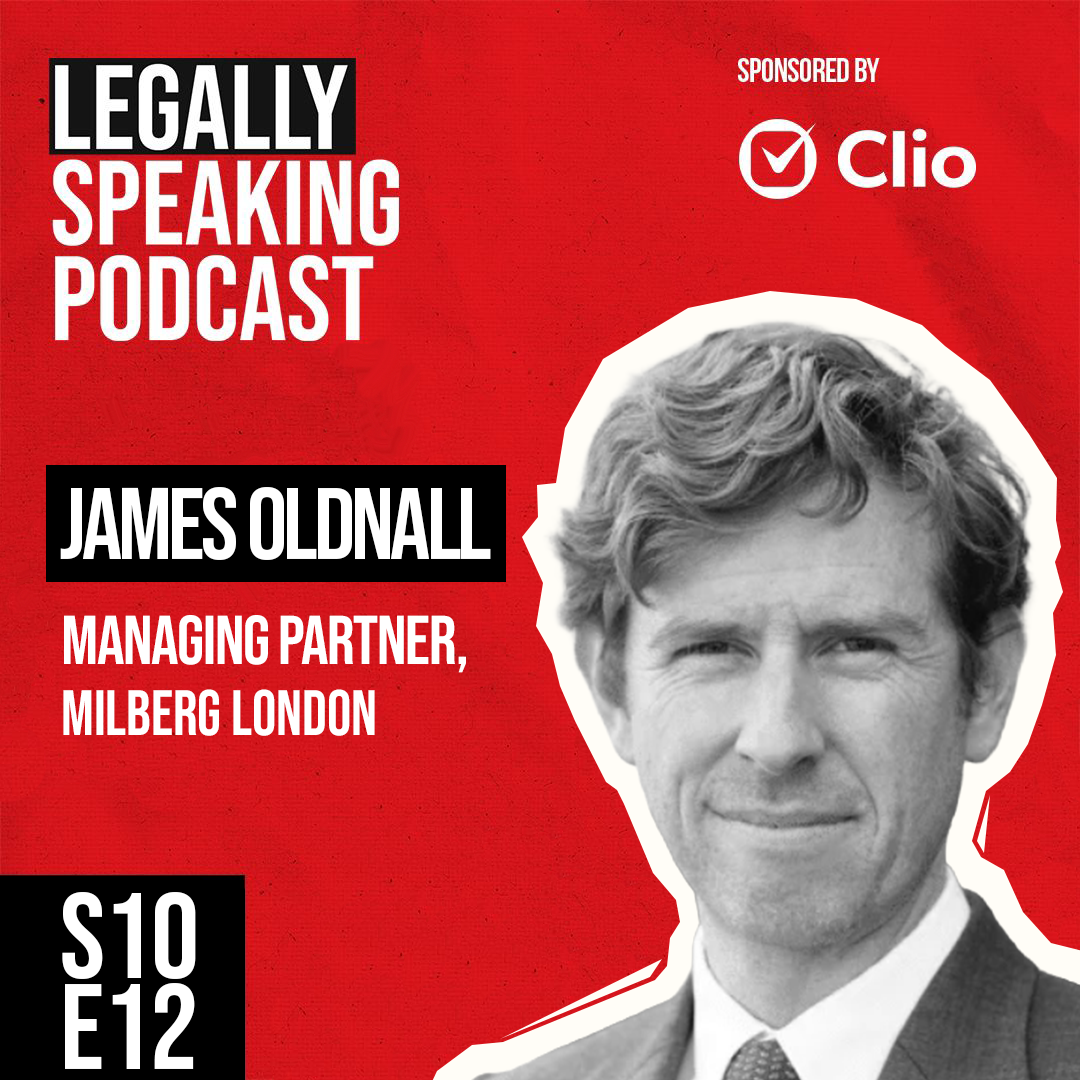
The Legal Rebel Who Took on Big Law & Built a Dynamic Litigation Powerhouse – James Oldnall – S10E12
On today’s Legally Speaking Podcast, I’m delighted to be joined by James Oldnall. James is the
On today’s Legally Speaking Podcast, I’m delighted to be joined by James Oldnall. James is the Managing Partner of Milberg and is a commercial litigator. He has experience in disputes in financial markets, private equity, data protection and fraud. James has worked on many UK high-profile commercial disputes, appearing in the national press. In 2016, he had 2 cases named in ‘The Lawyer’s Top 20 Cases of The Year’. James has also been ranked Band 2 by Chambers in its 2024 guide for Group Litigation, Claimant.
So why should you be listening in?
You can hear Rob and James discussing:
– Career Journey and Entrepreneurial Shift
– Importance of Team Building
– Challenges of Starting a Law Firm
– Litigation and Regulatory Differences
– Role of Curiosity and Adaptability
Connect with James Oldnall here – https://uk.linkedin.com/in/james-oldnall-771b2024
We had to learn so much when we started. We’ve got some tools at our disposal and we get to use those tools and that armory to try and make sure that wealth gets returned back to where it should be. And I think there’s a huge societal benefit that comes from that. It should be something that’s encouraged. You have to keep evolving. That was the process for establishing Milberg London. We had evolved. We reached a position where we could no longer do the work.
that was flowing towards us. And sometimes you feel it. You’re in a big law firm and you feel like you’re swimming upstream and it’s really painful and you jump out and you turn around and you go the other way and then you’re swimming with the current. It’s just so much easier. today’s Legally Speaking podcast, I’m delighted to be joined by James O’Donnell. James is the managing partner of Milberg and is a commercial litigator. He has experience in disputes in the financial markets, private equity, data protection and fraud.
James has worked on many UK high profile commercial disputes appearing in the national press. In 2016, he had two cases named in the lawyers top 20 cases of the year. James has also been ranked band two by chambers in its 2024 guide for group litigation claimant. So a very big warm welcome to the show, James. Hi Rob. Thanks for having me. Really excited to be here.
excited to have you. And before we get into your illustrious career and all the great things you’ve achieved and been getting up to in and around the world of law, we do have a couple of serious icebreaker questions. What is your favorite beverage and what is your preferred choice of footwear on a typical workday? Well, unconventionally, my choice of beverage, if I had any one drink I could drink on a desert island for rest of my life would be a glass of cold, refreshing whole fat milk.
Okay. Okay. I like it. Good for you. Can’t live without it. I’m actually addicted to it, but there you go. Slightly unconventional. And then on the footwear front, because I could never have them as a kid growing up, it’s Air Jordans for me. ⁓ yes. Taking me back now as well. Like it. Good choice. Milken Jordans. I’m with you. And with that, we can move swiftly on to talk all about you. So to begin with, James, would you mind telling our listeners a bit about your background and career journey?
Sure, I started practicing in New Zealand. ⁓ I was a ⁓ litigator. did my training there. And then after a few years, the bright lights of London lured me ⁓ across the world. And then I landed initially at Freshfields in 2006. And just as they were trying to gear up for, they could see that litigation was coming. They were gearing up and they expanded the team.
But unfortunately, because of the nature of the economic downturn, ⁓ they were conflicted out of all the interesting stuff to begin with because it’s all anti-bank. So I flipped from there to Clyde & Co and got straight into really crunchy banking litigation that kicked off because of the global financial crisis, which was a huge amount of fun. ⁓ And then I flipped from there to Mishcon to get
partnership role and ⁓ worked there as a partner for about seven or eight years, I think. And then got itchy feet, decided that I couldn’t do Big Law anymore. think that’s probably a familiar scene in many of your podcasts. I had a slight entrepreneurial itch, needed to do something different. So founded Milberg in 2020.
Love it. Love that you had the itch and then you took the action that next step. And hopefully that will inspire many others. And you’ve had rapid career progression. We’ll dive into that a little bit in a moment, but what inspired you originally to pursue a career in the law? I was really argumentative as a kid, always taking a position. I imagine I was very annoying as a parent now and I can see some of that DNA trickling through into my kids. And I’m like, man, my poor parents really must have suffered. ⁓
So it was really the only place I could go with that ⁓ argumentative streak. And so from a very young age, I had set my mind to being a lawyer. It was quite tunnel visioned in that way. Well, know thy strengths and play to them, which you did from a young age, I would say. So yeah, and as you mentioned that as a parent to a four-year-old, ⁓
Defiant daughter. think she may pursue a career in the law based on what you’re telling me. You mentioned before, you know, you’ve worked for some of the world’s best firms, Freshfield, Clyde & Clo, Mishcon. Of course you went to, you know, to start at Milberg with the entrepreneurial itch. But what was your experience like working in litigation at those firms and what are some of the key skills you acquired that have helped you moving forwards? Good question. I mean, the first thing you learn in big law is politics. There’s so much of it.
There are a lot of sharp elbows. There are a lot of talented people there. A lot of good people and a few not so good people. And it’s navigating that scenario, which is really difficult. Trying to make yourself stand out, but not stand out so much that you become a target. I think the key thing I learned in all of those places was strength in a team.
You have to build a team. You have to surround yourself with good people. You have to learn to work with others. And that’s the way to build a practice. You can’t do it all by yourself. You have to make sure that you’ve got leverage, people doing stuff with you and for you. Otherwise you cannot, you cannot climb that greasy pole. Yeah. And we talk about it a lot on the show and I say it time and time again, we is greater than me. If you can build those great people around you, you can inspire them. You can really get them.
to work to the common goal together, you can achieve so much more together. Okay. In terms of your entrepreneurial hat then, what did you see inside the elite city litigation practices? You touched a bit on it there, but then convinced you there was room for disruption when you’re going out on your entrepreneurial journey. Yeah. coming back to the team point, you know, in these big firms, there’s often a lot of people who are quite lost inside the machine because
The machine is looking for a particular type of talent and not everyone has that. Different firms are looking for different talents, but you take somewhere like Clyde & Co and Mishcon, they’re looking for rainmakers. They’re looking for people who can go out there and wear out the shoe leather and meet lots of people and convert them into clients and repeat clients. That’s not everyone’s skillset and the firms are full of
very, very bright, very talented people that don’t necessarily have that skill set or aren’t born with it or haven’t yet developed it. But they’ll have other skills. They will be incredible lawyers with huge talents. ⁓ And you can harness that if you’re someone who is ⁓ gregarious and confident and naturally able to just talk to anyone. ⁓ You should surround yourself with the people who aren’t naturally like that.
because they’ll recognize that skill in you and realize that they may not have it or need to develop it and can learn from you. And so then they’re prepared to lean in and give you that additional support and become part of that team. And so the team needs to have these complementary and different skills. ⁓ So then when you’ve got a team around you, and I had that at Mishcom when we looking to move, we were being frustrated by bureaucracy
That comes from a big firm. ⁓ And you’ll find that the bureaucracy increases the more senior you get, despite how entrepreneurial the firm will profess itself to be. It’s really hard because you’ve got lots of different people with lots of different aspirations and they’re all pulling in different directions. If you’re naturally entrepreneurial, you’re trying to grow your practice.
And each step that you take, you’re getting confronted with people who say, you can’t do that because of this regulatory reason, or this is inconsistent with this other business line. ⁓ then you start to think, well, I’m not going to be able to achieve the growth that I want under this umbrella. Yeah. And particularly in current times when there are so many changing and moving parts.
in just the world of business and politics and everything else, you need to be quite nimble. I always say with the big law law firms, it’s like the oil tankers, it’s quite hard for them to turn. Whereas I always say…
Butique is beautiful, actually. You can be nimble. You can meet clients where they’re at. You can try things. can get decisions done. You can take action. All the points that you’ve just referenced there. So to moving to actually founding Milberg then, know, London at the time, this is when litigation funding, ATE insurance and group actions were becoming quite popular. So what was the inspiration behind building Milberg, London specifically? So we had done some group action work, had some funded group action work at
At Mishcon, we launched the Lloyd and Google data breach case that went all the way to the Supreme Court, which became quite famous. so as a result, we started attracting more and more of that type of work. Funders taking note, insurers taking note, people who have ideas for claims taking note. So that would come across my desk with an increased frequency.
but you couldn’t always take those opportunities on within the confines of big law. So being free of that bureaucracy was attractive. We recognized that we were also going to be free of support when we went out on our own. So that bureaucracy is a result of having IT departments and HR departments and so on and so forth.
and you give up that safety blanket, you don’t longer have someone doing accounts, you no longer have someone making the coffee, everything falls to you. But as a result, you’ve got this massive open greenfield site where you can go and be as innovative as you’d like because there’s no one there telling you, no, you can’t do that. Yeah, it’s sort of spotting that blue ocean opportunity and going for it. And you know, people don’t like it, but you know, it’s not how hard you work.
determines your success is actually how much risk you take. And there’s a risk there, like you said, in terms of the more risk you take, the more success potentially comes your way in the sense of, you could have stayed there, you could have had the cups of coffee, you could have had the infrastructure, but you look at actually by not having that, all of the upside and all of the opportunities from stepping out of that comfort zone that have led you onto huge success with what you’re doing today with Milberg. Okay, could you explain a bit about the process to maybe inspire others that might be sat on that big law environment or any legal environment right now? thinking…
You know, James is inspirational. I want to go and do this. What’s been the process for you building Milberg London from the beginning to where it is today, generally? Well, the first thing to note is, you talk about the instability of the world as it presently stands. It’s always been like that. The global financial crisis was unstable. The dot com boom, the 1988 crash, every single, you know,
Every few years, there is this enormous impact socially, which flows into legal work. When I first started out as a trainee, I was working on cases that had sprung out of the 1988 stock market crash, where these things have a long gestation period. keep going and you have to evolve. You’re constantly evolving. Say you follow the work. I think it’s very easy as a lawyer to be fixed.
This is what I do. I’m a very niche person in this niche market. But that is a bit like being a buggy whip manufacturer. Eventually, there’s no more buggies and they don’t need whips anymore. And you might make the best buggy whip on the planet. No one wants it. So you have to keep evolving as a lawyer, particularly as a litigator. Now you see
crypto disputes. I don’t know anything about those, there’s a whole spectrum of younger lawyers coming out, cutting their teeth on crypto cases. That’s the latest currency, ⁓ pardon the pun, and that will carry on. Each epoch has this defining asset class or issue that gives rise to litigation. So you have to keep evolving.
that was the process for establishing Milberg London was we had evolved. We reached a position where we could no longer do the work that was flowing towards us. And sometimes, you you feel it, you’re in a big law firm and you feel like you’re swimming upstream and it’s really painful. And you jump out and you turn around and you go the other way. And when you’re swimming with the current, my God, it’s just so much easier. Cases that we were trying to launch in big law
I spent 18 months breaking my head against a brick wall. In six weeks, we were up and running because you know that you’re in the right direction. You’re working with us, what everyone’s demanding. You follow customer demand, you follow client needs, and it will take you in the right direction.
And you staying exceptionally client centric there and know, success does love speed. I love that you talk about the, continually evolving, you know, talk a lot about people with their careers, you you grow as you go, you know, you’re not going to continuously, you know, stay the same. And to your point, you know, market shift and expectations shift. So if you try to just stay here forever, then you will become obsolete, particularly, believing in not having mentioned the words AI yet or technology, but particularly in this world that we’re living. think it’s really important that we all stay curious. We’re all able to grow as we go along our journeys and keep meeting clients where
where they’re at and delivering and which absolutely you have, hence all the huge success you’ve had with Milberg and personally to date. All sounds great, James. All sounds absolutely bloody wonderful, but it isn’t. So what have been some of the challenges for you whilst building Milberg London and what’s helped you overcome them and hang in there to have the huge success you’ve had? We had to learn so much when we started. You just don’t realize how much of a safety net is in place in the Big Law environment.
Um, so we had to figure out how to do very basic things like, you know, creating an invoice and sending it out to clients. I mean, the first time we did that, we all sort of looked at each other and is this right? Does this work? Uh, you know, there is this, uh, this is real imposter syndrome when you start your own firm. Um, because all of a sudden you’re like, how, how, who am I to say?
that I should be paid 10,000 pounds for this work that I’ve done. And so that was a steep learning curve to just have the confidence that we are a thing and the legal work that we are doing is still valuable even though it doesn’t have a Mishcon brand on the tax invoice, et cetera. So there was lots of that learning about the underlying nuts and bolts of law firms.
And, you know, being VAT registered, when do you become VAT registered? How do you do your accounts? How do you do time recording? All of these things we had to figure out. Well, we basically were learning whilst flying the plane, which is suboptimal. And despite that, there was a lot of planning that went into it, but you never really appreciate what’s involved until it comes time to do the thing. So that was a real struggle.
We enjoyed it and we learned a huge amount, which means that running our firm now five, nearly six years on, all of the partners know everything, every detail about the business, about how things work. So if something goes wrong, anyone can be the plumber or the electrician to fix it. So that has been a valuable lesson, but time consuming and certainly hair raising at certain times.
Absolutely. Thanks for sharing that. But the number of hats you have to wear and skills that you pick up suddenly as you do break out from from Big Law, you know, it’s incredible. Like you say, the invoicing piece and I think you use our sponsor, Cleo, actually in terms of tech. know, tech probably quite helpful on this great platforms that can help with that. Okay, so let’s get to the present day then sort of five, six years on Milberg is doing fantastically well. What does a typical day look like for you as a managing partner of the firm? ⁓
It’s hectic in a short order. I you learn, I think that as the senior person in the firm, there are certain things that only you can do and you have to do those. And they’re not always the fun things and not always the pleasant ones, but it falls to you. I was reading recently a Peter Thiel’s book and he was talking about ⁓ sales.
And if you are selling low value items, then you can have a sales team. If you’re selling very high value items, you don’t have a head of sales, you have a managing director. And that’s my primary role is head of sales. And so we’ll do case origination, we’ll come up with group action ideas, where they’ll be presented to us. And then I have to go and sell that to funders, insurers, barristers, experts.
got to get all these people, all the elements required for a large group action. I’ve got to go and do the selling of that. you’re selling, ultimately, you know, the budgets that we put together on these cases are now 25, 30, 35 million pounds. That’s a big sale that you’re making. you can’t hand that off to a sales executive or anyone else. That resides with me.
So I spend a lot of time selling. Then the other thing that we’re looking for is some of the hard conversations. Sometimes I’m the most experienced litigator in the firm. Sometimes the case requires someone to be rolled out to have a difficult conversation with the client, with the funder, with the other side, et cetera. That’s the less fun part. I’m much happier doing the sales stuff, but sometimes you have to
to crack some heads together from time to time. Today’s Legally Speaking podcast episode is proudly sponsored by Clio. If your legal management software feels more frustrating than helpful, you’re not alone. Many solicitors across the UK delay switching because moving client and case data sounds like a headache. Clio makes it simple. As the intelligent legal work platform, Clio combines context aware AI with trusted legal research to power your practice.
And when you switch, their dedicated migrations team supports you every step of the way, ensuring a smooth transfer of your data. You’ll also get award winning support 24 5 via live chat, phone and email. So help is always there when you need it. Ready to leave frustration behind? Visit clio.com forward slash UK to learn more and discover why so many UK solicitors choose Clio. Now back to the show. So I know sometimes law and sales can
So sort of not necessarily they have different connotations and different perspectives. But, you know, again, it’s really important to educate and people to understand that if you’re to go out and build your own firm, it is a core aspect of the role because without that coming in, you know, at end of the day, you could be sat there twiddling your thumbs and not a lot happening. again, for people that might be getting quite senior thinking, wow, maybe not. don’t have as much sales skills or maybe I’m not doing as much business development. Is there anything you’ve done? Because obviously you’ve been able to get some credible cases.
that you think would help people maybe acquire these skills or learn these skills specifically on the sales side? I was really lucky as a teenager. I was a commissioned salesperson in a stereo shop. And so I learned very rudimentary skills about selling, which, you know, it would be an overstatement to say I still rely on those today. But they’re still the…
That’s still the bedrock was just learning at a very early age, these fundamentals of selling and seeing it as sales. And it is a sales role. You’re selling yourself, you’re selling your services, you’re selling a concept often, you’re selling credibility, and you’re having to try and build a relationship with someone you might not know very well. And there are loads of books.
that can be read, it’s worth doing that. There are skills, there are rudimentary skills that can be deployed. And I see so many talented lawyers who really don’t know what they’re doing when it comes to selling, ⁓ making basic mistakes. And I cringe and I wince when I see it happening. ⁓ I hesitate to give tips, but two things that occur to me all the time is lawyers do too much talking.
They should really be doing what you’re doing, Rob, which is asking questions to get the information out first and thinking and reacting and responding whilst the person, whilst the client is talking. Let them talk, ask them more questions, ask them that third, the fourth question. Ask them the question you think, gee, this is a bit cheeky. You got to ask the cheeky question to get the heart of the issue and try and find out what their objectives truly are.
I think that’s true of any brand of law that you’re doing. know, the law is a crude instrument. You can’t always give the client what they want or what they’re trying to achieve. You got to find out what that objective is. And before you start telling them all about how great you are and all the things that you can do. yeah, question, tip number one, ask more stuff, get more information. Tip number two is know when to shut up.
So there’s too much talking both at the start and at the end. So you’ve got to gather all the information, understand what the objective is that the client has, and then let your recommendation hang in the air. There’s this temptation to do an over-explanation because you’re lacking confidence. You’re worried that they haven’t understood what you’re saying. You’re trying to fill the space because you’ve got some imposter syndrome, et cetera, et cetera.
Sometimes the most powerful thing is to say very quickly, here are my thoughts and reaction to what you’ve just said. Boom, boom, boom. I think you should do this.
and let it hang and that pause can be really quite powerful.
And it is, hence my pause. But it’s so true. The power of silence is important and we have two ears and one mouth and we should use them in that proportion. And I say to people, if they want better information, they need to learn how to ask better questions and really be curious and understand the power of why and really get into the DNA and meat and potatoes of what you’re trying to do because you can be such a better consultant or advisor or lawyer or whatever it is that you’re trying to do. But I also think it always has to start from a piece of being genuinely curious. You really need to understand what is
What are we trying to achieve here? What are we trying to get to? And every question you’re asking is a benefit to them so you can get the information so you can be that high ticket lawyer, which clearly you are today and the huge successes and cases we had. So let’s talk about some of those cases. Let’s roll back the clock to 2016. You had two cases named in the lawyers top 20 cases of the year, one claim which was worth more than 2 billion against Citibank. What was the case about ultimately? And what was the outcome as much as you can share?
Well, mean, that’s rolling back the clock, it? 10 years ago, gosh. We were, I was acting for Guy Hands, who was the godfather of private equity investing, godfather, gosh, he’d like that, of private equity investing in the UK, hugely successful financier ⁓ and entrepreneur. ⁓ And he had ⁓ a private equity firm that he’d spun out
from Nomura, which was called Terra Firma. ⁓ And he had ⁓ purchased EMI records in 2007, ⁓ arguably at the top of the market. But his claim, the allegation that he made was that the Citibank who was selling the company had ⁓ given the impression that there was another bidder in place for the company. So a classic.
real estate agent kind of situation where someone says, oh, you’ve got to increase your bid for this house because, you know, Johnny down the road is going to pay so much more for it. And so you set your price based on that. So that was the that was the allegation. The case rumbled on for almost nine years, over nine years, almost 10. And what was interesting about it was that Guy decided that he wanted to have the case heard in New York.
in front of a jury and because it was Citibank and they were ⁓ headquartered in New York, we were able to ⁓ achieve jurisdiction against them. Buzali, they fought jurisdiction and said it should be hers in the UK. So we went to New York and in Cai, I was involved in, was governed by English law in front of a New York jury.
So was just like being on TV. It was fantastic. All the characters and all of the entertainment value that you would expect from a jury trial where you’re trying to reduce very, very complex private equity transaction down to something that a retired school janitor can pass and make sense of. So not surprisingly, we lost in front of the jury.
The judge had misdirected the jury on English law. He decided that he didn’t need expert testimony on English law because he had spent a summer in Oxford as a student and knew everything he needed to know about English law. So we appealed and I think it was the Second Circuit Court of Appeal decided that he had indeed misdirected the jury as to the test for
represent the reliance test of reliance and misrep case. And they ordered the trial to be re-heard from scratch. And at that point, Guy decided he didn’t fancy going in front of the New York jury anymore. So we approached Citibank and said, hey, you wanted it to be done in England last time. How about, you know, we do that now. And they said, all right, fine. So we shifted the whole traveling circus back from New York to London and had a second crack at it.
Love it. Thank you for sharing that fascinating stuff. And I can just imagine, some of the, some of the characters, ⁓ during that time and some of the sort of lessons you took from that. other case that you were named, ⁓ was a claim against Barclays acting on behalf of a small business owner, missold a product. So as a result, you were named the Times lawyer of the week in the high profile litigation. How do you feel acting for small business owners in comparison to the large financial institutions? It was fun, isn’t it?
So I’ve acted for billionaires and high net worth and private equity funds and hedge funds. And I really love working with those guys because they are so inspirational. You learn so much about business. You learn so much about how the city works and how decisions are made at this high level. It’s fantastic. And then I also love working for consumers and for ⁓ SMEs and small businesses.
because the similarities between billionaires and Johnny down the road are really considerable. ⁓ People frequently underestimate consumers and small business owners, and they shouldn’t because they’re switched on and have all sorts of life lessons to give as well. And I’ve learned a huge amount from acting for those kind of clients. we’re doing, know, increasingly we do more of that.
have tilted towards consumers. That’s the fun thing, right? We’re doing the same work and deploying the same skills. It’s a bit like an iPhone. Jeff Bezos has the same iPhone as I do. There is this ubiquity at certain levels and we’re trying to bring the same high quality of legal advice that we used for billionaires and hedge fund managers and so on for the man in the street. That’s the objective. That’s our goal.
Whether we achieve that, well, we’ll have to see, but that’s certainly what we’re trying to achieve. And I’m working very hard and, you know, I’d say doing a very good job thus far, that’s for sure. You referenced it before, but I just want to ask a couple of follow-up questions because it was so significant. In 2021, your data protection claim, Lloyd versus Google, went to the Supreme Court. Give us a bit more of an overview of the case and some of your personal lessons whilst on that case going to the Supreme Court that you think might be valuable for our listeners to know.
Sure. Well, that case was really innovative. We were approached by a gentleman. Actually, it came out of that Barclays case because that was high profile. I was approached by someone who said, hey, I represent tens of thousands of iPhone users who have had their phone hacked by Google. I want to bring a DLO
against them for a data breach. And I think there was at that point, four or five months before the limitation period expired. And the number of people who were affected were in the millions. And he said, Hey, why don’t we go and build this enormous book of people, get everyone signed up? I said, there’s just no chance. It’s completely impossible. So necessity being the mother of invention, we scoured around for some other idea.
found buried in the CPR. Well, was buried to me, I think probably other people knew about it, but it seemed like quite a nugget at the time to find what was CPR 19.6 now 19.8 representative action, which actually stems back from the middle ages when ⁓ one serf could turn up to the Lord of the Manor on behalf of all the serfs and say, ⁓ you know, can you let us plow that field please? And the,
Lord of the Manor would consider it. And so that has mapped all the way forward. And I really liked the concept that in 2017, I think when we launched it, we were using this 500 year old regime for something as modern as side loading or side hacking an iPhone, the most modern representation of modernity. So that was a really fun thing to do.
But it hadn’t really been done at that scale or in that way before. So we were making things up as we went along. Borrowing heavily, to be fair, borrowing heavily from things that had gone immediately before us. the Walter Merrick’s case against MasterCard, we based a lot of our approach on that. And that seemed to go down well with the court. They liked procedurally what we were trying to do.
but ultimately the Supreme court didn’t like legally what we were trying to achieve. That does help a little bit. Let’s stick with the, the Google case. ⁓ yeah, because the financial times, I think it was said as part of economic reckoning of personal data, described it. ⁓ what did you mean specifically by that? So at the time, ⁓ and it seems, it seems ancient history now, but data was seen as the, as the new gold rush, the new oil.
And everyone was, know, the GDPR was coming into force. All of the big tech platforms were using data and harvesting data in new ways. And I think societally we were adjusting to that and no one really understood it. Particularly the people in the street. I think, you know, we’ve become more accustomed to this now and more educated, but at the time it seemed like a frontier.
And there’s a huge amount of money being made as a result of this data use by the tech platforms, all of them, all the household names, which we take for granted now. But at the time it was all very new. ⁓ And there was a time when there was a thought that perhaps the value should be flipping from the tech company back into the hands of the consumer.
You know, if you’re not paying for something, then you’re the product. And we were the product. We are the product of Google. We are the product of Facebook getting all of their great services free, but we don’t necessarily recognize what the cost is, what money is being made from our data. So that case was an attempt to try and value that data, to try and show that using it didn’t come for free.
These companies are making enormous profits. Well, shouldn’t we have a share of that if we are, you know, the baseline ingredient? It wasn’t to be, unfortunately, and it’s still not. But that was the ambition at the time. And I love it. And I think, you know, the ambition is well-spirited as well and well-meaning. Absolutely. We’ve touched on a little bit about UK versus US from some of the cases you referenced, but what
If anything, do you think the UK has learned from US style class actions and are we behind the US when it comes to the likes of commercial litigation in your opinion? We’re so far behind. There’s this, I think, common misconception in the UK and Europe that we prefer regulation to solve the ills of the world. But if you look to America, actually find their regulators are actually stronger than the UK and Europe.
There’s this misconception that it’s Wild West out there and therefore you need litigation to keep people honest. It’s just not true. The reality is that the number of the value of the fines levied in the UK are 10 % of what’s done in the US. And that’s adjusting for the relative size of the economies. We just don’t have regulation in this country. What we have is a very effective myth that we have regulation. And as a result, we don’t have as much litigation either.
because you need the regulators to break some rocks that you can’t do as someone who’s representing consumers. You need the regulator to find some of these wrongs to investigate it. So then in America, you also have far greater litigation and it’s off the back of the strength of that regulation. And for many, many years, of course, there’s been this concept, well, you don’t want that litigation is going to be bad for the economy. Well, as we’ve seen over the last
10, 15, 20 years, the US economy is taking off and the European economy is moribund. It obviously is. It’s only a correlation, not causation. One you can’t say is that more litigation leads to poorer outcomes because that has not been the case in America. You need regulators, you need to keep these large companies in check or they will just chase down every last dollar.
and is seeking, seeking profits. That’s what they’re designed to do. That’s what their objective is. It’s not a criticism. That’s, you know, you can’t criticize a lion for eating a gazelle. That’s what it’s born to do, right? That’s what happens. But you need people on the other side to try and keep that, keep that in check. Yeah, no, well said. And again, thanks for sharing openly on that. And it’s clear that you have ambition, you take a view, you know, you’re confident, you’re successful. And as a result of that, you’ve achieved a significant amount.
before the age of 40, this year I turned 40 actually. How have you stayed ambitious and resilient during your highly successful legal career? Well, it’s a word you’ve used a lot, which is curiosity. And just keep wanting to learn and keep trying to figure out how things are done. And as you move, as
as you move from one industry to the next. One of the great things about being a litigator is every case is different and every person’s business is different, whether you’re acting for a consumer or an SME or a billionaire, it gives you an opportunity to see inside how the sausage is made and get a real handle on it, which is great fun. So I think curiosity is key. Then I guess there’s this sort of Robin Hood type ⁓ aspect to what we do.
Right. You identify someone who is taking money from the population unlawfully, like the sheriff of Nottingham was doing. And you get your band of, I’m really stretching the metaphor now, but you get your band of merry men together. And it is David versus Goliath. You’ve got a small group against an enormous institution who is systematically overcharging their consumer base.
The consumer base is powerless to do anything about it individually. And we’ve got some tools at our disposal, litigation funding, ⁓ procedural mechanisms, and we get to use those tools and that armory to try and make sure that that wealth gets returned back to where it should be. And I think there’s a huge societal benefit that comes from that. And it should be something that’s
encouraged this against more myth making in this country where, you know, ambulance chases, ⁓ you know, there’s this concept that it’s just for the benefit of the lawyers and the funders, et cetera, et cetera. ⁓ And I’m motivated to try and shift that impression, to shift that understanding, to make people appreciate that the laws are there for a reason. Everyone’s playing is on the same playing field. The rules are there.
The referees are asleep, right? We don’t have one of those in this country. They’re not doing their job. So you’ve got these small number of activists who can get together, use the tools that are available and try and move that wealth back into the hands of the consumer and the SME owner. And that’s a better place for that money to be, right? That money can then be spent into the economy with businesses who are playing by the rules.
And the whole economy and society will benefit from that. Yeah. You would see it as a positive win-win situation if, you know, if that can all be achieved. Okay. I want to talk now about something. I’m sure if anyone’s got a smartphone or social media or watched a TV advert, they’ve probably heard something about, which is emissions. So you’ve been acting on behalf of tens of thousands of motorists in various emissions groups claims. So could you tell us a bit more about these claims as much as you can? Yeah, of course.
It all springs out of Volkswagen diesel gate, which now again is quite ancient. And it actually springs out of America and it springs out of a regulator. So the EPA in California identified something was a bit wonky with Volkswagen vehicles. They’ve got an EA 189 engine in them. And they identified that these were spurting out way too much diesel particulate and nitrous oxide gases.
given that they’re very stringent rules and regulations about what those emissions are permitted to be. And then an academic, as I understand it, cracked open the engine control unit and noticed that they had these very special algorithms in there to turn off the diesel emission cleaning systems whenever the car was not in a test environment. So effectively, whenever you’re testing the car, it sits on a rolling road,
It’s in a laboratory set at a precise temperature. The test runs for precise length of time. So you can work out what the parameters of the test are. And then you can work out as soon as the car is doing something that wouldn’t be in that environment, you turn all the filters off and they can spew out as much gas and pollution as you like. So that’s what was uncovered in relation to the EA189 engines.
⁓ And then we have undertaken investigations into the other manufacturers to find how they have worked around the test regime. The allegations that are out there is that all of the main diesel manufacturers selling cars in the UK have some form of defeat device that’s designed to work around the test so that in the test environment, won’t pollute outside the test environment.
in certain parameters, it will. How big do you think this will be? Well, it’s already the biggest GLO that this country’s ever seen. There’s 13 GLOs that have been consolidated into a GLO of GLOs with ⁓ millions, well over a million clients signed into it and thousands of defendants. So it is enormous. It’s completely enormous.
Yeah. And you know, I have to say the more I read about it as well, I’m fascinated and I’m curious to see how it all will play out. You’ve mentioned before that we’re behind over here when it comes to commercial litigation. What developments do you expect to see with regards to it generally in the coming years, five to 10 years that might be somewhat changing and useful for people listening in today? I don’t know. I don’t know, Rob. There’s a lot of headwinds. There’s a lot of
institutionalized resistance to advances in this. You hear it from the labor government who’s pro-growth apparently. I think that means cozying up to American industries. So you can see politicking and lobbying taking place from vested interests trying to make this
activity as difficult as possible. It’s constantly under review. The laws are constantly being challenged. So that’s probably slightly pessimistic. And that’s certainly how it feels at the cutting edge of this work that we are confronted with an enormous defense industry who are, you know, his sole remit is to prevent guys like me and my colleagues from bringing these sorts of cases.
So I don’t see any sunny uplands, unfortunately. I see quite a lot of work to continue the fight. Well, there we go. Nothing like a bit of raw honesty. Flipping to, guess, before we let you close, a couple of career-focused questions for the next generation to start with. What would be your advice to aspiring lawyers who are looking to specialize in commercial litigation? And as a follow-up to that, for yourselves at Milberg, what are the types of lawyers that you’ve recruited that tend to perform well in that type of
environment. So, ⁓ gosh, that’s a very lofty question. ⁓ I mean, back to that word of curiosity, and then I think also nimbleness. you know, if you’re coming up as a commercial litigator or interested in it, I think one of the things that helped me in my career was being genuinely interested in the underlying subject matter. It’s not being interested in the law
per se is being interested in the business that is being affected. So take for example, at the moment, our, most finance mis-selling claim. That’s something that we’ve been following and monitoring for over six years. I’m a victim myself. And then you get curious, how does this whole thing work? What is going on? And you scratch away at it and you try and figure out what, what is the underlying wrong here? How does the business operate?
Who’s making money? Who’s not making money? Having that understanding of how it works so that when the client phones and says, hey, I’ve got this issue, you already understand how the world works. So I think any commercial litigator needs to be commercial. That’s the first thing. If you don’t understand how crypto works, then you’re not going to be able to be a litigator. If you don’t understand how financing works, you’re not going to be able to be a litigator. You have to understand the way the city works and
and read vociferously around how markets work and how all of these industries work. Love it. Okay. Fantastic. So that should hopefully help people understand what they need to do while they’re getting into careers. And then for those that are in careers now that might be sat in big law or might be thinking of career change and thinking, hmm, Milberg looks quite attractive. James and what they’re building over there is pretty good. ⁓ What are the types of lawyers that tend to perform well, the skills that you think…
particularly stand out when you’re looking to hire? Elasticity of intelligence. So again, playing on that theme of curiosity, but you can’t turn up into boutique law and just be really, really good at a particular part of the CPR. That’s not going to work. You have to be elastic in your approach and dynamic. And that means, you know,
Being confident with numbers, it means being confident with clients. It means being able to have a broad application of your skills, which is fun, right? It’s a really great opportunity as a junior lawyer. You’re not pigeonholed. You’re not just sitting there doing a disclosure review or a regulatory review. Any day you can be called upon to do the most random, bizarre tasks because there’s no one else to do it.
So that doesn’t work for everyone. Someone who likes to be in their lanes, who likes to be safe, that, you know, there are plenty of places for people like that to succeed and excel. But if you’re intellectually curious and get itchy feet and looking for new and interesting challenges, then a boutique is going to provide you with far broader experience and get you, think,
In most cases involved in higher level work, more difficult and challenging scenarios earlier in your career. I was trying to say, but it is a baptism of fire. You turn up and day one, there’s nowhere to hide. You’ve got to get amongst it and work really hard and do difficult things from an early, from an early stage in your career. Yeah, no, absolutely. And you look clearly it’s, it’s working because you Milberg is flying and it’s been a hugely
you know, successful career journey for you and no doubt that’s going to continue. And I’m sure our listeners will be inspired listening to your career, indeed what you’re building at Milberg today. So if they want to find out more, please do share some websites where they can get some more information or any social media handles. We’ll also include them in this episode for you too. Yeah. I mean, just check us out on Milberg. It should all be at Milberg.co.uk. ⁓ then ⁓ LinkedIn, we’re quite active on that platform.
⁓ You might unfortunately also see me on TikTok and Instagram trying to promote cases that we’re involved in. mean, that is another thing that we’re trying to achieve is there’s a, I think there’s a credibility gap between ⁓ consumer opt-in litigation and people’s expectations. think ⁓ people are not used to that.
The myths that we were talking about of it being ambulance chasey also sounds a bit too good to be true. You know, we’ve really had to battle that with our diesel case, with our motor finance case, ⁓ even with our competition claims. There’s this reluctance for people to get involved. You know, there’s a huge amount of information out there about scams and don’t share your data. And people are very nervous about that sort of thing.
I really want to habituate British consumers to participating in these sorts of things. And hopefully as people get more used to it and they start getting money back. mean, we’ve sent thousands of pounds out to individual consumers for their losses. And, you know, it’s a really nice moment. They sort of can’t really believe it that it’s happened because you
read something on social media, hey, sign up to this thing, we’ll get you some money. And I, yeah, sure. But ultimately the system can work. It requires participation. And I think the more we get people participating, the more that the judiciary will have confidence that this is a real thing. The more that the government will see that it’s not just for lawyers and for funders, right? And so you start to achieve social change just through participation.
attacking that skepticism that’s out there and is fomented by big corporations. They want you to remain skeptical. They don’t want you to participate. So that’s our mission for the next five years, right? Is to try and shift people into getting completely used to this line of a bit like, you know, if it was Groupon, you people are used to getting discounts by using a consumer purchasing power.
That’s the same ethos we want to try and subscribe to here is safety in numbers, power in numbers. You can affect change and along the way people can get some of that wealth transfer back out of the big company into their pockets. And we’re here for that and we fully support that mission and all the great work you and the team at Milberg are doing. It just leads me to say, James, thanks so much for joining me today on the Legally Speaking podcast. been an absolute pleasure.
having on the show. From all of us here wishing you lots of continued success with you fighting that fight, your own career and indeed future pursuits. But for now, over and out. Thank you for listening to this week’s episode. If you like the content here, why not check out our world leading content and collaboration of the Legally Speaking Club over on Discord. Go to our website www.legallyspeakingpodcast.com. There’s a link to join our community there.
Over and out!
You may also tune in on Goodpods, Apple Podcasts, Spotify, or wherever you get your podcasts!
Give us a follow on X, Instagram, LinkedIn, TikTok and Youtube.
Finally, support us with BuyMeACoffee.
🎙 Don’t forget to join our Legally Speaking Club Community where we connect with like-minded people, share resources, and continue the conversation from this episode.
Sponsored by Clio – the #1 legal software for clients, cases, billing and more!
💻 www.legallyspeakingpodcast.com
📧 info@legallyspeakingpodcast.com
Disclaimer: All episodes are recorded at certain moments in time and reflect those moments only.
On today’s Legally Speaking Podcast, I’m delighted to be joined by James Oldnall. James is the
Welcome to the first episode of Legally on the Move: Professional Training, our brand new miniseries
Welcome to the first episode of Legally on the Move: Professional Training, our brand new miniseries

On today’s Legally Speaking Podcast, I’m delighted to be joined by Ahmed Elnaggar. Ahmed is the
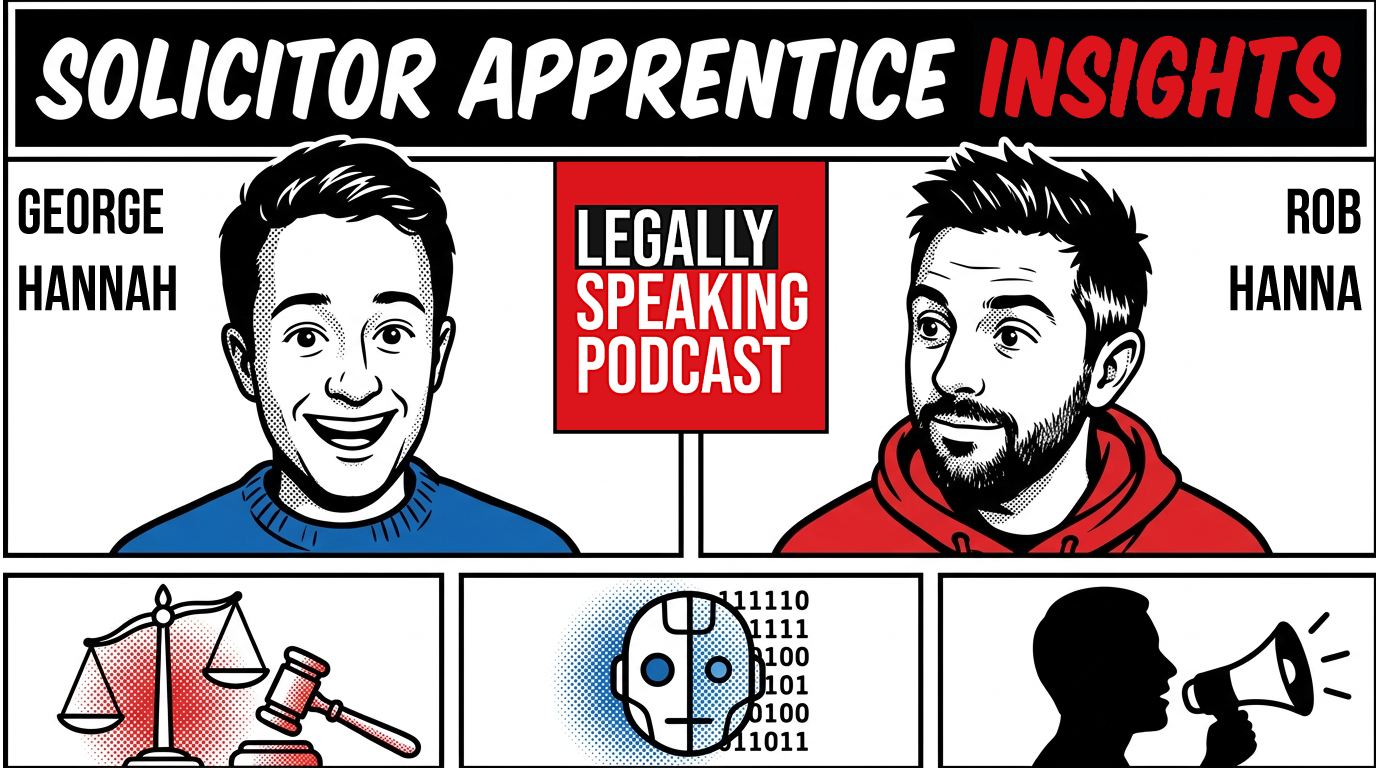
In today’s rapidly changing legal landscape, understanding how technology, personal branding, and innovative training pathways impact
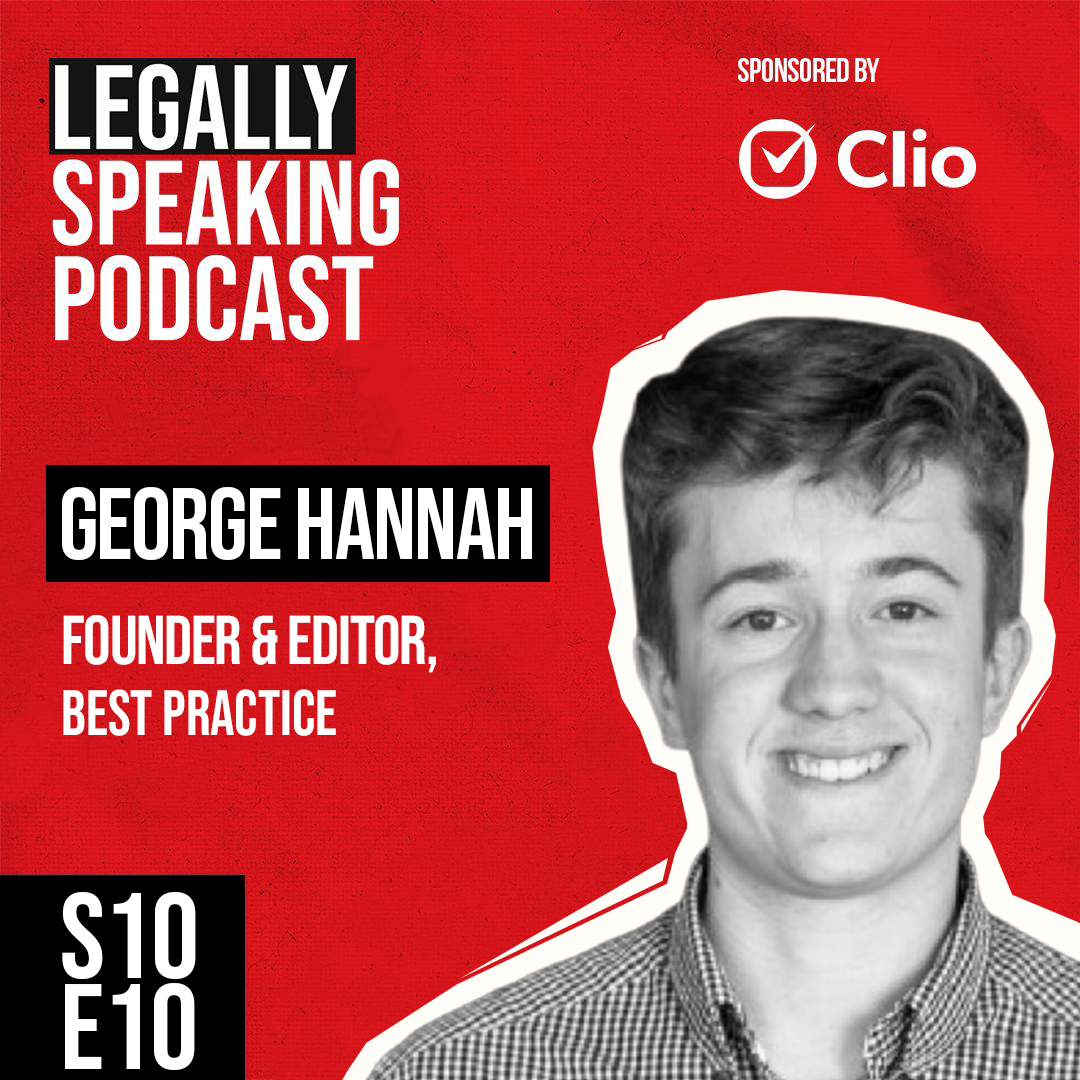
On today’s Legally Speaking Podcast, I’m delighted to be joined by George Hannah. George is a

*DISCLAIMER* All episodes are recorded at certain moments in time and reflect those moments only. The podcast does not support or associate itself with any inappropriate behaviour or actions that may have occurred after recording.